SCOTCAT.COM
your internet guide to all things catfish
| An Observation On A Spawning Of Brachyrhamdia imitator, Myers 1927 |
by J. T. Morris |
After a quarantine period of 10 days in a bare quarantine tank, the seven Brachyrhamdia were put into a 30 gallon tank set up with biological filters (sub-gravel), bog wood and tree roots to provide cover and help them settle down. In the bare, but for a Tetra sponge filter and small clump of Java Moss, quarantine tank I found that the Brachyrhamdia proved to be highly nervous and huddled together under the Java Moss. Even when placed in the heavily planted and decorated tank they still refused to come out and swim in the open. To try and give them the confidence to venture out and about in the open, I placed 12, 50-75mm Corydoras in with them, 6 of the C. melanistius melanistius they were imported with and 6 C. aeneus (Gill 1858). After the addition of these fish the desired effect was achieved and the Brachyrhamdia came out of cover to swim with the shoaling Corydoras. Feeding behaviour tended to be frenzied compared to the toutine style of the Corydoras. Small Poecilia reticulata, present were left untouched but for the slow swimming males which were eaten. Young livebearers which tended to stay just below the water surface were ignored. All types of food were taken with positive liking for the meatier foods, fresh prawn and chopped earthworms, Tubifex, bloodworm, etc. were taken eagerly. Favourite flake food taken was Tetra Cichlid Flake with its distinctive red flakes. One peculiar observation was the Brachyrhamdia stayed with the C. melanistius types and the C. aeneus were nipped and driven out of the shoal. The only reason I could imagine was that the C. aeneus lacked the distinctive eye mask and shoulder bar and this made them stand out from the shoal. The C. aeneus were removed and 8 Corydoras melanistius brevirostris (Fraser Brunner, 1947) were added. These similarly marked Corydoras blended in well with the shoal and were not chased or nipped. Brachyrhamdia imitator
The water in the aquarium was around the 6.6 pH mark, hardness unknown, but local tapwater is quite soft. A week after the addition of the C. melanistius brevirostris the Corydoras started to clean plant leaves and sections of glass. The first species to actually spawn was the C. brevirostris they chose to use the glass sides of the tank to site their eggs. During the spawning act the Brachyrhamdia became highly active with the three smaller male specimens chasing the larger plumper females round into the clump of densely planted Vallisneria which, in this 15in. deep tank reached to the surface. Two pairs went through the motions of spawning amongst the Vallisneria. Observations of the actual act were made difficult by the speed of the actual spawning runs, but a side by side method was employed. Many small transparent eggs were produced which adhered to the plant leaves. However, these proved to be infertile. Size was smaller than the average Corydoras egg but this was made up for in the larger numbers produced. The trigger factor seemed to be the spawning of the Corydoras (the sexual emissions from them, milt, etc.) but further study will see if this is true. Brachyrhamdia imitator has proved to be a challenging species to keep and try to breed, but with most catfish it is the second or third spawning which is the most successful. I hope to be able to write soon with a more complete account of successful breeding observations.
Imaage:
© Allan
James @ This article was originally in the Catfish Association of Great Britain's magazine No.41. |
 arly in
1983 in a shipment of Corydoras melanistius Regan
1912, there was a number of Brachyrhamdia imitator.
The Brachyrhamdia is a naked catfish. It is found
shoaling with the armoured Corydoras in its native
country, the most likely reason for this behaviour is
protection.
arly in
1983 in a shipment of Corydoras melanistius Regan
1912, there was a number of Brachyrhamdia imitator.
The Brachyrhamdia is a naked catfish. It is found
shoaling with the armoured Corydoras in its native
country, the most likely reason for this behaviour is
protection.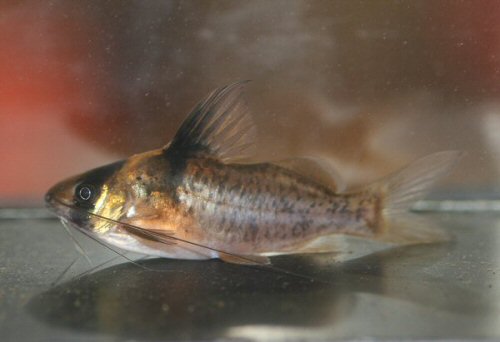
 courtesy
of
courtesy
of 

If you would like to contribute an article, please e-mail me. You will of course be credited for your work.
If you would like to donate any denomination of money to the site just click the above link button. All proceeds will go to running the site and hopefully to keep it going for a few years yet.
Print or e-mail this factsheet below


