SCOTCAT.COM
your internet guide to all things catfish
| Observations On The Spawning And Raising of A Member Of the Genus Parotocinclus Eigenmann & Eigenmann, 1889 |
by J. T. Morris |
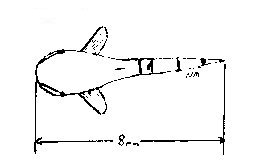
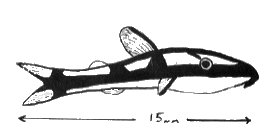
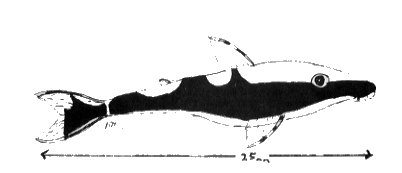
Colour, size and shape is the easiest way to tell them apart: males have brighter, denser colouration, females slightly duller and heavy when roed up. The spawning site for this species was a clump of Aponogeton leaves in the direct flow of the power filter. Males cleaned the underside of the chosen leaf. The colour of the leaf was critical, a light lime green. When this plant died back spawning stopped, though plenty of other leaves were available. Only when these plants grew back did spawning resume. When satisfied that the site was suitably clean, the female joined the male on the leaf. A clutch of twelve large 2mm sized eggs were laid on the underside of the leaf the male covering them each time as they were laid to ferilize them. No more than two clutches of eggs per female were laid. The eggs were exactly the same shade of green as the leaves. Approximately five days later (time varied from batch to batch, but no later than six days), tiny light green fry made a frantic dash to cover (Figure 1). Two small yolk sacs were absorbed over the next 36 to 48 hours. After the yolk sac has gone, the shape becomes more elongate, the greenish colour disappears and the flesh now becomes transparent (Figures 2a, b and c) with black lines and dots. At this stage the fry are syphoned out in a shallow fry tank 24" x 15" x 8" deep. The only other fish in the breeding tank were a shoal of ten Corydoras pygmaeus (Knaaek 1966) which spawned freely throughout the aquarium. These were possibly the initial spawning trigger factor; sexual emissions from them in the form of sperm, milt, etc.
Figure 1 Figure 2a
Figure 2b Figure 2c
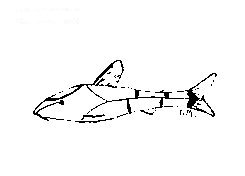
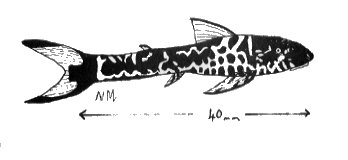
First food taken was crushed lettuce coated in micro worm. Two weeks later the lines on the body thickened and the fins formed properly, especially the adipose (Figure 3). Crushed Tetra Tabs and chopped white worm are taken eagerly. Colour still transparent with black markings.
Figure 3
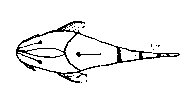
Figure 4
Finally, they become perfect miniatures of the adult Parotocinclus (Figure 6). At approximately 25-30mm the basic background on males is yellow with green speckled black marbling with bright red edges to the fins. Females are virtually identical but not quite so brightly marked.
Figure 6
The first spawning from the first pair resulted in 20 young Parotocinclus raised to young adult stage. Four different pairs were obtained from the original twelve. The remaining four were immature males. The pairs spawn once a fortnight in a six week cycle and then rest eight to ten weeks while females roe up again. Youngsters from first spawning are now ready to spawn themselves (March, 1984), are in the process of pairing off (born 20th December, 1982).
Things
not to do or "How to kill Parotocinclus
fry in 7 easy lessons! Since spawning
the original species, I have aquired a second species
of Parotocinclus very like Parotocinclus jimi
Garavello 1977, and the fry from them have proved to
have the now typical lined and transparent first stage.
Both Parotocinclus species laid on the plant
leaves. The two recently spawned Otocinclus species
preferred the undergravel uplifts and the glass sides
of the aquarium. The transparent eggs and the fry are
approximately half the size of the Parotocinclus.
The fry once again bear a striking resemblance to each
other in the first stages. With further study I hope
to be able to tell if this is a coincidence or link
between the two groups, Parotocinclus and Otocinclus.
|
 he main
problem when attempting to spawn a new type of catfish
is aquiring enough specimens to form a viable spawning
group, usually they arrive as a single specimen in a
shipment, by accident, but I was fortunate enough to
be in the right place at the right time, and aquired
a group of twelve Parotocinclus types (nearest identification
seems to be Parotocinclus britskii Boeseman 1974).
when placed in a well planted and established aquarium
they settled in well, feeding on lettuce and Tetra Tabs.
The aquarium used was a 36"
x l8" x 15" with undergravel filtration and
a small internal power filter, heavily planted with
Aponogeton sp. and Cryptocoryne sp., bogwood and small
rock caves. Temperature: a steady 78o ; pH: neutral;
hardness unknown but local tap water soft. Males soon
established their own territory but females were allowed
to roam freely.
he main
problem when attempting to spawn a new type of catfish
is aquiring enough specimens to form a viable spawning
group, usually they arrive as a single specimen in a
shipment, by accident, but I was fortunate enough to
be in the right place at the right time, and aquired
a group of twelve Parotocinclus types (nearest identification
seems to be Parotocinclus britskii Boeseman 1974).
when placed in a well planted and established aquarium
they settled in well, feeding on lettuce and Tetra Tabs.
The aquarium used was a 36"
x l8" x 15" with undergravel filtration and
a small internal power filter, heavily planted with
Aponogeton sp. and Cryptocoryne sp., bogwood and small
rock caves. Temperature: a steady 78o ; pH: neutral;
hardness unknown but local tap water soft. Males soon
established their own territory but females were allowed
to roam freely. 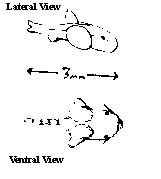

If you would like to contribute an article, please e-mail me. You will of course be credited for your work.
If you would like to donate any denomination of money to the site just click the above link button. All proceeds will go to running the site and hopefully to keep it going for a few years yet.
Print or e-mail this factsheet below


