SCOTCAT.COM
your internet guide to all things catfish
| Observations of Three Species of the Genus Corydoras |
by Jim Makin |
|
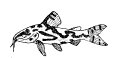
Corydoras (Scleromystax) barbatus (Rio de Janeiro)
10cm/12cm. This is the largest of the three species both in actual size and stature. The finage is much larger, having longer pectoral and dorsal fins and the males sporting cheek bristles.
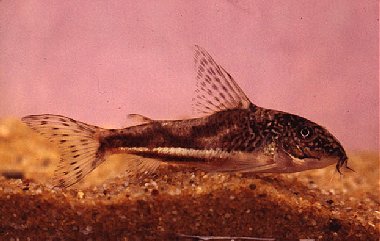
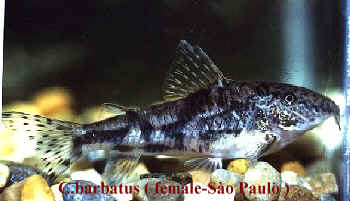
Corydoras (Scleromystax) barbatus (Sao Paulo)
9cm/10cm.This is now being sold as Corydoras kronei and is a finer looking species never attaining the size of the Rio de Janeiro type. The males do not appear to have cheek bristles (at least they are not visible by the naked eye). The females of these two barbatus forms are almost identical.
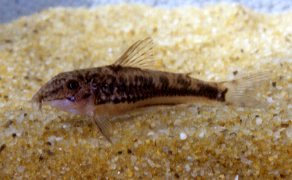
Corydoras (Scleromystax) lacerdai 5cm/6cm.
In size this Cory resembles the genus Aspidoras but its body shape certainly resembles C. barbatus but having no apparent cheek bristles. When eight fish ( 4 males 4 females) were bought some Aspidoras were in the same shipment, which I had mistakenly caught as they so closely resembled the female C. lacerdai.
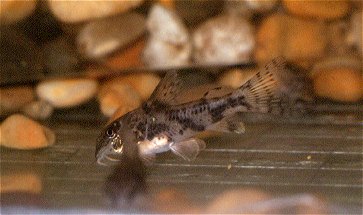
I believe there is a fourth type, C. barbatus, sp. (BAIANINHO 11) this type is caught in black water tributaries, totally different conditions from the other three types mentioned. I have not seen this fish, in the flesh so to speak, but in the photo’s it does appears similar to the Sao Paulo type and appears to be a little smaller like C. lacerdai, but may have a different head shape, only time will tell. Breeding C. barbatus (Sao Paulo). (Ref. Catfish Association GB. 1978).
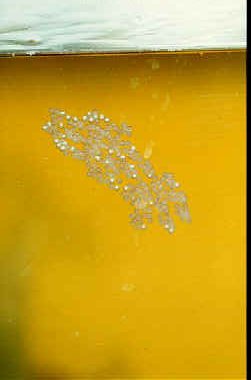
I have very recently bred these fish again (1999), on this occasion five fish, 2 males and 3 females were kept in a 72 x 24 x 15 aquarium with Corydoras narcissus and Cory. sp (Peru Blacks). Temp was low at 70F, pH 6.8 -7.5. DH was never checked, the tank was well filtered and plenty of water circulation. On this occasion some interesting observations were made with both males taking turns in spawning with the two females, the females would lay their eggs on the area where the respective males had cleaned.
Both females spawned with the two males. It would appear that the aquarium was large enough to accommodate territories for both males, the eggs were laid high near the water surface. The eggs were removed and hatched out in a small tank. The fry were moved on as they out-grew their container and they were finally reared on in 24 x 24 x 12 tanks. They were fed on brine shrimp, micro worm and grindle worm. I found that you had to be very careful with the micro worm as they could easily infest the tank/container and eat the very small fry. I also found that one of the commercially made fry foods was the best until the fry could eat the grindleworm or brine Breeding
C. (Scleromystax)
barbatus (Rio
de Janeiro) This form was first kept in the late 80’s but no serious attempt was ever made to breed them. It was not until the mid 90’s that they were kept and bred. A group of six large fish were kept in a 40 x 15 x 15 aquarium and the spawning occurred after they had been conditioned for several months. An apparent pecking order was observed. The alpha male had a richer colour and dominated the tank with his constant showing of to the females and subordinate males. The dominant male carried out the spawning, and as the females became ready he would entice her to the area he had prepared were they would lay the eggs in the normal Cory manner and then place them within an inch or so of the water surface. They hatched within four to five days and reared as previously described.
Breeding Corydoras (Scleromystax) lacerdai. Reproductive and feeding activities are similar to the other two. The eggs again being laid high and nearly out of the water, they did prefer higher water temperatures and out of 6 spawnings only three produced viable eggs and fry. The male would be so obsessive, chasing the other males away. The female he was spawning with would eventually strip herself of eggs. She could be seen coming out of the water laying the eggs as near to the water surface as possible. The eggs were collected and fry reared as C. barbatus. Some difficulty was encountered when spawning attempts were made as the males were more aggressive and would not tolerate any other males (similar aggression was observed in C Narcissus and C.sp (Peru Blacks). In fact two males were lost which appeared to be caused by harassment from the alpha male. In later attempts with C. lacerdai, the fish were paired off and placed in a 12 x 10 x 10-inch tank with C. Pygmaeus and some young Cory’s. This was not successful, as the fish did not seem to settle in this situation. Both the C.barbatus types were produced easily and in large quantities, but sadly not the C. lacerdai. After six spawning I lost all the parents and remaining juvenile fish after I moved them to the new fish house. I do believe some of the young I bred still survive around the UK today, and hopefully will be reproduced.
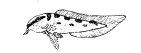
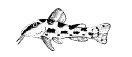
Drawings of fry growth.
Fry 7 days
60 days
C. lacerdai developed their adult colour patterns by nine months and they are sexually mature and would produce viable fry by one year. C. acerdi colour will change to adult between 6/ 9 months while C. barbatus retains this colour till 18 mouths. Conclusion.
References: Photo Credits: Top : Allan James
@ Second: Jim Makin. Third : Adrian Payne. 4th, 5th, 6th & Drawings
: Jim Makin.
|
 eturning
to the hobby after a break of several years I was expecting
to find many a new and interesting species, but a dwarf
species resembling C.barbatus? this I would love
to have. In the eighties I kept and bred some 20 species
of corydoras, having particular success with barbatus
(Sao Paulo type) but never having bred the larger barbatus
(Rio de Janeiro type) until returning to the hobby
in the mid nineties. In 1997/8 I managed to purchase
eight Corydoras lacerdai, my first thoughts were
how close they resembled Corydoras barbatus,
which I had at home at this particular time. I
have now kept and bred all three species but now felt
it was time to collect all the information gathered
during my spawning success.
eturning
to the hobby after a break of several years I was expecting
to find many a new and interesting species, but a dwarf
species resembling C.barbatus? this I would love
to have. In the eighties I kept and bred some 20 species
of corydoras, having particular success with barbatus
(Sao Paulo type) but never having bred the larger barbatus
(Rio de Janeiro type) until returning to the hobby
in the mid nineties. In 1997/8 I managed to purchase
eight Corydoras lacerdai, my first thoughts were
how close they resembled Corydoras barbatus,
which I had at home at this particular time. I
have now kept and bred all three species but now felt
it was time to collect all the information gathered
during my spawning success. 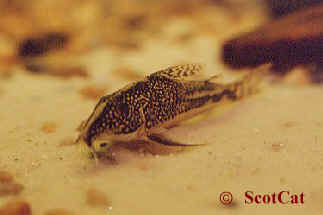


If you would like to contribute an article, please e-mail me. You will of course be credited for your work.
If you would like to donate any denomination of money to the site just click the above link button. All proceeds will go to running the site and hopefully to keep it going for a few years yet.
Print or e-mail this factsheet below


