SCOTCAT.COM
your internet guide to all things catfish
| Spawning Synodontis multipunctatus |
by Chad Christensen |
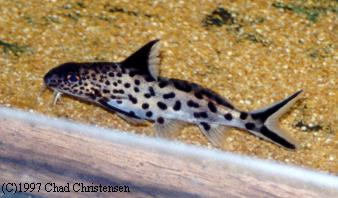
S. multipunctatus has a base body color that is golden beige when young, but this seems to get darker with age. The body is covered with dark black blotches that are randomly strewn across the body and head. Pectoral, dorsal, and tail fins are black with a white margin, although the dorsal fin's white margin is only on the posterior of that fin. Their undersides are creamy white, as are their six barbels. The upper pair of barbels consist of two single stalks while the lower four are comprised of four single stalks with many cilia off of either side of each stalk giving the feelers a feather-like appearance. Fairly abundant in the lake, great schools can be seen swimming at depths of 40 meters or more, where the harsh cast of the sun is filtered to a dim light. Once thought only nocturnal, a more appropriate classification might be "light sensitive" (Brichard, 474), which becomes apparent in the aquarium as the species greatly appreciates the canopy lights to remain off. A hardy aquarium inhabitant, S. multipunctatus enjoy a variety of foods including various flakes and pellets and also frozen meats such as brine shrimp and bloodworms. A temperature of 78 degrees Fahrenheit is adequate and large, weekly water changes and efficient filtration are needed as these fish produce a large biological load when fed their fill.
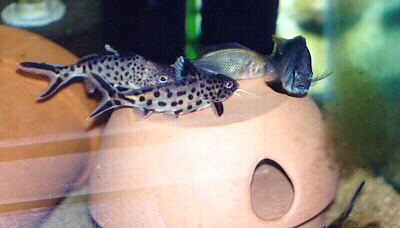
Synodontis multipunctatus spawning with host fish, Haplochromis
As has been previously published, these catfish are parasitic mouth brooders in that they, themselves, do not mouth brood their fry, but procure the services of a mouth brooding Cichlid. National Geographic was so cunning as to catch this feat on film. They show a swarm of Synodontis multipunctatus bully their way into the shallow breeding nest of a pair of Ctenochromis horei. The unsuspecting Cichlids attempt to continue spawning while driving away the persistent catfish. Every time the female C. horei would lay an egg, it would be snatched up by the S. multis before she could even turn around and pick it up. Meanwhile, the catfish drop eggs or spray milt. They may even end up eating some of their own eggs. In her haste, the female Cichlid picks up whatever eggs she can. The end result is the female Cichlid with a mouthful of fertile Cichlid eggs AND catfish eggs. This is how the fish behave in the aquarium, as well. I have watched these fish spawn dozens of times now, and every time it is just as interesting. It's like watching a sport. Sometimes, one switches "teams" and roots for a different side than usual…the Cichlids! One can't help but feel sorry for the Cichlid parents, as the fate of the Cichlid fry is sealed if only one fertile catfish egg was picked up. Within about 3 days, the S. multipunctatus will hatch and begin devouring the Cichlid eggs before they even hatch. Then, days later, when the Cichlid fry do hatch, their lives are still in jeopardy. The minuscule catfish grab on to their yoke sac and suck them dry. Often, after stripping a Cichlid, one will see both dead fry with no yoke sacs or live fry with stress marks peppering the yoke sac in the form of bloody areas. The voracious catfish waste nothing, however, and once they are big enough to eat the entire Cichlid fry, which is only another few days, they will do so. My breeding group of eight S. multi started with a single fish I acquired a few years ago. A got the other seven from Steve Edie. He had pieced together the group over the years and had even had one successful spawn in the past, but his interests migrated to the Synodontis petricola and as he began piecing his S. petricola colony together, the S. multipunctatus spawning effort was put on the back burner. After the fish had hung around for almost a year with no spawning activity, I strong-armed Steve into selling them to me. This was accomplished by a combination of whining, sniveling, and the occasional threatening letter left on the old welcome mat. Then came ACA97 and the time was right. Steve wanted to open up the tank space for all the little gems that would accompany him home from Chicago. The trap was sprung and I carted home the mob of Synos and put them in a 75 gallon tank about a week before we all headed north to the ACA97. Now came the need for a host. Steve Edie and I theorized that inexperienced breeders might be a more productive alternative to an established breeding group because they would never know breeding under any other condition than the harassment of the Synos. I think Steve also made some comment that, in a cleaned up version, went something like "young breeders are like teenagers, they're so "active" that they will do it no matter what". So began the search for a young, prolific species just reaching sexual maturity. A little inquiring led me over to Ted and Liz Rall's house where they, too, were clearing tank space for possible convention purchases. Home I went with thirty young adult Haplochromis sauvagei. These fish were quarantined in a 20H. I also wanted to sort out males and females. To accomplish this, I waited for fish to spawn. As soon as a female was packing, she was removed from the 20H and put in the 75 gallon. After I had moved about a dozen female Haps to the 75 and fattened them up for a week, I moved the three most dominant males from the 20H to the 75. Within two weeks, almost all the females were packing and some S. multipunctatus breeding activity was witnessed. Evidently, S. multipuntatus can smell the breeding activity. Within seconds after a male and female Hap start spawning, Synos pour out of the 6 large igloos they call home (similar to feeding time) and swarm the area of courtship. Once they all get chased away the first time, they are more timid about intruding. Usually then only single fish or pairs dart in and out trying to steal a plump, delicious Cichlid egg snack. At 1/16" and dark beige, the Syno eggs blend in well with the sand substrate. I regularly see the Hap eggs drop, but have only witnessed the Syno eggs dropped once. This from a female Syno that is part of a pair that seem to have a loose pair bond. Every time courting begins and the caves empty, this female can be seen cruising with her male swimming beside her, trailing about half a fish length back.
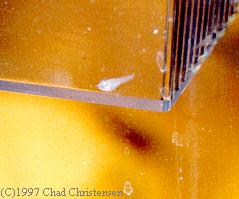
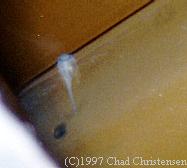
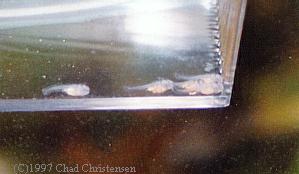
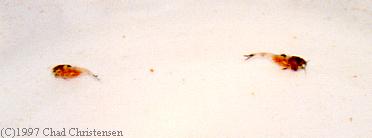
The fry are ghostly white when very small
A week later, the breeder traps were again full of Syno and Hap fry. This time, the breeder traps were secured. Again, the fry grew amazingly fast. The dark pigment first appeared on the top of the head and then the back and tail. Soon the entire fish was colored in the golden beige base color with black dots cascaded across the body. After about two weeks, the fish were about 0.75". At this point, they were receiving crushed flake food as well as the frozen baby brine. At a size of about 1.25", these fry were moved to a 10 gallon tank of their own to free up the space in the breeder nets. I have gotten into a cycle of stripping all the Hap females every one or two weeks whether they look like they are carrying or not. I have had a few surprises when doing this. Occasionally a single, but chubby, catfish will wiggle out into the net. Yes, if one waits too long to strip, the Synos have eaten all the Cichlid fry and turn to cannibalism. Only the strong survive! The next time I stripped, I liberated about 18 various sized fry. With large batches of fry, they are split into several breeder nets for their own safety. I once witnessed a Syno that felt the baby brine was too small a meal to waste its time and went straight for another Syno within 5 minutes after being stripped. There was nothing I could do as I watched it swim around with another Syno's head sticking out of his mouth. He had devoured his sibling tail first! These cannibalistic tendencies seem to be quenched if the fry are stripped young and weaned immediately onto frozen baby brine. If left in the Cichlids mouth to feast on Cichlid fry, they learn that big prey equals full belly and, therefore, that is their first pick if given the choice between fry and baby brine. When weaned early onto baby brine, I had no problems with conspecific consumption. With the new batch of 18 fry, I started experiencing high fry mortality, which was not an issue with the first batch of fry. Initially, I blamed the other Syno fry, but the bodies were not eaten. Soon I was loosing fry every day or two. Within a couple weeks, all the fry were deceased. I was perplexed. I had been doing 30% to 50% weekly water changes and had plenty of biological filtration in the form of a Hagen Fluval 403 canister filter and SeaStorm 240 fluidized bed filter. I deduced it must be a water quality issue, however, after ruling out all other possibilities. I am on a well water system, so the thought of contaminants in the well water crossed my mind. I do water changes with water from a 55 gallon drum that I circulate for 24 hours or more through a Magnum 350 canister filter with micron cartridge. The micron cartridge is to remove grit and the 24 hour circulation is to aerate the water as well as let it naturally come up from its out-of-the-tap pH of 6.5 to its rock stable, naturally buffered 8.0 pH. The high pH swing and stabilization is not surprising when the waters hardness ranges from 330ppm to close to 380ppm out of the tap! With this, it takes only 1.5 teaspoons of Kent African Cichlid buffer in the 55 gallon barrel to raise and lock the pH at 8.6. I don't usually use carbon on any of my tanks, as they get large weekly water changes. I saw a change was needed. I replaced the micron cartridge with the carbon holding insert and started carbon filtering the water change water for 24 hours of more before each water change. I also added carbon to the middle compartment on the 75 gallon tank's Fluval. The premature deaths ceased immediately. From more experience with this tank, it appears that it was not a contaminant in the well water, but the amazingly heavy bio-load on the tank that caused the deaths. Even with the large water changes, the carbon is still used and changed monthly on that tank. Since this additional mode of filtration was added, no deaths have occurred.
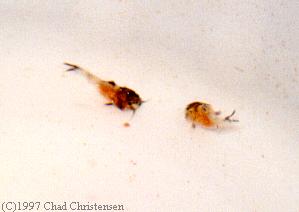
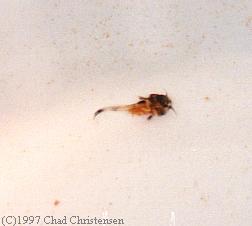
The
first places the fry gain dark pigment is on their
head and fins, then their back In the wild, it is likely that the Cichlid hosts have uninterrupted spawns between the chaotic attacks by the catfish. In the aquarium, the host fish have no such luxury. It is, therefore, recommended that the host fish be given a break from the pressure of defending a spawning session in the form of moving the catfish or the host fish to another tank where they may spawn unmolested. Some breeders have two tanks of hosts going at once and move the catfish from tank to tank every 3 - 6 months, thus giving the Cichlids a much needed break. Another alternative is keep a supply of up-and-coming young breeders available. I have chose this route. I keep as many Hap fry as I can and grow them out in other tanks. As soon as they reach spawning size, they will be available as new hosts.The investment of growing a group of Synodontis multipunctatus to sexual maturity can be a time and space consuming task, but can be well worth it to witness the fascinating spawning technique of the species. If time is an issue, purchasing adult fish will shorten the wait considerably. However one gets there, the reward of working with this species lies within the unique spawning technique that will stand out among all others. References
Cited:
|
 ynodontis
multipunctatus is a
rather well known Synodontis hailing from Africa's
Lake Tanganyika. Through articles in popular magazines,
such as Tropical Fish Hobbyist, the public has been
enlightened as to the unusual spawning behavior of this
Rift Lake catfish which utilizes mouth brooding Cichlids
as foster parents for their fry . S. multipunctatus
has been classified in the family Mochokidae,
which it shares with over one hundred other species
of African Synodontis (Brichard, 472), including
several Tanganyikan endemics which are very similarly
marked.
ynodontis
multipunctatus is a
rather well known Synodontis hailing from Africa's
Lake Tanganyika. Through articles in popular magazines,
such as Tropical Fish Hobbyist, the public has been
enlightened as to the unusual spawning behavior of this
Rift Lake catfish which utilizes mouth brooding Cichlids
as foster parents for their fry . S. multipunctatus
has been classified in the family Mochokidae,
which it shares with over one hundred other species
of African Synodontis (Brichard, 472), including
several Tanganyikan endemics which are very similarly
marked.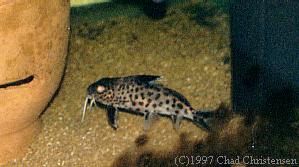

If you would like to contribute an article, please e-mail me. You will of course be credited for your work.
If you would like to donate any denomination of money to the site just click the above link button. All proceeds will go to running the site and hopefully to keep it going for a few years yet.
Print or e-mail this factsheet below


