SCOTCAT.COM
your internet guide to all things catfish
| The Spawning and Raising of the Pygmy Cat, Synodontis petricola |
by Graham Burnside |
On returning home to Scotland and after a period of quarantine, I then housed them in my 48" x 18" x 15" Rift Valley tank that had been set up in my fish house for a few years, with an assortment of Cichlids coming and going over a period of this time. This tank was furnished with tufa rock and sand filtered by a Fluval 403 filled with perlag to help boost the p.H. Time passed and one night in September 99., I decided to take my new digital video camera into the fish house to video a tank that was situated above my Rift Tank which of course housed my 3 Synodontis petricola which by now had a single tankmate, Tropheos moorii. As I was busy videoing, something caught the corner of my eye in the tank below; I spotted two of the S.petricola chasing around each other in circles with the T. moorii in attendance. They were releasing eggs and the moorii was busy eating them.! You can just imagine the panic that I was in! so I quickly removed the Cichlid to another tank and went back to watch the spawning scene that was unfolding in front of my eyes.
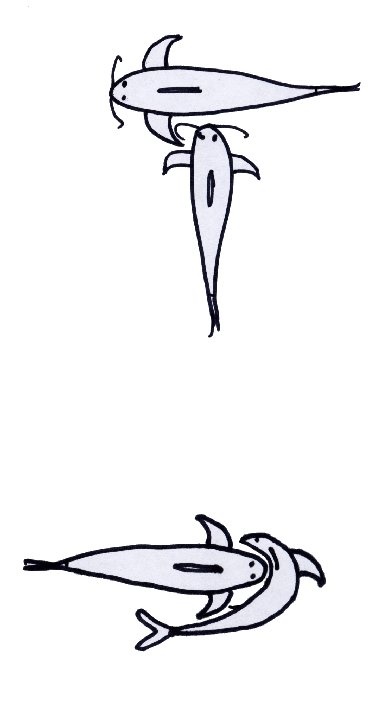
I started videoing the ritual that involved the male laying his body across the female’s head in a quivering motion not unlike the T-position encountered in the Corydoras species. The female was very rounded between the pectoral and ventral fins and the male would move his mouth up and down her flanks in this area and use his mouth in a rasping motion. He would also follow/chase her around the tank using his mouth to stimulate her then they would take up the spawning position where he would grasp her head firmly and they would both shake violently until a cloud of eggs were released. He would also lie alongside the female quivering his body wherein the female would release her eggs and the male would fertilise them with his sperm. The eggs were honey coloured and were between 1.25-1.50mm in size, they were difficult to see as they blended into the sand as they were similar in colour. The spawning sequel lasted about 2 hours so I took the parents out and the other petricola, (most likely a younger female as it was less plump, and the male was making half hearted advances to it) who took no part in the proceedings. The male had a very prominent pointed genital papilla in front of the anal fins and pointing back towards the caudal, the papilla was white the same as the underbelly. In the female it is a rounded, swollen enlargement from which the eggs are expelled. The parents (and the gooseberry) ignored the eggs while they were spawning and were removed when they stopped. I removed about half of the eggs into various small tanks and ice-cream cartons (with the ice-cream out of course!) I then added Methylone Blue to some of the containers, as I wanted to lengthen my odds on hatching rates. So I had 3 options, eggs lying in the main tank, eggs with or without Meth Blue, I also placed aeration in some of the tubs but this didn’t make any difference later on with the quality of the hatchings. I did inadvertently add an extra drop of Meth Blue to some of the containers and even though the water was still a light blue in colour the eggs did not hatch, so I quite possibly overdosed them, which then led me to the conclusion that the eggs were sensitive to an overindulge of this treatment. Some of the hatching tanks -containers were illuminated by florescent tubes and there was no difference in the hatch rate, so there is probably no sensitivity to light.
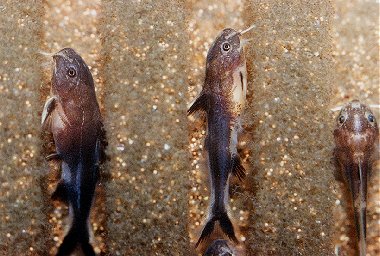
Image
of young on heater The grand total of eggs reached 800 and out of this number I managed a 65% hatch rate, the rest of the eggs turned white and were non viable. The fry hatched out after 24 hrs and were like thin slivers of glass and very small.Fry were free swimming after three days, their bodies and fins were white all over including the large yolk sac. On the tenth day after spawning they started to take freshly hatched brine shrimp and a few days after this they started to take on dark brown patches along the top of the body, but no spots. A very hardy fish as only thirty or so have died since they were free swimming and most have these have been due to filter problems (see handy tip later). Food-wise the fry also loved finely ground aquarian flake +promin (80+20%). The young are happier in larger groups and more likely to come out into the open to feed, the tanks with more young in them grew faster no matter the size of tank or filter. Provide plenty of hiding places to make them feel more confident. I then fed Brine Shrimp Naupli for the first couple of months as their mouths are very small, and after this fed Tetra tabimin tablets and my own recipe of a homemade mix of flake and spinach bound together with gelatine. After I had moved about a dozen female Haps to the 75 and fattened them up for a week, I moved the three most dominant males from the 20H to the 75. Within two weeks, almost all the females were packing and some S. multipunctatus breeding activity was witnessed. Evidently, S. multipuntatus can smell the breeding activity. Within seconds after a male and female Hap start spawning, Synos pour out of the 6 large igloos they call home (similar to feeding time) and swarm the area of courtship. Once they all get chased away the first time, they are more timid about intruding. Usually then only single fish or pairs dart in and out trying to steal a plump, delicious Cichlid egg snack. At 1/16" and dark beige, the Syno eggs blend in well with the sand substrate. I regularly see the Hap eggs drop, but have only witnessed the Syno eggs dropped once. This from a female Syno that is part of a pair that seem to have a loose pair bond. Every time courting begins and the caves empty, this female can be seen cruising with her male swimming beside her, trailing about half a fish length back.
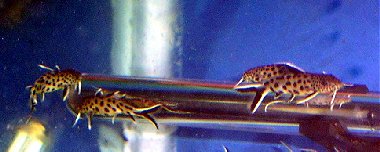
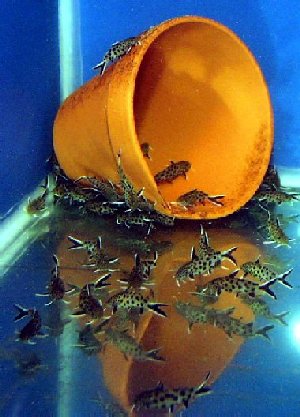
Young petricola around plant pot
At 6 months they were 1½ins standarlength (from snout to caudal peduncle). I found them to be very slow growing but I now have about 500 carbon copies of the parents which are relatively easy to raise on the afore mentioned food Tank Information: 24” x 12” x 12” with tufa rock, sand and a large sponge filter. P.h. 7.5. Handy Tip: If using internal power filters make sure the return outlet is above the water line, as the like to swim up this and into the impellor (death) chamber, especially if the outflow is slowing down. Another place you will find them is below your undergravel filter plate, so make sure your uplift tube ends above the waterline. Afterthought: These fish have apparently been spawned in the aquarium before but using the cuckoo method and with small numbers of fry being produced. This spawning was obviously an egg-scattering type, as the number of eggs (and the video) clearly proves. So what does this fish use as a spawning method in the wild, the similar species Synodontis multipunctatus has only ever been reported as spawning in the cuckoo style, is that why it is more prolific in the wild, as it gives its young a better start in life rather than just scattering its eggs ??? Editorial: As of the paper by Wright, JJ and LM Page (2006) we now know that this species, which was formely called "Dwarf Petrocola", as Synodontis lucippinis. Reference:
Wright, JJ and LM
Page (2006) Taxonomic revision
of Lake Taganyikan Synodontis (Siluriformes: Mochokidae).
Florida Mus. Nat. Hist. Bull. 46(4):99-154.
|
 first
chanced upon this species in the spring of 1995 in a
well-known aquatic outlet in Bolton, Northern England.
The price of £37.50 put me off at first but I
then decided on the spur of the moment to splash out
on 3 youngsters which I was told were about one year
old and wild caught.
first
chanced upon this species in the spring of 1995 in a
well-known aquatic outlet in Bolton, Northern England.
The price of £37.50 put me off at first but I
then decided on the spur of the moment to splash out
on 3 youngsters which I was told were about one year
old and wild caught.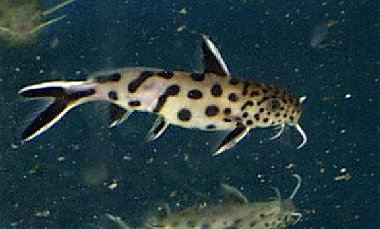

If you would like to contribute an article, please e-mail me. You will of course be credited for your work.
If you would like to donate any denomination of money to the site just click the above link button. All proceeds will go to running the site and hopefully to keep it going for a few years yet.
Print or e-mail this factsheet below


