 was
not a fish keeper in 1997 when I saw my first “Zebra
Pleco”. They were hanging out among the small,
perfectly stacked pieces of slate on the bottom of a
75-gallon tank in the apartment of my neighbor, Jeff.
I became so enamored with the fish that I made up reasons
to visit him. During one of these visits, I ventured
to mention an old dream of keeping a few goldfish in
a 20 gallon long. A few days later, after a trip to
Jeff’s basement where he kept his collection of
once-used equipment, I had everything I needed. I bought
the goldfish, but imagined them with black and white
stripes.
was
not a fish keeper in 1997 when I saw my first “Zebra
Pleco”. They were hanging out among the small,
perfectly stacked pieces of slate on the bottom of a
75-gallon tank in the apartment of my neighbor, Jeff.
I became so enamored with the fish that I made up reasons
to visit him. During one of these visits, I ventured
to mention an old dream of keeping a few goldfish in
a 20 gallon long. A few days later, after a trip to
Jeff’s basement where he kept his collection of
once-used equipment, I had everything I needed. I bought
the goldfish, but imagined them with black and white
stripes.
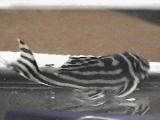
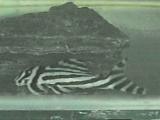

Jeff had collected
what few articles he’d run across in the three
years he’d kept his trio of Hypancistrus zebra.
There was little information available so what he had
we revered as TRUTH. We discussed all the care and feeding
issues, but always returned to the basic and first questions:
“Is there a pair?” and “How do we get
them to spawn?” As to the former, Jeff could quickly
spot the male and declare which of his 2 females was
gravid, it was not bravado. He can come to my house
today and accurately do the same thing with my fish.
Some people have it...By the spring of 1999 I had developed
into both a novice fish keeper and an Internet junkie
and these two new worlds were explored simultaneously.
To be a fish hobbyist
is to be an Internet explorer and vice-versa and the
two are interconnected. It seems natural then that when
I was ready to buy my dream fish I would shop in cyberspace.
The other, somewhat more practical reason was the local
fish store prices on wild caught Hypancistrus zebras
starting at $45.00 each. The experience of ordering
fish on my computer and then shipping them through the
United States Postal Service (or any other service)
still makes me grin. The fact that a fish can live
in a bag, be sent in a box, fly hundreds of miles at
30,000 feet and arrive alive after no less than 24 hours
is some kind of what? Magic?. Opening a shipped fish
box is like pulling rabbits out of a hat to me. When
mine arrived, I pulled out 4 rabbits. Unfortunately,
only three made it, 2 males and a female. The trick
was, and remains, faulty. It’s important
to note that only one of these first 4 fish (the dead
won was immediately replaced) are involved in the spawning
event 15 months later that prompts the writing of this
article.
In all the other
research I’ve done, this percentage does not present
itself as unusual. It is even reflected in my tanks
today. If you plan to purchase or continue maintenance
on a group, consider the possibility that only 1 in
4 fish are sexually active. Your odds of success
are then proportionately better if you have more fish
(Universal truth). Of all the sometimes wrong sometimes
inspired tricks I tried over the next 13 months I’ve
come to believe that only a few of them really matter.
I say that, in part, due to the things I learned from
one of the two people I know (through correspondence)
who have spawned Hypancistrus zebra, Carol Ann
Nellen In September 2000, Carol Ann anonymously contacted
Wendy McKenna, a trading friend of mine near San Francisco,
California. She wanted to sell her “Breeding Adult
Zebras”. Wendy immediately contacted me and through
a series of events I became the owner of 4 of these
fish. Their story deserves an article of its own, but
for now I include these edited e-mail excerpts. Know
that Carol Ann’s fish ranged from 1.5 years to
7 years of age at the time, she had 6 adults and was
recently finding spawn and/or fry about every 6 months.
Information contained
[in] brackets is mine, gleaned from other conversations.
Below is Carol Ann's e-mail.
*******************************************
<Tank: 36 inches long, 17 inches high, 12 inches
deep [29 gallons], Equipped with an undergravel filter,
2 large power heads, a large canister filter and custom
hood with special high intensity lights. Lights came
on at 7am and went off at 7pm. Since these are fast
water fish, I made sure there was plenty of water flow.
Gravel was a mix of natural and minor dolomite about
2 to 3 inches thick. Good sized pieces of driftwood
with many zebra size creases and holes were piled so
high that some of it stuck out of the water. One little
tank cleaning Otocinclus and lots live plants completed
my setup. I used city water that I conditioned. Generally
this [South San Francisco water] is sometimes mixed
with well water, very hard and very alkaline. I adjusted
to a pH [with a brand name pH reducer] of about 6.5
and used [brand name water conditioners]. Water was
kept between 80 and 83 degrees. When I changed water--1/3
to ½ volume every second or third week--I’d
sometimes put new water in at a little warmer temperature.
Breeding was often initiated after a water change. Zebras
were fed flakes [and] tablets only. Once in a LONG while,
I’d throw in an algae wafer, but I don’t think
they appreciated it. ><When I discovered eggs
[between 5 and 7 at the time], usually while making
a water change, I removed them and placed them in a
quart Mason jar with water from the tank. I also put
in a splinter of driftwood and a piece of live plant
in the mason jar with the eggs, but made sure no snails
or snail eggs were on these. I put an air stone covered
with some filter wool about 2 inches above the eggs
and put a piece of sheer curtain material or any other
thin light porous fabric over the top of the Mason jar.
I just used a rubber band to keep the material and airline
in place. The jar is placed back in the tank, resting
firmly on the gravel bottom. The air stone was a surrogate
father. The curtain material covering the jar top kept
any snails or other fish away from the eggs. The air
stone tubing may have to be crimped a little to keep
a light bubble. You want the air to escape through a
pinhole in the material as a small stream of bubbles
...not get trapped under the material and "burp"
hugely. If the air is too forceful, the eggs get banged
about and the water from the tank is not exchanged well
with the water in the jar.><The big white eggs
hatch in about a week. Without good eyes, you may not
even notice that the babies have hatched. They look
like a little wiggly hair on top of the egg. As they
use up the yolk sac, they start to get their black and
white stripes. Within a week, they look like tiny adult
zebras. They will not be able to move about or eat until
most of the egg sack is absorbed. I fed the babies [brand
name fry food]. Careful not to overfeed. If you notice
any competition between babies or there is a very large
clutch of eggs, you may want to separate the kids and
use more than one Mason jar.><If there were only
zebras in my tank, I let the babies loose in the tank
when they were about 1/4 inch or more long. To play
it safe, I covered the intake of the canister filter
with filter wool so the babies would not be accidentally
sucked into the filter. I changed the filter wool every
other day. Also make sure that the usually unused air
tube openings on power heads are blocked so that the
babies will not be sucked into the power heads through
those small openings. I tend to overfeed my fish and
rely on the good filtration system and water changes
to keep the water quality up. The babies seemed to find
plenty to eat in the tank. Adult zebras don't hurt the
babies from my experience and the babies seem to hang
with the adults for protection.>
<Carol Ann Nellen. Fall, 2000.>
*******************************************13
months after receiving my first zebras in the mail and
trying every trick I could to get them to spawn, I discovered
a surprise birthday package in their tank. The
following e-mail (to fellow Milwaukee aquarist, Tom
Wojtech) acts as a snapshot of the conditions on August
20th, 2000.
*******************************************
<Tom, My Hypancistrus zebra spawned last
night.
pH = 7.0 Temperature = 80 degrees 15 days since last
water change (I was in the middle of an experiment)
LOTS of current in a 15 tall.
Black worms and "Carnivore" pellets every
other day (and then too much) I believe the pair that
spawned are from a trio I bought 13 months ago (and
were about 2" at the time). 2 others in the tank.No
obvious weather activity. Maybe a dozen 4mm eggs discovered
during a water change. First spawn. R/O to tap mix at
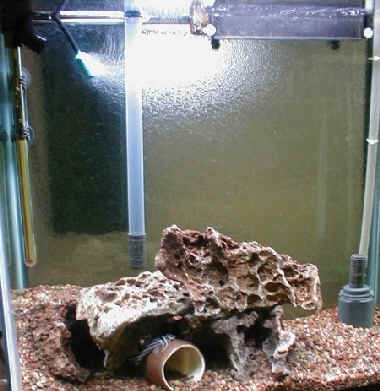
40ppm. 1 ceramic cave/vase (for the dominant male to
CLAIM) buried amidst "Lace" rock.>
*******************************************
I was not entirely
surprised by this event. The older female was quite
gravid and there was a marked increase in activity over
the final few days. The spawn was infertile, but that
was not surprising either. It was their first spawn
and I actually half expected it. The thing that DID
surprise me (and eventually helped convince me that
conditions did not have to be PRECISE at all times)
was that the spawn occurred under pretty poor tank conditions.
My e-mail mentions an experiment. I was in a very
simple “Let it go” mode and the big pay-off
WAS to be triggered by a big, cool, Corydoras-like
water change sometime in the next week.
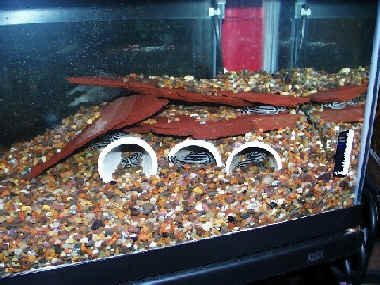
45 days later,
with my 4 fish combined with the “new”
4 from Carol Ann, the pre-spawn activity began again.
The time between noticing the activity and the departure
of the female can take 3 days!. This time it was
my older female (the same as in August) courting
the apparent Alpha male of Carol Ann’s. The
two challenge and wrestle and line themselves up
(in my tank it happens in a cave/vase). The female
lays the eggs and is chased out by the male who
then moves in/over to fertilize them. If you have
ever kept and spawned any of the bristlenose Ancistrus,
the activity is identical. Once the male is “on
Guard”, he is almost impossible to remove…and
you don’t have to if you use a portable cave/vase
device. You can, as I did, remove the entire item,
male and all, into an isolated incubation tank with
similar water conditions.
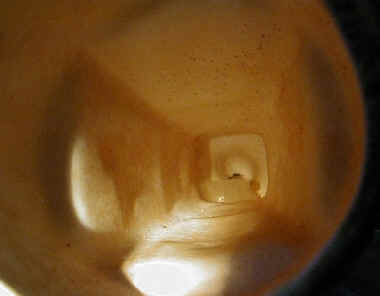
On the third day after spawning, I was surprised
to find 3 escaped wigglers. These fry never
returned to the vase and gave me a perfect ‘control’
by which to gauge the growth of those remaining
in the vase. On the 11th day after spawning I decided
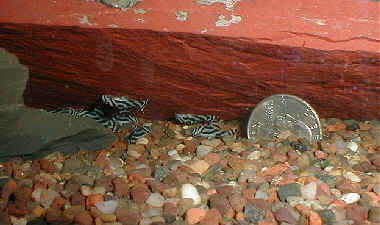
to forcibly remove the male. 13 fry tumbled out
to join those that had developed on their own. 15
stripy little sac-bound miniatures at nearly 3/8”. One
of the escapees died, it was my only mortality. There
are excellent egg and fry development pictures in
the January, 1996 TFH magazine article, “New
Information on the Zebra Pleco”. Do not, however,
pay too close attention to the captioned day counts.
The rate the fry use up their egg sacs seems temperature
related. As my zebras spawned in slightly cooler
than recommended temperatures, the fry were raised
in the same.
I became concerned
when the "control" fry still had huge
sacs when the pictures indicated they should be
gone. I even posted a few panicked messages on the
Internet (Catfish Digest) about it. In retrospect,
I am tempted to believe that these lower temperatures
(under 84) might help the fry development by slowing
the process. Yolk sacs might "burn-up"
too quickly in warmer temperatures. Underdeveloped
fry may die off starvation. This is just a theory.
I’m in no position nor mood to try and prove
it.
I did not feed
my fry while they were sac-bound. Some suggested
that baby brine shrimp would be a good food at this
time, I disagree. Sac-bound fry do not eat
and the food only fouls the water. Once they were
sac-free, they ate like pigs, but only for a few
days. They quickly became night only feeders
and by week 6 they were being fed on the same schedule
as the adults,with heavier feeding on one night
and lighter feeding on the next. I’d like to
include here what information I have about the 2
remaining adults of Carol Ann’s. Her entire
set-up, as described in her e-mail excerpts, was
sold to Jan Carpenter of Fremont, California. Jan
maintained the set-up as Carol Ann had and was quickly
rewarded. Here are some e-mail excerpts.
*******************************************
Kevin,
I just went to clean out my zebra tank and 3 babies
about a quarter inch long dropped out of a piece
of driftwood!!! Somebody's been busy in there. .
Judging by the '96 article [TFH], I'd say they're
about 2-3 weeks old given their size and evident
striping. Those little sneaks, I never saw a clue
that they were breeding in there. . .I can't wait
to run this experiment again and actually see the
eggs and know what's going on. I guess the babies
found something to eat, I wasn't giving them anything
special during their infancy. The article suggested
feeding baby brine shrimp, but at this point I think
they might be too big to eat them. They look more
like they could handle adult shrimps>
*******************************************
Jan eventually
found a total of 8 fry, but wrote me this news about
7 weeks later:
*******************************************
<I still have one zebra baby alive and thriving.
The problem seems to have been a very high nitrite
count. When I did water changes, I did very small
changes with tap water and counted on the tempering
effect of the driftwood to correct the pH which
apparently it did since the pH was 7.0 when I tested
it [Jan reports her tap water pH at over 8.0]. .
.>
<Since I was doing such small water changes on
both tanks, I wasn't cleaning the gravel well enough
- hence the high nitrite. This, I believe, caused
the death of the other 7 babies. . . >
<(When I told you of all the meat alternatives
I was offering as food, it was because) I saw no
interest in the meat I offered. I was desperate
to find anything that might interest them because
I thought they must be starving. I now believe that
the nitrite was making them so ill, that they had
no appetite. Currently he [the surviving fry] eats
blood worms, microworms (oddly), and daphnia among
other meat choices. I think he is now eating the
brine shrimp too, but am not sure. At best, he does
not prefer it. . .>
<I have the vases in the big tank, but I think
the adults were also feeling the effects of the
high nitrite count, and have not reproduced again.
They have, to date, shown no interest (even passing)
in the vases. I'm guessing that it will take them
a bit to get back to normal.>
<(On temperature)
The temperature in the big tank was 84. 4 of the
8 fry died in there before setting up the 5 gallon
[hospital tank]. The 5 gallon was at 82 degrees,
now I keep it at 86. I think the babies like
the warmer water even more than the adults. . .>
<(On aggression)
I don't know about removing the adults. I often
saw the little guys hanging out with the adults
and no one seemed to mind, in fact when I first
found them, there were 2 young hanging out with
an adult in a hole in the log. I suspect that if
there's enough space and hiding places, they don't
get as protective of territory; Especially with
young ones. I've never seen any aggression towards
my 2 adolescents either, and they're about half
grown now. Then again, maybe they just didn't feel
up to the task of running off the competition. Not
enough good data yet on my experiences.>
<(On pulling fry)
I wish I knew how many eggs hatched in my clutch.
I found 8 babies, but don't know how many I may
have started with. That might give some indication
of how dangerous or innocuous the adults are toward
babies. In keeping with the "better safe than
sorry" strategy, it certainly wouldn't hurt
to isolate the babies. Another thing to consider,
maybe the other adults didn't like having fry around
that were not their own. I have 3 adults and 2 juvenile
zebras in the 30 long, but there are thousands of
places to hide in there too.>
*******************************************
I’ll end this now overlong article with what,
in my opinion, are the basic requirements for the
best shot at breeding the "Zebra Pleco"
Hypancistrus zebra.
1)
Have a young adult pair. As I mentioned earlier,
only the one female of my original 4 fish was (and
still is) spawning, that’s a 25% probability.
Of the 4 adult fish of Carol Ann’s that I bought,
only one has been involved in a successful spawn,
same odds. If my experience is representative, 2”
fish need another year or more of conditioning.
Jeff’s 3 remaining fish, over 6 years old now,
have never (apparently) spawned and have remained
about 3 inches. Carol Ann’s fish, some of which
may be 7 years old and nearly 4 inches, are big,
beautiful adults, but may be past their prime. There
is too little information known to say for sure.
2) Feed meat.
I suspect the main difference in clutch size (and
possibly in spawn frequency) between the two groups
was diet. Mine were fed Black worms and frozen bloodworms
regularly.
I tried beefheart once but ended up having to vacuum
it all up. I’ve also fed “Carnivore”
pellets and small chunk trout chow. All of these
foods are very rich and fatty. I have slowly developed
an every other (or 3rd) day attitude about feeding
the adults. They just don’t need to eat that
much when they eat that well.
3) My first
spawn occurred in 80-82 degree water. I do not suspect
that the higher temperatures recommended in the
earlier TFH articles are critical, but I have not
tested the theory. I currently keep my breeding
tank at 84 to 86 degrees. Remember too that uneaten
food rots quicker and algae blooms faster in water
this warm.
4) Current is
needed, if for no other reason than it reflects
the native conditions and aides aeration. It has
been my experience however, that they tend to hide
a little more in the higher current. When Jeff turns
his power head off to feed, his zebras come out
and wait!
5) Breeding
caves/vases are optional. I would not set-up without
them now that I’ve used them. Carol Ann and
Jan were successful without them. In a previous
BAP article I explained how I built some vases for
another cave spawner. The process is simple, the
vase, a simple 8-inch clay item readily found in
grocery stores and pharmacies, needs its bottom
sawn off, the other, smaller end (the original top)
is then plugged up with whatever is handy, the final
effect is a small funnel with a wide 3 inch opening
and no exit. These are the vases my zebras are using
now. They were designed after the ‘higher tech’
knick-knack item known locally as Buoy Bells. They’re
named for the design of a floating marina buoy on
their side. These items are a regional phenomenon
and available through the hobbyist who bought the
rights to reproduce them. The zebras seem to choose
their favorite cave/vase based on its position relative
to the powerhead current. It appears that individual
fish (males) have individual preferences...or maybe
the dominant male gets the place they all want and
the rest choose from what’s left. I do
not know the answer. The only things I notice consistently
are that no one chooses the cave/vase facing the
current, nor do any healthy ones choose to be away
from the group in some isolated corner of the tank.
Some will hang on the fringes of the group, but
always WITH the group.
FINAL
NOTE:
Another spawn occurred exactly 45 days after the
one that yielded the 15 fry. I allowed
the male to stay with this cluster. The adult female
was also present. I never saw how large the
egg ball was, but have no reason to believe it was
any smaller than the last two. On the 18th day,
the male allowed two fry out of the vase. They were
the only two to make it. Ask me in 6 months why
I think this happened. I’m bound to have an
opinion by then.!
References:
Hypancistrus Zebra. 12-6, 2000 Written by Kevin
Korotev for the SPLASH, the official publication
of the Milwaukee Aquarium Society, INC.
kkorotev@sbcglobal.net
Contributions from Carol Ann Nellen, South San Francisco,
California and Jan Carpenter, Fremont, California.
Additional
information:
Sue and Craig Dalton’s website: homepages.ihug.co.nz/~zebra/
“Suckermouth Catfish of the Ancistrine Group”
from Ancistrinae Internet Lecture from www.planetcatfish.com
“Catfish of the Month” November 1997 from
"planetcatfish.com/cotm/1997-11.php Imperial
Pleco”
Newsgroup excerpts from thekrib.com
“The Sorrows of Stripes and Smudge”
TFH Magazine, September 1993
“Zebra Plecos” TFH Magazine, September
1995
“New Information on the Zebra Pleco, Hypancistrus
Zebra” TFH Magazine, January 1996
Photo Credits:
Top 3 pictures from Sue and Craigs New Zealand site
at homepages.ihug.co.nz/~zebra Bottom 4 pictures
are by the author.
Editors
note: Most
of these links above do not work now since this
article was first published in 1996.
|



