SCOTCAT.COM
your internet guide to all things catfish
| The Tadpole Madtom, Noturus gyrinus |
by Robin Engelking |
The tadpole madtom is usually
found in streams and riffles, but can occasionally
be found at the margins of lakes. They are often found
among stones in rocky streams. They can also be found
under branches, leaf detritus or even in old cans.
The best way to collect madtoms is with a seining
net or a kick net and if you're really lucky you might
find them in an old can or bottle. If you net something
that reminds you of a small bullhead, you might have
a tadpole madtom. They have smooth, scaleless skin
that is yellow brown to brown on the dorsal surface
with a cream or white belly. There are four pairs
of prominent barbels framing a wide thick-lipped mouth.
The head is broad and flat with very small eyes and
in a healthy fish the barbels are held pointed forward
forming a "cup". You can usually locate
your fish's lair by looking for the tips of the barbels
sticking out. This is how the fish keeps track of
what is going on in its tank. I have had my female
tadpole madtom for three years now and when I got
her she was a little over an inch long, now she is
approximately 5? inches long. |
 oturus
is a genus in the family Ictaluridae.
Ictalurids are found in North and Central America
east of the Rockies from Canada to Guatemala. Noturus
is the largest group in this family and they are found
in many states, including Minnesota.
oturus
is a genus in the family Ictaluridae.
Ictalurids are found in North and Central America
east of the Rockies from Canada to Guatemala. Noturus
is the largest group in this family and they are found
in many states, including Minnesota. 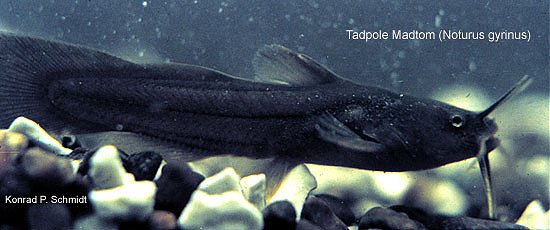

If you would like to contribute an article, please e-mail me. You will of course be credited for your work.
If you would like to donate any denomination of money to the site just click the above link button. All proceeds will go to running the site and hopefully to keep it going for a few years yet.
Print or e-mail this factsheet below


