SCOTCAT.COM
your internet guide to all things catfish
| Hypancistrus sp L028, An undiscribed species of Loricariid from the Rio Guamá | |||||||||||||||
by Yann Fulliquet |
|||||||||||||||
Hypancistrus sp (L028)
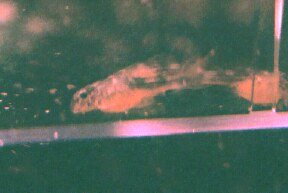
The tank is filtered with a 700L/H external pump in one side and two internal pumps in the other side, one 700L/H and one 1400L/H. The tank is light with two "Gro-lux Ò" tubes during 7-9 hours a day. The parameters of the tank are a pH: 7.4 dGH: 4-5° dKH: 2°, Conductivity: 140 microsiemens. Every week 50% water changes are made and replaced with 60% water from a R/O unit and 40% tap water. The temperature is set at 27 ° Celsius. I usually feed them bloodworms, fresh water's shrimps, and dry food from the hobby, usually tabs for Loricariids and other bottom feeders. I have tried to feed them vegetables but they don't seem to touch them. Spiruline tabs are taken but not as avidly as the bloodworms. Still they don't seem to be picky on what is offered to them. After reading an article of Ingo Seidel's about keeping and breeding Hypancistrus sp L66 in an issue of the Datz, the idea of trying to breed my fish started to grow in my mind. I started to search around for any information, but could only come with a little info from Erwin Schraml, who told me about two spawning accounts, sadly not much was written about it. Since these come from a big river, I thought that I would apply what has worked for breeding Hypancistrus zebra and L66, so I started to do 50% water change every two days. I would make the temperature sink from 27°C to 20°C. and I would also leave the heater unplugged over night and plug it back the next morning. I would also feed the fish with bloodworms and spiruline tabs. Still after a week of that treatment, no sign of response, well except for the Corydoras present in the tank!. After three weeks I had to stop because of a sign of disease on one of my L66s. I had to treat the whole tank as a prevention, so I left the tank untouched except for feeding during 8 days. The fifth day of the treatment I did find that the male and the female were trapped in the same cave. Sadly 3 days later the female was out and had not spawned. This was going to be a long wait I first thought, but two days later I found her trapped again in the same cave but this time with the dominant male. They did stay there together during 4 days. During this time I could see the male fanning and sometimes stopping and reacting like he was being hit by some electrical shock, this alternatively lasted for about every 10 seconds with sometimes a little break. I suppose that this is a way to stimulate the female to spawn and show her that he is strong enough to take care of the young. On the evening of the fourth day I found a strange activity near the cave, the male was fanning even faster and longer than usual, he was also doing some back and forth movements in front of the cave but without getting out completely, when near the entry he would again be taken by some sort of spasms for around 20 seconds. They behaved like this for about 20 minutes and during this time they did it about 7-8 times. The male finally went out completely and so did the female and the male went back in. The female stayed there for a while and did try to get back in to the cave. At this time I was able to see her pink oviduct which was well out, which left me without any possible doubt. She did not stay there for long. After checking in I was able to see about 30 eggs and I estimated their size to be around 5- 6 mm. Well sadly after two weeks all the eggs were gone. I don't know the reason, as the eggs seemed to be fertile. Well then I sort of gave up on them.
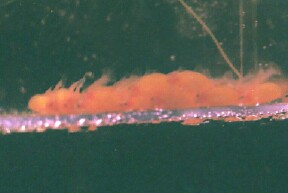
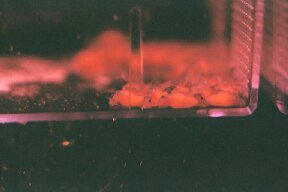
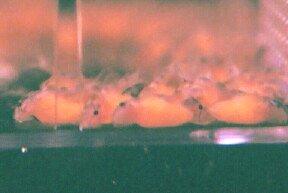
I did notice one thing about the Loricariids during this time, breeding male develop elongated odontodes on the lateral plates, which is not the case with submissive males. The interoperuclar odontodes are also different on dominant and submissive males. In submissive males, the interopercular odontodes are barely bigger than those on the females which can leave a doubt about the sex, but by looking on the pectoral odontodes this doubt should be gone as on male's they are about twice as big than on the female. The interopercular odontodes on dominant males are rather big achieving easily one inch long, compared to ¼ to 1/3 an inch on females and submissive males. About two months after that unfinished attempt, I retried and started again with my water changes. This time after just a week I found the male and female trapped again in the same cave as previously used. The only difference was that it was not with the same male. The pair staid in that cave for the incredible time of 13 days after the female decided to lay her eggs. The male was fanning the eggs very well and after 8 days the young finally hatched. I left the young with the male one day and then took them out. I usually don't like doing so but as I was looking inside to see if the young were doing well, I was only able to see 5-6 of them. I was scared that again I was going to lose the youngsters so I took the decision to take them out. I put the bamboo cave with male and babies in a little plastic tank and started to collect the young, 2-3 went out, then the male, and suddenly around 15 of them. One more look inside the cave and I could see that it was empty. Obviously I was wrong, the male was a good dad, who was taking care of the young, so I put the cave back, and just to avoid any problems I put the young in a nursery with water flow coming directly in, so I was sure that the young would have good oxygenation.I measured one of the young 1 day post hatching and it had a size of 13mm total length. I was impressed by these babies, all of them had a huge yellow yolk sac and did not have any colouration. The second day they were already getting some colour on the top of their head. After 16 days they had completely absorbed their yolk sac and were almost looking like replicas of the adults. At this stage their size had risen to 20mm., which impressed me even more. I had at this point started to feed them with mostly spirulina tablets which I like to use on them as their stomach turns dark when they have eaten them I have also tried little bloodworms but that only manages to scare them, so they haven't eaten any yet. So far I have only lost one fry due to an unknown reason, the others are doing fine and they receive about 3-4 meals a day. While I was occupied with the little ones I did not notice that the female and the male had been at it for a second time. Obviously the egg laying took way less time. Despite checking inside every cave for about every day or two, just to see if everything was all right. Well even this way I did not notice that the eggs had been laid, neither I did see that the male was fanning them, he is doing this all the time. So not long ago I did see while doing a check a yellow thing just under the male's anal fin, I first thought that it was a lone egg but by looking deeper inside I could see again about 30 of them. What I did not expect was that it was no more an egg but rather a fry that had just hatched. It seems that the others were about to hatch as well. I could clearly see the male sort of chewing the eggs, probably to help the fry out. This time I left the young with them to see how things would work out. At this point the young in the nursery were doing good and eating well and the other batch of young, still in the cave, were absorbing their yolk sac. To conclude this long article I will give you an update on them. If you are searching for a nice species of Loricariid that does not get too big and is quite easy too spawn, well this is the fish for you. They prove that if good conditions are given, spawning is not impossible. The main problem with these L-numbers is their prices, which sort of inhibit people to buy more than one. The other reason why not more species are spawned by aquarists is that often people only have an individual of several species. Hopefully, the future will bring more and more reports of successful spawnings, and eventually the price of these beauties will drop making them more affordable for others. Finally I would like to thank Erwin Schraml for the information he gave me concerning the existing literature about this fish, especially about the breeding report and for having made a short summary of the main information. I also wish to thank J. W. Armbruster for all his information shared, and his encouragement's on breeding this species. Finally thanks to Allan James for asking me to write something down, as I would probably never have done it!.
References: Seidel, Ingo,
2000. Zebra & Co.- die Gattung Hypancistrus. Datz,
12/2000 53 Jahrgang, pages 12-18.
|
 his beautiful fish was first introduced to our hobby
by the German magazine Datz in July 1989. It is found
in the Rio Guamá, near Ourém in Brazil.
Its maximum size is 12 cm, which make it a good citizen
for an average size tank. It is supposed to belong to
the genus Hypancistrus because of the typical
mouth and teeth of the genus ( Seidel 2000), but it
is yet to be scientifically described. It is also supposed
that the fish labeled in the Datz as L04, L05 and L73
are the same fish than our L28, which would make the
repartition of this fish in the Rio Tocantins, Rio Pará
and naturally the Rio Guamá. This would have
to be confirmed scientifically as well (Seidel 2000).
his beautiful fish was first introduced to our hobby
by the German magazine Datz in July 1989. It is found
in the Rio Guamá, near Ourém in Brazil.
Its maximum size is 12 cm, which make it a good citizen
for an average size tank. It is supposed to belong to
the genus Hypancistrus because of the typical
mouth and teeth of the genus ( Seidel 2000), but it
is yet to be scientifically described. It is also supposed
that the fish labeled in the Datz as L04, L05 and L73
are the same fish than our L28, which would make the
repartition of this fish in the Rio Tocantins, Rio Pará
and naturally the Rio Guamá. This would have
to be confirmed scientifically as well (Seidel 2000).








If you would like to contribute an article, please e-mail me. You will of course be credited for your work.
If you would like to donate any denomination of money to the site just click the above link button. All proceeds will go to running the site and hopefully to keep it going for a few years yet.
Print or e-mail this factsheet below


