SCOTCAT.COM
your internet guide to all things catfish
| I taut I saw a taw a puddy tat |
by Mr. Fish |
|
The fish I got was Platydoras armatulus (previously P.costatus, see here), the Striped Raphael Catfish. He was around three inches long and about an inch and a half wide. Striped Raphael catfish have been in the hobby for a long time and this was not the first time I had one.
Platydoras armatulus
Feeding the Raphael is easy as it will eat anything. It prefers snails, insect larvae and definitely tubifex worms. If you have a snail problem, this is definitely the fish to take care of it. This black talking catfish has a white stripe across its lateral line, down its back and on a line from the mouth to the outer edges of the pectoral fins. This distinctive and striking pattern makes it popular among fishkeepers seeking an oddity for the community aquarium. Like most catfishes, Platydoras armatulus is extremely nocturnal. The females are larger than males, but since you generally will only have one of these cats that is not important to the general fishkeeper. What is important is that the Raphael Catfish can be extremely territorial towards its own kind and is likely to dispute ownership of caves, nooks and crannies with other nocturnal catfishes. However, it is not over aggressive and will do little more than outspread its pectoral and dorsal fin spines and this is only dangerous when directed at scaleless fishes disputing territory. I might add that the spines can be hazardous to your hands, so be careful. So after the mandatory three weeks in the quarantine tank where I fed and fattened up this little armored catfish for entrance into the cold hard world of many more cats and many big cichlids, he made his grand entrance. He promptly headed into the rock grottos that make up my 240 gallon aquarium and I didn't see him again. About three months ago while I was up late at night, raiding the refrigerator, I happened to spot Raphael foraging around the tank. It had been so long that I forgot that I even had him. So out of the corner of my eye "I taut I saw a taw a puddy tat". That drew me to the aquarium and I spent about an hour just watching the tank in the dark. The cichlids were all drifting mid water fast asleep and the catfish were out. It was an exciting night to be alive. This article first appeared
in the Tampa Bay Aquarium Society Newsletter, Volume
III, Issue 5, January 1995.
|
 brought
home an unusual catfish from the store the other day
and put him into my quarantine tank. Since this was
the first catfish that I had acquired in some time
I decided to set up the quarantine tank with numerous
caves so that the catfish would feel at home and also
so that I could observe him by putting the caves all
facing out.
brought
home an unusual catfish from the store the other day
and put him into my quarantine tank. Since this was
the first catfish that I had acquired in some time
I decided to set up the quarantine tank with numerous
caves so that the catfish would feel at home and also
so that I could observe him by putting the caves all
facing out. 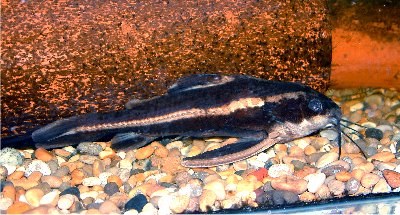


If you would like to contribute an article, please e-mail me. You will of course be credited for your work.
If you would like to donate any denomination of money to the site just click the above link button. All proceeds will go to running the site and hopefully to keep it going for a few years yet.
Print or e-mail this factsheet below


