SCOTCAT.COM
your internet guide to all things catfish
| Spawning Corydoras metae |
by Jim Makin |
Hoplisoma metae
The new stock, nearly all males
and smaller than members of the original colony, were
housed in the Corydoras stock tank. By late
August all the new H. metae were looking really
good. Three males were seen pursuing one fish around
the 100cm tank. Perhaps this was a female, but there
was no sexual characteristic visible. I decided it
was time to move the six smaller fish (now 38mm) to
the breeding tank containing the original H. metae
(which still had not spawned). After five days at a temperature of 75°F, twelve eggs hatched (eight had been removed after fungusing). Liquifry was added to the tank on the second day and thereafter brine shrimp, micro worm and prepared fry food were fed regularly. Despite an abundance of these foods the fry did not appear to be getting any nourishment. Their stomachs did not seem to be full at any time and they started dying after three days. By the third week only eight fry survived, but all were looking much healthier, with full stomachs. During this critical period the bottom of the tank was siphoned every day and topped up with aged water of the same temperature. This kept the tank very clean. Again the males were showing interest in the females and this time I watched closely. It was late evening and three males followed one female around the tank. Again no typical Corydoras spawning activity occurred. The female took up the characteristic 'T' position with a male, placing her barbels close to the male's ventral area. A single egg was released and she lazily swam away to place the egg on the roots of the Java Fern. The spawning was very haphazard and only five eggs were laid -one at a time, and placed on the roots. Next day thirty eggs had been laid on the roots of the Java Fern. The plants and eggs were removed as previously described. Again, I had the same difficulty feeding the fry. By the end of the first week ten fry had died, no matter what was fed (including liquefied spinach) their stomachs was never full. It was not until the fourth week that the deaths stopped. The growth of the twelve fry was very slow, but at six weeks they were moved to the tank containing the first spawning of H. metae, which were now twelve weeks old. Both spawnings continued to grow and to date all are the same size. Since then, there has been a spawning of 100 eggs (possibly a flock spawning), 75% of which were fertile. The same procedure was followed and again heavy losses occurred during the first week. After discussion with other breeders I stopped feeding newly hatched brine shrimp and deaths ceased the next day. The fry are now on a mixed diet excluding brine shrimp - growth is still very slow, but it is hoped that a higher percentage will reach maturity. This experience would seem to indicate that the fry of H. metae are intolerant of the salt content in newly hatched brine shrimp. Lineage: Placed in Lineage 9, the "short-snouted" species with the designated type species: C. punctatus. A revision in the future would constitute the resurrection of the genus name Hoplisoma (Agassiz, 1846). Remarks: As of the latest revision (Dias et al 2024) Corydoras metae has now been placed in Lineage 9 and has the new genus name of Hoplisoma.
This
article first appeared in the Catfish Association
of Great Britain Newsletter 1982 |
 ver
a number of years I have collected specimens of my
favourite Corydoras - C. metae (now Hoplisoma
metae) My best fish were found at Arbroath in
June 1981. These were in excellent condition, having
no signs of shipping damage and I purchased six which
quickly settled in.
ver
a number of years I have collected specimens of my
favourite Corydoras - C. metae (now Hoplisoma
metae) My best fish were found at Arbroath in
June 1981. These were in excellent condition, having
no signs of shipping damage and I purchased six which
quickly settled in.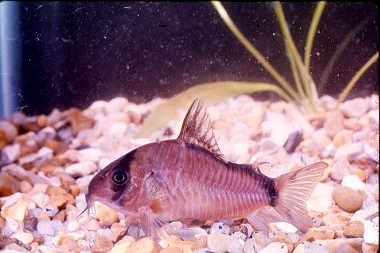

If you would like to contribute an article, please e-mail me. You will of course be credited for your work.
If you would like to donate any denomination of money to the site just click the above link button. All proceeds will go to running the site and hopefully to keep it going for a few years yet.
Print or e-mail this factsheet below


