 ll
though similar in looks, habits and often confused
by the aquarist, Corydoras hastatus and C.
pygmaeus, Knaack,1966 have differing reproductive
modes. Previous efforts to induce C. hastatus
to spawn have met with no success, although spawning
of their own volition had been observed in my Corydoras
community tank, where two young C. hastatus
have been produced over a six-month period.
ll
though similar in looks, habits and often confused
by the aquarist, Corydoras hastatus and C.
pygmaeus, Knaack,1966 have differing reproductive
modes. Previous efforts to induce C. hastatus
to spawn have met with no success, although spawning
of their own volition had been observed in my Corydoras
community tank, where two young C. hastatus
have been produced over a six-month period.
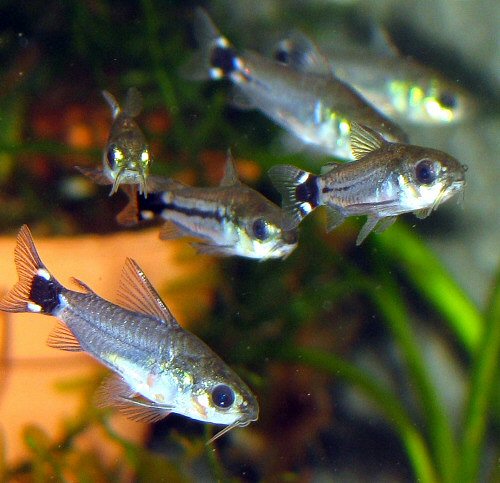
Gastrodermus
hastatus
C. hastatus
may not have spawned in the prepared tank because
only ten fish were available - 5 males, 3 females
and 2 juvenile fish. This I felt was a little low
in numbers as C. hastatus are a naturally shoaling
fish.
19.1.81
My total stock of 10 C. hastatus were introduced
into a 61cm x 25cm x 25cm tank filled to 10cm with
stock tank water (pH 6.87 Temp. 72°F). Substrate
was Dorset pea and sandy outcrops. The tank was planted
with different Cryptocoryne's and pieces of bogwood.
After the fish were introduced the tank was topped
up with fresh tap water - Temp. 72°F. the tank
was lit by room lighting.
27.1.81
A week and several water changes later, the C.
hastatus were very inactive. All of them were
hiding at the rear of the tank and were seldom seen
shoaling in the normal manner. This action was expected.
I decided to introduce 10 C. pygmaeus. This
should lift the C. hastatus off the gravel
and make them feel more at ease.
28.1.81
It had paid off. Both C. hastatus and C.pygmaeus
were shoaling together and feeding well. Water conditions
were pH 6.8, temp. 72°F.
30.1.81
The fish have been observed for the past few days
and the extra fish have made a great difference. C.pygmaeus
spawned, laying 40 - 50 eggs on the front glass and
on the plants. The spawning was typical of C. aeneus
(Gill,1858) and C. paleatus (Jenyns, 1842).,
i.e. plenty of activity. The C. pygmaeus were
not removed as the C. hastatus have become
very active and the eggs were not being eaten. Checking
the tank that evening, 5 male C. hastatus were
seen chasing one female. There was a very interesting
point the female's eyes were completely black. The
iris was not visible - only the pupils could be seen
and they were jet black. The males chased the female
for 2 hours and no eggs were laid. I was ready to
give up when I noticed the female with one very small
egg held firmly in her ventral fins. Actual delivery
of the egg was not seen, but the males were all quivering
round her at this time. (The other females were shoaling
with the C. pygmaeus and their eyes were normal.
With the egg cradled in her ventral fins, she then
began to swim over and under the plant leaves with
the males in close pursuit. They seemed to be cleaning
the leaves. She swam around with the one egg for half
an hour, before depositing it under a plant leaf.
I am quite sure only one egg was laid at this time.
15.2.81
This spawning activity has continued in the evening
for 2 weeks. Only one female spawning at a time, and
laying only one egg. Whether or nor it is the same
female each time is hard to tell as they are all similar
in size. During the period when the C. hastatus
spawned, fry were seen in the tank. They were silver
in colour with 2 - 4 dark patches along the back.
Some had a distinct black patch through the caudal
peduncle. As the fry grew, 4 C.hastatus fry
of varying sizes were seen swimming with the 30 C.
pygmaeus fry.
OBSERVATIONS
1) To date
(mid- March). The C. pygmaaeus have not spawned
again, but still the odd C. hastatus appears.
Could the C. hastatus be a periodic spawner,
as are some of the Julidochromis species from
Lake Tanganyika?
2) The eyes
of the spawning female turned completely black. The
gold iris vanished and the full eye appeared black.
3) The growth
rate of the C. hastatus is quicker than that
of C. pygmaeus. The older C.hastatus
are 1cm whereas the 30 C.pygmaeus are under
6mm.
4) Feeding:
Powder food was fed as soon as the first fry were
seen and thereafter every day in small quantities
for any newly hatched fry. Brine shrimp and micro
worm were fed along with normal daily food for adult
fish.
5) Regarding
the high mortality rate reported by some aquarists,
which can occur at 4/ 6 weeks period, i.e. the fry
will try to lift to the water surface and spin to
the bottom (water depth does not matter). The fry
were very weak and wasting away and would die in a
week. The size of the fry seems to be the important
factor - not the age. I have a few theories:
a) At first I thought that a nutritional
deficiency was the trouble. If the fry were left with
the parents the high mortality rate did not occur.
Perhaps the parents helped feed the fry, or they received
nutrition from mulm caused by the parents. Of course
you will lose some due to the parents eating fry or
eggs. No deaths occurred. Could the fry be developing
their secondary breathing system and getting chilled
(as do anabantids when the labyrinth organ is developing).
Lately, a very high success rate with C. barbatus
(Quoy & Gaimard,1824) and C. aeneus, with
the parents removed, perhaps the tanks were higher
than normally used and so water and air temperature
were not equal Or can it be put down to bad management.
This article first appeared
in the Catfish Association of Great Britain Newsletter
!982.
Photo Credit: ©
Reinhold Wawrzynski
Update: Corydoras
hastatus is now Gastrodermus hastatus.



