SCOTCAT.COM
your internet guide to all things catfish
| Corydoras robineae | ||||||
by Eric Bodrock |
||||||
|
Brochis robineae
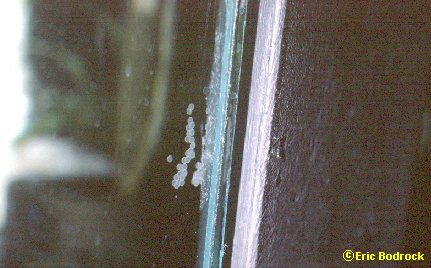
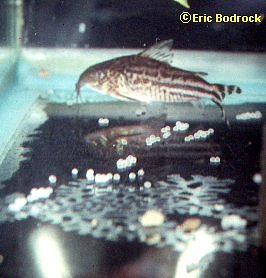
The robineae laid their eggs during mid to late afternoon. About half of the two hundred eggs were placed on the bare glass bottom of the tank, in the open, along the left side and closer to the back wall. I would guess that about sixty eggs were scattered among the roots of a Java Fern and an Anubias plant. The remaining forty or so were deposited in a couple of small, tight groups on the tank sides, just about three inches off the bottom. The eggs on the floor were also laid close together in smaller groups and somewhat in a row. Eggs measure at two millimeter and are sort of white in color. I thought at first that none of the eggs were good and they had begun to fungus already! As to not have “all my eggs in one basket” I decided to move the plants that were full of eggs into a bare two-gallon tank with an air stone at moderate airflow. With my fingers I rolled off about fifteen eggs and placed them into another tank that was already set up for hatching some other Cory species. I shut off the return water from the central system in the original spawning tank and lowered the water level to about five inches.
Click on thumbnails for larger image.
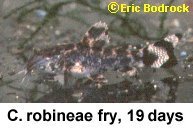
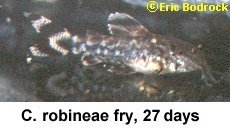
The eggs began to hatch late on the third day, spotting a single wriggler on a tank bottom. The remaining eggs hatched on the afternoon of the fourth day. Most of the eggs in the original spawning tank had fungused by the fourth day and only six fry hatched. The eggs that were attached to the plants that had been moved produced seven fry and the eggs I moved with my fingers resulted in nothing. Within about two days after hatching, I began added a small amount of Microworms every couple of days to both fry tanks. In the two gallon I did a cup or two water change every other day & left the other, larger, tank alone. Within a week I began adding small amounts of newly hatched baby brine shrimp into their diet and shortly after that, tiny amounts of assorted crushed flakes were given. The fry in the two-gallon tank grew slightly faster than the others, I’m sure due to the water changes. The fry in the small tank were moved into a half filled, ten-gallon tank on day eighteen. (With smaller fry I like to keep the water level low to reduce the water pressure on them.) At twenty-two days their total length reached three quarters of an inch and at thirty-five days a solid one inch. This is rapid growth for a Cory/Brochis, probably because of the small number of them getting some specialized attention from me! My hopes are to raise these fry and set them up in a breeding colony, I’m thinking that tank-raised, F1 fish, will be easier to spawn than wild caught fish. Remarks: As of the latest revision (Dias et al 2024) Corydoras robineae has now been placed in Lineage 8 sub clade 4 and has the new genus name of Brochis. |
 he
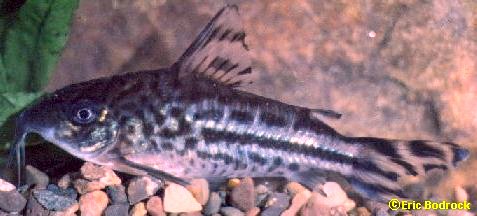
"Flagtail Cory”, I would say is the most
strikingly marked Brochis of all. Their tail
is the first thing that catches the eye, five or six
bold black horizontal stripes on a white background.
Three distinct stripes in the middle of the tail appear
to run into the body pattern, breaking up into large
spots by mid-body. Their main body, which is a silver/white
color, is patterned in what looks like broken stripes
along the back and lower sides. The dorsal fin shows
a couple of faint black stripes, while all the other
fins show just a hint of black in them.
he
"Flagtail Cory”, I would say is the most
strikingly marked Brochis of all. Their tail
is the first thing that catches the eye, five or six
bold black horizontal stripes on a white background.
Three distinct stripes in the middle of the tail appear
to run into the body pattern, breaking up into large
spots by mid-body. Their main body, which is a silver/white
color, is patterned in what looks like broken stripes
along the back and lower sides. The dorsal fin shows
a couple of faint black stripes, while all the other
fins show just a hint of black in them.


If you would like to contribute an article, please e-mail me. You will of course be credited for your work.
If you would like to donate any denomination of money to the site just click the above link button. All proceeds will go to running the site and hopefully to keep it going for a few years yet.
Print or e-mail this factsheet below


