 here
are a number of catfish that belong to the family
Doradidae. Quite often these fascinating catfish
are referred to as "Doradids", "Dorads",
"Talking Catfish", "Thorny Catfishes"
and other names, which cannot be mentioned, as they
are too rude! This group of catfish are found throughout
South America. There are small doradids and large
doradids commonly offered for sale at most good aquatic
retailers. The problem with some of the larger species
such as Pseudodoras niger (Mother of Snails
Catfish/Black Doradid) and Pterodoras granulosus
(Common Bacu) is the fact that they would soon
outgrow a 72"x 24" x24" aquarium and
are therefore not ideally suited to life in an aquarium
unless you can provide a large enough aquarium or
tropical pond to house them in. As I do not wish to
encourage any unsuspecting aquarist to keep large
catfish I will concentrate this article on some of
the smaller representatives of this family of fish.
Those of you that know me will already be aware that
this family of fish is perhaps my favourite, as I
am unable to resist walking past a dealers tank without
looking to see what doradids lurk behind the décor.
here
are a number of catfish that belong to the family
Doradidae. Quite often these fascinating catfish
are referred to as "Doradids", "Dorads",
"Talking Catfish", "Thorny Catfishes"
and other names, which cannot be mentioned, as they
are too rude! This group of catfish are found throughout
South America. There are small doradids and large
doradids commonly offered for sale at most good aquatic
retailers. The problem with some of the larger species
such as Pseudodoras niger (Mother of Snails
Catfish/Black Doradid) and Pterodoras granulosus
(Common Bacu) is the fact that they would soon
outgrow a 72"x 24" x24" aquarium and
are therefore not ideally suited to life in an aquarium
unless you can provide a large enough aquarium or
tropical pond to house them in. As I do not wish to
encourage any unsuspecting aquarist to keep large
catfish I will concentrate this article on some of
the smaller representatives of this family of fish.
Those of you that know me will already be aware that
this family of fish is perhaps my favourite, as I
am unable to resist walking past a dealers tank without
looking to see what doradids lurk behind the décor.
Why are they referred to as
"Talking Catfishes" I hear you ask? I will
now attempt to answer this question. Doradids have
two ways in which they can produce "Talking Sounds",
which subsequently gives them their common name. The
first way of communicating sound is by the fish partially
locking their pectoral fins in their sockets, and
then the action of moving the fins, the fin spines
grate against the socket producing the sound. The
second way, in which these fish produce sound is via
a mechanism known as the "elastic spring mechanism",
there is a muscle that is attached to the rear of
the fishes skull at one end and to the anterior of
the swimbladder at the other end. The fish is able
to quickly contract and relax this muscle and as a
result it can make its air filled swimbladder resonate
to produce sound. These catfish use these methods
of communication as a means of self-defence against
would be predators and also as a way in which they
can find conspecifics in its natural environment (or
aquarium). The doradids can also be described as narrow-breasted
or broad-breasted. The narrow-breasted species tend
to have feathered barbels a characteristic that the
broad-breasted species do not posses. With the broad-breasted
species the width between the base of the pectoral
fin spines tends to exceed the length of the head.
One of the main features of
this family of catfish is the fact that they posses
bony projections along the lateral length of their
bodies. These bony projections are known as "scutes",
which are very sharp just like thorns. These scutes
give this family of catfish an almost prehistoric
look about them. Care should be taken when removing
these fish from an aquarium as they all too often
get themselves snagged up in nets. When these catfish
are frightened they immediately lock their pectoral
and dorsal fin spines erect. These fins have serrated
edges and when locked makes the fish safe from would
be predators. If nets have to be used then they should
be very fine meshed in order to prevent the scutes
and fin spines from penetrating it. Some aquarists
prefer to pick these catfish up by their dorsal fins
taking care not the get their fingers trapped between
the pectoral fins and the scutes on the body of the
fish, as believe me this can be a very painful experience!
If you can use a plastic container or a plastic bag
in which to chase the fish this is perhaps the best
way of removing the fish from the aquarium. When removing
the larger species it is perhaps best to wrap the
fish in a bath towel(s) and lift it out of the water
(this tends to be a two person job one lifting the
head end the other the tail end taking care not to
cut your hands on the razor sharp scutes.
The ideal
set-up for these catfish would be an aquarium with
a sand substrate such as BD Aquarium sand or fine
gravel. Décor should include bogwood in which
the catfish will hide, smooth rocks to avoid damaging
the bodies of these fish. Some aquarists use plastic
or clay pipes for their catfish to hide in, if these
materials are to be used please ensure that they are
large enough to allow the catfish to be able to get
out of. I have known a number of people to lose their
catfish as they have become too large to get out of
the pipe and they have subsequently become stressed
and died. Wherever possible use large diameter pipes
if they are to be used. I would personally recommend
an aquarium that is at least 36" x 15" x
12"in order to keep these catfish satisfactorily.
The ideal water conditions are pH 6.5-7.5, temperature
in the range 22-26ºC or 72-79ºF and dH up
to 15º. These catfish thrive on a mixed and varied
diet that includes sinking catfish pellets, granular
foods, flake, tablet foods, aquatic snails, shredded
prawns, earthworms and frozen foods such as bloodworm.
As sand has been mentioned as the ideal substrate
for these catfish I would suggest that internal power
filtration or external canister filtration be used,
as under gravel filtration would not be efficient
as the sand would cause it to clog. Weekly or fortnightly
20-25% water changes should also be undertaken to
ensure good water quality at all times. When undertaking
water changes always ensure that you use a water dechlorinator,
preferably one that will treat both chlorine and chloramines,
prior to adding the fresh water to your aquarium.
As promised
I will now mention a few species that will not grow
into "Tank Busters" and would be ideally
suited to life in a community type aquarium. Please
bear in mind that whilst these catfishes are not predatory
they will eat any unsuspecting fish small enough to
fit inside their mouths. This said I have kept some
of the smaller doradids in with small fish, BUT I
am not recommending that you should. I will begin
with some of the more commonly seen species and mention
also some that are not so readily available.
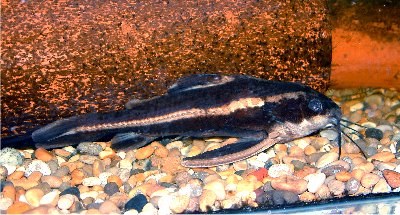
Platydoras
armatulus commonly
known as the Humbug Catfish, the Striped Talking Catfish
or Striped Raphael. This particular catfish is readily
available from most good aquatic retailers, and is
perhaps the most commonly seen representative of this
family of catfish. Like most of the doradids it prefers
to be kept in a small group, although there may be
the odd squabble over territory. The natural habitat
for this catfish is the river system of South America
from Peru to Brazil. Platydoras armatulus
(previously known as Platydoras costatus)
can attain a length of 200mm
or 8". I have found that when kept in small groups
these catfish will soon rid an aquarium of an aquatic
snail problem. Single specimens will relish snails
but will be unable to rid an aquarium of snails single-handed!
Price guide £4-£10 depending upon size.
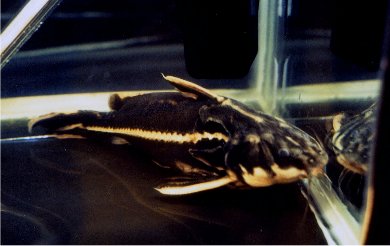
Orinocodoras
eigenmanni is
more commonly known as the Raphael Catfish. This catfish
is not commonly available but to the trained eye the
odd specimen can be picked out amongst imports of
Platydoras costatus, which has been the way
in which I have gradually obtained a group of them.
Orinocodoras eigenmanni has a more pointed
snout and its scutes tend to be smaller than those
of Platydoras armulatus (previously known as
P.costatus). There are other differences as well
such as the length of the adipose fin and the shape
of the caudal fin, which when viewed side by side
is quite apparent. Like most of the doradids these
catfish also like to be kept in small groups, which
can be difficult when only the odd one or two specimens
are available. Fortunately these doradids are quite
happy to shoal with Platydoras armulatus. The
natural habitat for these catfish is the Orinoco River
system in Venezuela hence its name Orinocodoras.
This catfish can attain a length of 175mm or 7".
Like the other doradids this catfish also relishes
aquatic snails as part of its mixed and varied diet.
Price guide £5-£15 depending upon size
and if the retailer is aware that this fish is amongst
Platydoras armulatus.
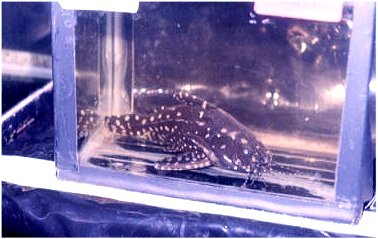
Agamyxis
pectinifrons
is commonly known as the Spotted Talking Catfish,
White-spotted Doradid and Spotted Raphael. This particular
catfish is also quite often available at most good
aquatic retailers. The colour pattern tends to differ
slightly from individual to individual, but is quite
eye catching being jet-black body colour with white
to creamy coloured blotches along the body and fins.
Again this catfish prefers its own company so the
aquarist should ideally keep them in small groups
of between 4 and 6 specimens. The natural habitat
for these catfish is throughout the river systems
of South America notably in Peru and Pebas. This particular
species can attain a length of 140mm or 5½".
These catfish thrive on a mixed and varied diet including
aquatic snails. Price guide £4-£10 depending
upon size and availability.
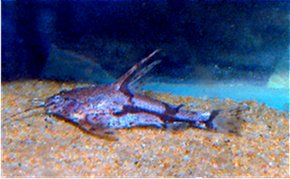
Amblydoras
nauticus (previously
known as Platydoras hancockii)
is commonly known as Hancock's Catfish or Talking
Cat. There is also reference made to this catfish
under the name of Amblydoras affinis just to
add to the confusion. This catfish is occasionally
seen at some retailers and is quite often imported
at no more than 50mm or 2" in length. This species
can attain a length of 100mm or 4". Again another
catfish that fares better in small groups therefore
I would recommend keeping between 4 and 6 specimens
together. The natural habitat for these catfish is
widespread throughout the rivers of South America
from Guyana to Brazil. This particular species prefers
water that is neutral and soft with dense vegetation
for it to hide amongst. Again these catfish thrive
on a mixed and varied diet that includes aquatic snails.
Price guide £5-£10 depending upon availability.
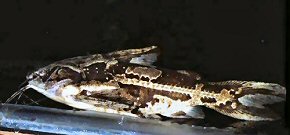
Anadoras
grypus is commonly
known as the Dusky Doradid. This catfish is not very
often available for sale to the hobbyist. The odd
one or two sometimes appear amongst shipments of Amblydoras
hancocki, which as juvenile fish share a similar
colour pattern. Whilst collecting fish in Peru I was
able to collect large numbers of what initially appeared
to be Amblydoras hancocki, but which later
turned out to be Anadoras grypus. The specimens
collected were approximately 25mm or 1" in length.
This particular species can attain a length of 150mm
or 6". Another peaceful doradid that prefers
to be kept in groups of at least 6 specimens. The
natural habitat for these catfish is South America,
widespread throughout the Amazon Basin. As with Amblydoras
hancocki these catfish prefer neutral and soft
water conditions with plenty of plant cover. They
will thrive on a mixed and varied diet including aquatic
snails and bloodworm. Price guide £8-£20
depending upon availability.
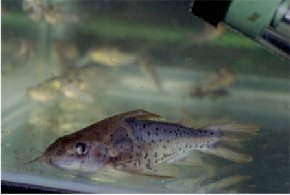
Ossancora
punctata is commonly
known as the Feather Barbels Catfish. This is another
species that is not readily available to the hobbyist,
but is a very peaceful addition to a community aquarium.
This species can attain a length of 115mm or 4¾".
Another doradid that prefers safety in numbers assuming
that you can purchase them. I would recommend that
you keep at least 4 specimens together. The natural
habitat for these catfish is the rivers of Peru and
Ecuador. Good water quality is required by these fascinating
catfish, as is a diet that includes finely shredded
shrimp and bloodworm. Price guide £ 8-£15
depending upon size and availability. (Editors note:
Was known until recently (2011) as Doras punctatus
until a new paper by Birindelli, JLO and MH Sabaj
Pérez (2011) asigned a new genera, Ossancora
to this species).
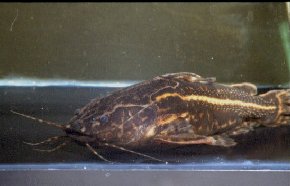
Acanthodoras
cataphractus
is commonly known as the Painted Talking Catfish and
is also sometimes referred to as the Milky Cat. This
catfish is occasionally available to the hobbyist.
It can attain a length of 150mm or 6". I have
kept these catfish in small groups of 4 specimens
when numbers have been available to purchase, otherwise
I have kept them with the other species of doradid
already mentioned. The natural habitat for these catfish
is South America throughout the Amazon River estuary.
This species fares well on a mixed and varied diet.
Price guide £8-£15 depending upon availability.
There are a number
of other species of doradid available to the hobbyist
in small numbers, which is why I have concentrated
this article on those species mentioned above. I hope
that this will give you an insight into this fascinating
group of catfish and that some of you reading this
article will take up the challenge of keeping them.
This article also appeared in
the U.K. fishkeeping magazine Practical
Fishkeeping.
Photo
Credits:
Platydoras
armatulus |
Allan James
@  |
Orinocodoras
eigenmanni |
Allan James
@ |
|
Agamyxis pectinifrons |
Danny Blundell
|
Amblydoras
nauticus |
Allan James
@ |
Anadoras
grypus |
Danny Blundell |
Ossancora
punctata |
Danny Blundell
|
Acanthodoras
cataphractus |
Danny Blundell |



