SCOTCAT.COM
your internet guide to all things catfish
| Rineloricaria parva, The Whiptail Catfish |
by Helen Burns |
Rineloricaria
parva Approximately one year had
passed and theywere definitely large enough to spawn.
At this point I did not know the sex ratio of them
but I placed a few PVC pipes in the tank "just
in case".Unfortunately the only inhabitants
in the pipes were the dwarf cichlids. During a re-organisation
of tanks I moved the parva's back into
the fish house beside some young Apistogramma
macmasteri, ever hopeful the pipes went along
with them. Within a fortnight there was a pair inside
the pipe spawning. What I Do When They
Spawn. The father’s job is finished and he leaves the pipe. It is essential to ensure that the male has feeding for several days before being returned to the main tank, so I normally remove him into one of my other peaceful community tanks as soon as the fry are free swimming, then at a later date return him back with the females. The tiny scaled down miniature parva’s like to attach themselves onto the glass and hang like little Christmas decorations. For their first feeding
I place a scalded lettuce leaf or a small slice
of cucumber in the tank, always ensure that this
is replaced daily with a fresh piece. An additional
sponge filter is added to cope with the sudden population
explosion and small water changes are carried out
daily, I also place a suitable sized piece of bogwood
in their tank for them to browse on. After about
a week or so I then move them into a larger tank
24"x12"x12". Growth rate seems very
slow in the beginning but with a ready supply of
food and maintaining the water quality, their growth
rate soon increases. From past experience if I do
not remove the male plus eggs into a maternity tank
when the fry become free swimming they are devoured
by the other tankmates. |
 was
given my first whiptails from a friend in the aquatic
club, six young which he had brought along for his breeder’s
team. They were initially housed in a small tank in
my fish house but later on I transferred them into one
of the tanks in my house, 36x18x18 which housed three
juvenile Discus, dwarf cichlids, neon tetras, honey
gouramis and Corydoras sterbai. This tank was
heavily planted with Amazon Swords and giant Vaillisneria.
The parva's stayed hidden most of the time
but quite often they would stay motionless on the pieces
of bogwood.
was
given my first whiptails from a friend in the aquatic
club, six young which he had brought along for his breeder’s
team. They were initially housed in a small tank in
my fish house but later on I transferred them into one
of the tanks in my house, 36x18x18 which housed three
juvenile Discus, dwarf cichlids, neon tetras, honey
gouramis and Corydoras sterbai. This tank was
heavily planted with Amazon Swords and giant Vaillisneria.
The parva's stayed hidden most of the time
but quite often they would stay motionless on the pieces
of bogwood.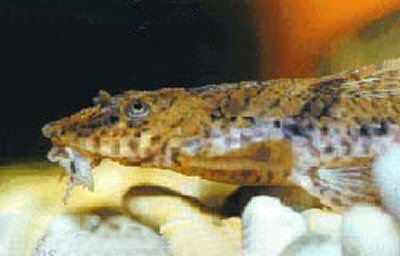

If you would like to contribute an article, please e-mail me. You will of course be credited for your work.
If you would like to donate any denomination of money to the site just click the above link button. All proceeds will go to running the site and hopefully to keep it going for a few years yet.
Print or e-mail this factsheet below


