SCOTCAT.COM
your internet guide to all things catfish
| Final speech for the “Walking Catfish”, Clarias batrachus |
| by Wolfgang Ros |
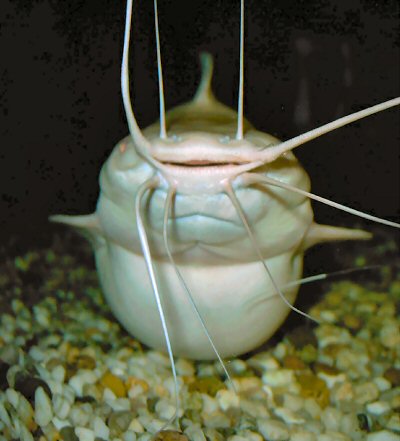
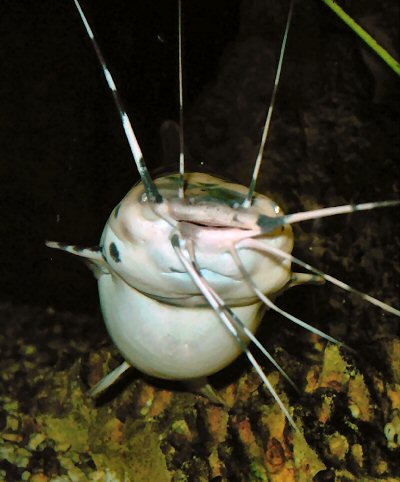
With the species Clarias batrachus the second name component might refer to the exterior of this catfish resembling a little frog in particular after just being fed - from therefore also the German description “Froschwels” (“Frog Catfish”).
Clarias batrachus belongs to the Clariidae family. This name refers to its additional respiratory organ in form of a breath bag. Thus additional taking up of surface air is made possible for the fish in its often oxygen-poor habitat. The designation also alludes to the ability of these fish to be able to survive for some time also outside of the water. With the species Clarias batrachus the second name component might refer to the exterior of this catfish resembling a little frog in particular after just being fed - from therefore also the German description “Froschwels” (“Frog Catfish”).
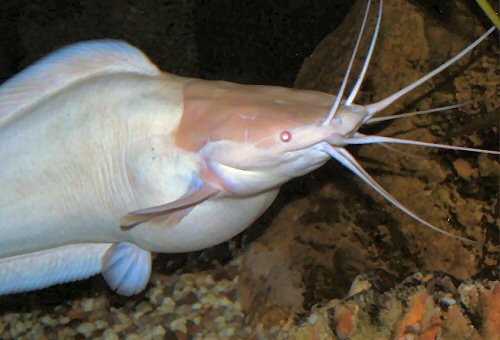
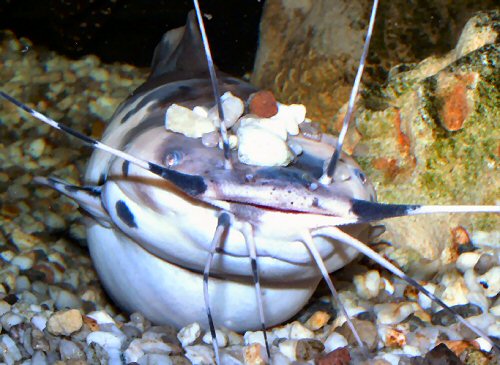
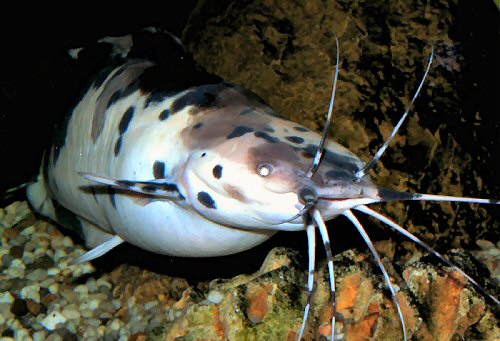
Their original homeland lies in tropical Asia, where they are common in rivers and pools. However they increase strongly also in some parts of Florida. There it was easy for them to escape from the fish ponds, in which they originally had been inserted, into closed waters, with the consequence that they also did damage to the fauna there. This circumstance surely also contributed to the negative image of the species. Though you can see differences by looking in front of Clarias batrachus - the female altogether looks more imposing and stronger (see pictures below), the only safe sex specific distinguisher, anyhow with the albino and semialbino animals which we usually can buy and which are substantially more remarkable in contrast to the inconspicuous wild colour, is the form of the genital papilla. With the female it is thick set, short and blunt, with the male being elongate and pointed at the end.
C. batrachus - female
C. batrachus - male
Personal
experiences: The animals are fed alternately with tablets, cichlid sticks and even “Forelli” (specialized food used for feeding farmed trout, but from this food you have to give less, otherwise the danger of fouling the water increases!), just as with mosquito larvae (also frozen) and now and then also with cattle heart, shell meat and earthworms. The fact that Clarias batrachus has been described as taking vegetable food , might refer probably only to the portion of vegetable materials in the detritus, which the animals in nature also search for food. As co-inhabitants I tried large Silver Sharks (Balantiocheilos melanopterus) without any considerable problems and are rather calm and also South American cichlids like the Oscar (Astronotus ocellatus,) also Red Tail Black Sharks (Epalzeorhynchus bicolour), different Botia such as Botia modesta, macracanthus and lohachata, even 5 cm large Chinese algae eaters (Gyrinocheilus aymonieri), which the Catfish could swallow easily as a whole. This statement might probably astonish some readers, who have so far believed that one can not socialise so small a fish with such a catfish. If one wants to associate large Plecos with Clarias batrachus, then some caution is required. Fully grown Plecos can be very dominant and are capable of inflicting injury on scaleless catfish with the sharp leading ray of their pectoral fins. Surely these statements can’t be generalized. Naturally particularly their greed is to be considered with the socialization of catfish with other species. And in particular this applies to Clarias batrachus. Naturally it is the best, if the proportions are at least to some extent correct. If one wants to socialise the afore mentioned smaller remaining Botia with Clarias batrachus, then it is important that the Botia are given hiding places, because, as the Clarias pursue them now and again and especially in the mating season, opportunities for avoidance are important. And still another reference: A socialisation with living-bearing fish is not possible; these are regarded by Clarias batrachus as feeder fish because of their comparison for example to the Botia which can swim away. Nevertheless the Clarias by any means does not belong to the predatory catfish, which nourish themselves almost exclusively of fish, even if Clarias is often called such. Rather it is from nature an omnivore, which pursues above all at night also young fish, which fit into its routine feeding pattern; however those living food portion consists mainly of smaller animals such as worms, small crustaceans or insect larvae. Clarias must locate these with priority with its 4 pair of barbles due to their smell and less due to their movement, since it might not see too far with its small eyes. (see thumbnail on menu) The muzzle of Clarias batrachus is comparatively small; in contrast to many actual predatory catfish it can not devour too large a portion. From larger, already dead fish they can separate mouth-sized pieces only under difficultiy by strongly shaking movements. The greed of Clarias batrachus however is really considerable. The animals can devour so much at one time, until the belly swells to the size of a golf ball. That applies in particular to young animals, which achieve it this way as fast as possible so to make them larger and thus safer (protection from enemies). In addition, in nature fully grown animals have the possibility in this way of eating so much food that they can get unwell afterwards, so better to have a longer time between feeding regimes. With animals kept in the aquarium one should be conscious of this fact, otherwise they lay in a corner fully eaten and are sluggish and slow acting. One should pay attention not to over-feed the animals, but rather to resist the begging attempts, to give less and also insert one or other fasting days in the week. In addition with the socialization it is to be noted that one does not select aggressive cohabitants. My Clarias get along first of all therefore with the mentioned Oscars so well, because these Cichlids are calm, and at least outside of the spawning season, they rather shy away from the Clarias. However if Clarias batrachus are socialised with aggressive Cichlids, who might be pre-programmed to be aggresive, I would advice against this practice. Clarias batrachus are assertive animals. Thus they will leave, once the pecking order is ironed out, the fish associated with them usually in peace. They do not like it however at all, if other fish want to dominate or show themselves to be more aggresive than them, then they feel obviously bad in this situation. Keeping three or more of this species can be problematic on a long-term basis also in very large tanks. The animals are not asocial, but already recent Clarias tend to push weaker co-inhabitants aside when feeding. And at the latest if in the spawning season a pair has been found, then both partners pursue at least surplus females incessantly and cause to them injuries with their biting attacks. That was also the reason, why I finally had to move on another female which was originally together with my two Clarias batrachus. Even in a 2-meter (6 foot) aquarium this female had found no safe resting place.
The nuts and bolts of keeping of Clarias is the requirement to give the animals a roomy aquarium at their disposal. If no large tank is present, one should avoid co-inhabitants, if necessary one should also do without the acquisition of other species. If the tank selected is too small (and those are already for an individual that attains full growth, all aquariums under 300 litres), with increasing growth of the “Walking catfish” a whole set of negative factors add up: Plants are then already uprooted by them every now and then due to the hectic swimming movements of the animals. Cohabitants do not have a retreat area and with feeding they are chased incessantly by the Clarias and pushed aside, because they regard these as food competitors. Due to the high feeding regime the need for repeated water changes must be adhered to. This wanting to avoid water changes and feeding too little, can be fatal for other fish with the large greed of the animals. In short, thus a vicious circle and under these conditions Clarias batrachus will live up to its bad reputation. Clarias batrachus differ from the behaviour from most other Catfish, which remain mostly in a certain hiding place lurking, and move if necessary after switching the lighting off creeping along the substrate. If they achieve a certain size (for instance starting from 15 cm) and if they are not associated with clearly larger fish (in this case they can be quite fearful, too), then they prove as quite swim-joyful animals, which regularly by day swim through the tank searching jerkily for something to eat and due to their active way of life, with the viewer keeping them, they never becomes boring. Naturally they also rest themselves, but these phases however are comparatively short. If a pair is formed, then the movement of the animals become even more by their courting, but particularly with the later stages of spawning. Even with the keeping of an individual full grown “Walking Catfish” the minimum of the aquarium should have at least 1,20 m length (48inches) (better: 1,50 m). How does it look with the size of the animals in the aquarium? Here I would like to calm our readers down who come up with the size of 60 cm or more. Even FishBase indicates 47 cm as maximum size - a number mind you, which orients itself on animals in the wild. Admittedly I have photos of wild Clarias batrachus who have already reached the size of 60 cm as indicated. However these fish differ already clearly by a different head shape and muzzle portion from the albino or semialbino animals, which are now and then offered for keeping in the aquarium. Probably here the fact is important that it concerns with the cultured variety and so also with my Clarias not coming from Thailand, but rather the Indian species. According to a personal reference of the Thai scientist Professor Uthairat Na-Nakorn both differ from the number of their chromosomes clearly from each other. The Indian species exibits at least in this relationship more similarity with Clarias fuscus, a species, which FishBase indicates as approximately 25 cm. I think the animals offered to us in the trade on the average, do not get much larger than 40 cm, and I keep contact with other catfish enthusiasts, who have this fish and did not even reach this size, even after many years, however two of them also report who kept the albino form of 45 and 47 cm length. My Clarias grew up to a size of 30 cm very fast. If you feed very well, Clarias batrachus probably can reach this size in only one year. Afterwards Clarias batrachus grows only comparatively slowly. Already since a half year they seem to be “standing still” with approximately 38 cm. length. Anyhow I can determine from then on they have not put on growth, the animals rather increase in width and thereby altogether look more strongly than before. While the female albino did not change colour in this time, with the male piebald the colours faded somewhat. Characteristics: In particular they seek to leave the aquarium if it is becoming too small or if they were not fed for a long time. In nature this ability, to be able to “move” over the country to the body of water, is an unbeatable advantage over other fish, in aquariums however it can be a death sentence, except the animals that are found in time after their escape and again put back in the tank. Even nearly drained and already believed to be dead animals have recovered themselves again. So that it does not come out at all, one provides for an aquarium cover and weights as a necessary addition. A danger is the sharp pectoral fins when catching our large animals. Since injuries by these pricks can hurt badly, in addition they take a long time to heal and can get infected, thereby it is best to use large buckets. In nets they will get hooked and will thrash about. In such cases they often give of noises. Breeding: The spawning of the animals can extend to nearly a whole day. Both partners work together to dig a hollow in the gravel, which has a diameter of approximately 30 cm. In mating the male loops u-shaped over the female. (see thumbnails on menu) Depending upon the size of the animals altogether some hundreds to over 1.500 eggs are delivered. After the last spawning the male protects the pit with the eggs, the female secures the territory around it. The embryos slip out after approximately 30 hours. They are protected only a few days by the parents against possible enemies. Important
(!) concluding remarks: To
that extent I am also more than sceptic to recent
offers of dealers in Germany, who sell Clarias
batrachus "10 pieces for 25 euro".
Because hardly anyone possesses such a large aquarium,
in which such a number could be kept appropriate
in the long term. However soon the surplus catfish
happens - caused by the rapid growth of the animals
- of it the recurring advertisements in newspapers,
magazines and in the Internet speak for themselves
("’Walking catfish’ owing to circumstances,
will deliver"). Who ever is serious with the
keeping of these fish and tries to consider the
references which are given here, will be able to
make many of the observations described and perhaps
also will succumb a little to the fascination, which
comes across from these animals.
|
 robably
you already know the comments, if they are from fish
enthusiasts in their associations, literature, or in
the many forums on the Internet. Mostly they speak of
Clarias batrachus as an "aggressive, up
to 60 cm catfish largely becoming an enormous robber",
a "fish-corrosive monster", who can muzzle
up to mice and frogs and can dispatch everything, which
has not at least two thirds of the size of this catfish.
However with such an evaluation usually only uncritically
opinions passed on, which are based on information,
which comes from often doubtful origin? Anyhow own experiences
rarely seem to flow into these evaluations. Because
honestly - who is already willing to keep a fish in
the aquarium which has generally such a bad reputation?
How do these animals actually behave, if they are kept
in comparatively large aquariums? If they are associated
with other fish types, which equal them for size and
do not show the aggressiveness at least, which one attributes
to Clarias batrachus generally in such a way?
With this topic I would like to deal here, more in greater
detail.
robably
you already know the comments, if they are from fish
enthusiasts in their associations, literature, or in
the many forums on the Internet. Mostly they speak of
Clarias batrachus as an "aggressive, up
to 60 cm catfish largely becoming an enormous robber",
a "fish-corrosive monster", who can muzzle
up to mice and frogs and can dispatch everything, which
has not at least two thirds of the size of this catfish.
However with such an evaluation usually only uncritically
opinions passed on, which are based on information,
which comes from often doubtful origin? Anyhow own experiences
rarely seem to flow into these evaluations. Because
honestly - who is already willing to keep a fish in
the aquarium which has generally such a bad reputation?
How do these animals actually behave, if they are kept
in comparatively large aquariums? If they are associated
with other fish types, which equal them for size and
do not show the aggressiveness at least, which one attributes
to Clarias batrachus generally in such a way?
With this topic I would like to deal here, more in greater
detail.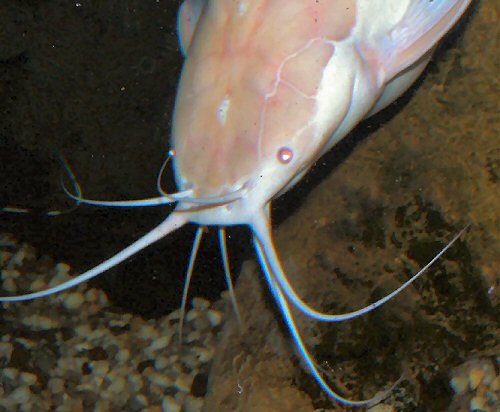

If you would like to contribute an article, please e-mail me. You will of course be credited for your work.
If you would like to donate any denomination of money to the site just click the above link button. All proceeds will go to running the site and hopefully to keep it going for a few years yet.
Print or e-mail this article below


