SCOTCAT.COM
your internet guide to all things catfish
| Extreme Catfish |
by Garold W. Sneegas & Dean A. Hendrickson, Ph.D. |
The Balcones Fault Zone is a complex system of limestone strata (Edwards Limestone Formation) that has been fractured and eroded over time by geological forces. Water travels not only through numerous cracks and fissures but also through massive underground caverns, streams and rivers. The limestone strata slopes towards the Gulf of Mexico. In northern Bexar County the limestone formation is exposed on the surface. In the southern part of the county the formation is 3,000 feet underground. San Antonio's water supply comes from an area of the aquifer known as San Antonio Pool and is considered the "Good Water" zone. South of the Balcones Fault Zone lies the Gulf Coastal Plain which contains anaerobic, saline and sulfurous groundwater known as the "Bad Water" zone. Water from both zones meet and mix in a line that roughly parallels Interstate Highway 35. Blindcats reside along this narrow mixing zone and may be dependant on the unique environment created at the mixing point of these two zones. No one knows for certain how the blindcats colonized the aquifer. One theory suggests that during the last ice age surface ancestors of the widemouth and toothless blindcats, invaded cavities to escape cold temperatures. Over time they adapted to life deep underground; adaptations and identifying characteristics include no eyes, no pigment and no swim bladder. The swim bladder has been replaced with a mass of adipose (fatty) tissue believed to be an adaptation to the great hydrostatic pressure encountered at the depths they inhabit. Other adaptations include more highly developed sensory systems, lower metabolic rates, smaller body size (2 to 4 inches) and longer life cycles. The widemouth blindcat is the top predator of the aquifer and is believed to have a common ancestor with Pylodictis olivaris, the flathead catfish. It has a similar head shape, strong jaws and well developed teeth. The lateral line is well developed and there are also numerous well developed lateral line pores covering the head. The barbels are also large and well developed. The widemouth blindcat probably relies heavily on it's well developed barbels and lateral line system to obtain food. Stomach contents examined from the few specimens available, contained decapods, amphipods and isopods. It is also believed that the widemouth blindcat probably preys on the toothless blindcat.
Satan eurystomus
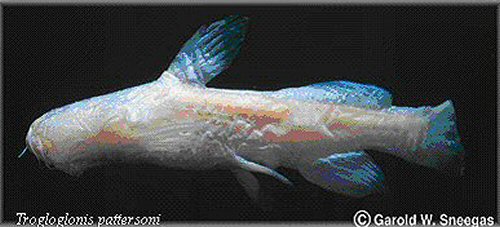
The toothless blindcat is the most specialized catfish known. It's closest surface relative is Ameiurus melas, the black bullhead. It has evolved a unique suckermouth with papery thin jaws and no teeth. The upper lip has modified parallel folds of soft ridges. The lower lip is small and turned into the mouth. No other catfish has this type of mouth. The lateral line system is not as well developed as the widemouth blindcat's system. The olfactory senses of the toothless blindcat however are more developed. Nostrils in the toothless blindcat are larger and the anterior nostrils have a specialized flap that enhances water flow. Black bullheads have taste buds, cells with cilia (short hair-like extensions) covering their external skin. Microscopic examination of the toothless blindcat's skin revealed a densely packed covering of taste bud cells. The external skin of the widemouth blindcat lacks these cells. The toothless blindcat probably feeds on dead or dying invertebrates and a fungus commonly found in the Edwards Aquifer.
Trogloglanis pattersoni
The extreme inaccessibility to the blindcats habitat in addition to water quality monitoring by state and federal agencies, has protected the habitat of these two unique species. The biggest threat to the blindcats is probably over-pumping the aquifer beyond its' recharge capability. Drawing down the aquifer could cause the sulfurous "Bad Water" zone to encroach into and replace the "Good Water" zone. Prior to 1978 the scientific community had only three specimens each of these two species. In 1977-78 a survey of the Bexar County groundwater fauna was conducted by Glenn Longley and Henry Karnei. Since their survey little work has been done on either species. Access to many of the known sampling sites has been limited by low flow rates of artisan wells and denied access to previous collecting sites by current land owners. Hopefully, at some point in the near future, scientists will again be able to study these "extreme" catfish |
 elow
the city of San Antonio Texas lies a vast aquifer known
as the Edwards (Balcones Fault Zone) Aquifer. Two rare
and unusual catfish reside in the aquifer, Satan
eurystomus, the widemouth blindcat and Trogloglanis
pattersoni, the toothless blindcat. They are the
only known troglobitic catfish in the United States.
The only specimens of both species ever collected have
come from deep (1,200' to 1,500') artesian wells within
the city of San Antonio itself and parts of southern
Bexar County.
elow
the city of San Antonio Texas lies a vast aquifer known
as the Edwards (Balcones Fault Zone) Aquifer. Two rare
and unusual catfish reside in the aquifer, Satan
eurystomus, the widemouth blindcat and Trogloglanis
pattersoni, the toothless blindcat. They are the
only known troglobitic catfish in the United States.
The only specimens of both species ever collected have
come from deep (1,200' to 1,500') artesian wells within
the city of San Antonio itself and parts of southern
Bexar County. 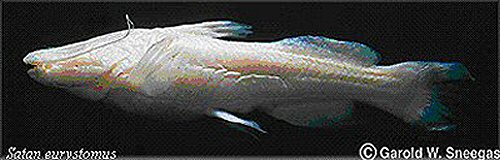


If you would like to contribute an article, please e-mail me. You will of course be credited for your work.
If you would like to donate any denomination of money to the site just click the above link button. All proceeds will go to running the site and hopefully to keep it going for a few years yet.
Print or e-mail this article below


