SCOTCAT.COM
your internet guide to all things catfish
| Breeding Corydoras elegans Steindachner 1877 |
by Allan James |
Corydoras elegans - pair, female to left
Corydoras
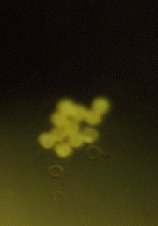
elegans - eggs I picked out two pairs of this species from a friends collection, noting particularly that one of the females was quite heavy. After getting them home I put them into an 18in x12in x 12in tank which I use for breeding Corydoras, with small rounded pea gravel, java moss and a sponge filter. I fed my usual foods, flake, tablets, daphnia and bloodworm (live and frozen). After about a week I added a powerhead for extra aeration and started with cool water changes about twice a week. Three weeks after obtaining them, they spawned for me, with the eggs being laid on the tank sides and the java moss. The eggs were surprisingly small, being so used to the larger eggs of C. metae, panda and davidsandsi, I had quite forgotten that the Elegans Group are decidedly smaller. I had spawned C. napoensis about six years ago and I was interested to see if they were similar, so I looked up my notes and indeed they were, with the females of both species carrying about six eggs in their ventral fins, and being of the same small size. I usually take the eggs away, but there were so many of them and being so tiny, I decided to take the parents out instead, I also switched off the powerhead and they took four days to hatch at a temperature of 78F. The fry disappeared into the gravel, so I left them for two days then started to feed Liquifry No 1 for about three days, as the fry were very small. I then upped the feeding to Egglayer Fry Food and microworm. The kittens at ten days old are about 6mm long (TL) with a dark head and four spots along the lateral line and at four weeks old the spots join up to form a black line. At this moment in time they become a little more adventurous, swarming over the gravel and java moss looking for food. I ended up with about forty young. One thing I did notice about the adults was the females dorsal fins being a bit ragged suggesting that the males were being aggressive at spawning times although I never noticed anything during my observations, maybe some readers of this article could throw a little light on this. For the record, the pH of the water was 6.5 and a General Hardness of 1.
 |
 his
species is the type species of the Elegans Group, which
involves most of the dwarf Corydoras. Sexing
this species is relatively simple as the adults are
dimorphic with colouration being the main point, and
the males are more ornately patterned and have also
reticulations on the dorsal fin, while the dorsal of
the female is usually clear.
his
species is the type species of the Elegans Group, which
involves most of the dwarf Corydoras. Sexing
this species is relatively simple as the adults are
dimorphic with colouration being the main point, and
the males are more ornately patterned and have also
reticulations on the dorsal fin, while the dorsal of
the female is usually clear.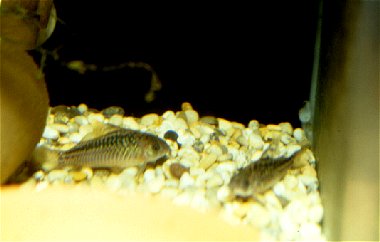

If you would like to contribute an article, please e-mail me. You will of course be credited for your work.
If you would like to donate any denomination of money to the site just click the above link button. All proceeds will go to running the site and hopefully to keep it going for a few years yet.
Print or e-mail this factsheet below


