SCOTCAT.COM
your internet guide to all things catfish
| The Big Tank Buster Debate |
by Daphne Layley |
Pseudodoras niger sitting astride a Red-tailed Catfish
Nevertheless it begs several questions, firstly - was the customer told how big it would get when he bought the fish? Assuming he or she got it from a shop, did the staff warn him of it’s potential size and check that it’s housing requirements would be met; and then did he buy it anyway, assuring them that he could provide a huge tank for it? In that case the retailer was not to blame but the customer was. Or secondly - was it just a simple ‘cash for fish’ transaction with no questions asked by either side? In that case the customer was to blame for not asking the relevant questions but the retailer was also to blame through either ignorance of his stock or the lure of a fast profit with no thought of the fish’s welfare. Or thirdly and worse still - did the customer ask and was he told that ‘Yes – it is perfectly OK for a 3 foot long community tank’? In that case not only was the retailer definitely to blame but also he should have his competence as a pet trader critically scrutinised by the appropriate authority and, if I had my way, his licence would be revoked. This is just one of many similar instances but the questions which I have applied to the above scenario, could and should be applied to all these cases which we are hearing about, and the truthful answers, if only it were possible to get at them, wouldn’t make pleasant listening. As in most aspects of life, it is the few who bring disrepute to the majority, and this sad subject is no different. There are many experienced fish keepers out there who love and specialise in large fish (not always but quite often large catfish) and who have enormous tanks and tropical ponds and equally large filtration systems to match and I am lucky to count myself amongst them. Very often, these fish become almost members of the family and are spoilt rotten, becoming tame and living many years longer than perhaps they would in the wild, where they have to run the gauntlet of even larger toothy predators, natives with harpoons and hungry children to feed, and the drying out of their natural habitat if the seasonal rains are late. Some of these species, those which attain a maximum length of perhaps two feet, are often slow moving and sedentary fish who display a certain degree of intelligence or at least learn to recognise and respond to their human keepers, and are reasonably easy for the experienced enthusiast to cope with, provided all the criteria necessary for their welfare are met in a generous and humane fashion. These slightly smaller “biggies” such as Tinfoil Barbs, Oscars, Jaguar Cichlids etc. to name but a few, can still prove problematical to the unwary novice. These all look really cute in the shop when they are two inches long but they don’t stay that size very long, and if you haven’t done your homework or if the retailer doesn’t warn you, you’ll soon have big trouble in little tanks! As I said before, in the hands of experienced fish keepers who have big tanks and filters, these smaller tank busters, and others like them can make excellent pets and it is not really these species, or their devoted keepers, that this article is aimed at. However, we all know our limitations and there are some fish that even the most dedicated and well equipped of us would not dream of trying to keep because it is just not practical and, more importantly, not fair on the fish. There are always exceptions, and there is bound to be at least one lottery-winning reader out there who has a tropical pond the size of an Olympic swimming pool. But for the vast majority of us, some species which are probably best left alone include Giant Pacu, Pangasius and Channel Catfish, ultra large Pimelodid, Bagrid, Clarias and Silurid Catfish, Red Snakeheads, Arapaima, large Tiger Fish, some giant Cichlids, Giant Gouramies, extra large Barbs such as Lemon-fins etc. etc…the list goes on!
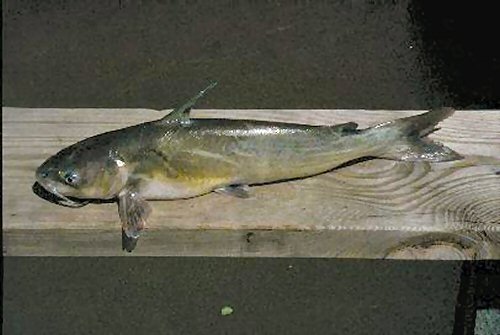
Ictalurus punctatus - Channel Catfish
However, there are a few sad souls out there who, for a variety of reasons, have the need to keep very large, predatory, dangerous looking animals, fish or reptiles with often exaggeratedly fearsome reputations, in totally unsuitable sized cages or aquariums in their living rooms just as status symbols to impress their gullible friends and to make them think they must be very macho and powerful to possess such beasts. Perhaps, if they were dog owners instead, it might be Pit Bull Terriers… When the friends finally get bored and the novelty wears off, the poor creature is off-loaded, either by being advertised or offered to a shop (if one can be found that will take it) or, if it’s not so lucky, released in a dark place such as the local pond, canal, or woodland at the dead of night (ref: first paragraph). They are the sort of people whose irresponsible and often downright cruel actions spoil things for the rest of us, and they are the sort of people who shouldn’t be allowed to buy these animals. But how can the concerned retailer be sure which customers are bona-fide enthusiasts and which ones aren’t, and therefore who should they refuse to sell a baby tank buster to? More importantly, what can be done about those retailers who don’t care either way providing a nice wad of crisp twenties is waved under their nose - it happens! These shops are most definitely in the minority, but we must not let the few spoil it for the rest. The vast majority of shops are extremely reputable and I know of many who will put a potential customer through an intensive barrage of questions about tank size, filters, etc., and even then refuse the sale if they are not satisfied with the answers they are given. These shops do this voluntarily and are quite prepared to lose the sale of a fish costing perhaps many hundreds of pounds for the sake of the fish’s welfare and the shop’s own reputation. This is a very commendable attitude but, as I said, it is the retailers choice - so far the ‘vetting’ of a potential customer by a shop is not the subject of any legal obligation, only perhaps a moral or ethical one! I went recently, incognito, into a branch of Maidenhead Aquatics and pretended to be interested in buying a large Red-Tailed Catfish that was on display. I deliberately asked some pretty dumb questions after which I found myself being comprehensively interrogated by a member of staff who eventually said that they would not consider the sale, until one of the staff had paid me a house visit to inspect the aquarium and filtration system which I proposed to use for the fish. I was so impressed by this that I contacted the manager and congratulated him on his policy. Another shop with exemplary ethics regarding the sale of tank busters is Wharf Aquatics in Nottinghamshire who also have much more thought for the welfare of the fish they sell than they do about laughing all the way to the bank. These are just two of the vast majority of our shops who do the right thing, but we all know a few who don’t; let’s hope some of them are reading this! So, I have talked about the rights and wrongs of the customer and also of the retailer but there are other factors to be considered. For instance, what happens when a retailer orders certain fish from the wholesaler’s list only to find, upon delivery, that the ordered fish are out of stock and have been substituted by another species? For example I know of a shop that recently ordered some small Asian Mystus catfish only to find that they had been replaced with another Bagrid, the Giant Indian River Catfish, Sperata (Aorichthys) aor, a voracious predator with a potential length of over seven feet. What would we expect the retailer to do in such a case? Why, jump on the telephone to the wholesaler of course, but that does not help the fish, does it? Assuming that the fish, however unwanted by the shopkeeper, had been in the bag for several hours and were already stressed, should they be sent back to the wholesaler and endure another several hours of stress and perhaps arrive back already dead or dying? Or should the retailer try and make the best of a bad job and put them on display in the shop with a warning note to customers saying that when mature, this fish will be seven feet long, whereupon it will be capable of eating cats, dogs and small children?
Sperata (Aorichthys) aor - Giant Indian River Catfish
If there were legislation to restrict the import of certain species, how would it be implemented? Could the relevant authorities employ enough people with enough specialised knowledge to be able to identify and distinguish one small brown fish from another, in a bag of many similar ones, as they are unloaded off the plane? I personally don’t think so. Even if they could, what would happen to the illegal species in the shipments? – our zoos and public aquariums are already overstocked. So, would the offending fish have to be killed – after all, they could hardly be sent back, could they? There is yet another angle to this – many of the largest and most spectacular species are becoming rare in their natural habitat, some to the point of near extinction. There are many reasons for this – deforestation to make way for roads, crops or grazing farm animals, dam building, pollution and the aquarium trade to name but a few. The indigenous peoples have caught and eaten these fish for thousands of years but they only take what is needed for the cooking pot and they realise the importance of preserving some adult breeding stock. After all, one does not kill the goose that lays the golden eggs! The aquarium trade however, did not seem so concerned with maintaining the status quo and the indiscriminate capture of, for example, sexually mature Amazonian Red Tailed Catfish over the last few decades has resulted in the disappearance from many areas, of the really large specimens that used to breed there. Recently the authorities have started to realise their mistakes and this species (and many others) are now being artificially bred in the Far East from where today’s aquarium specimens come. Surely this is like ‘closing the stable door after the horse has bolted’. If there had not been such a demand, twenty or so years ago, for this species of tank buster (and others like it), perhaps more of those big mature females would still be breeding out there in the Amazon – here I must hold my hand up and admit to buying an eighteen inch long specimen twenty-plus years ago and, thinking back, it was obviously wild caught. But hindsight is a wonderful thing, so they say, and if my actions in those days, along with others like me, contributed to the decimation of that magnificent species in the wild, then I can only say how much I regret it now and wish that I could put the clock back. Thank goodness, in a way, that they can breed them artificially now – at least the species will not die out completely – but instead of supplying the world’s aquarium trade with thousands of 3 inch long baby Red Tails, which will doubtless grow up to be the next generation of tank busters, I would like to see some of them be restocked back into the Amazon from whence we took their predecessors, all those years ago. Maybe there is something like that already happening – I don’t know but I’d like to think so. And so we go round in circles; even if legislation were applied to limit the import of certain tank busters, some specimens would always sneak through in the guise of something smaller and more community-compatible, although others, more easily identifiable, would be lost to true enthusiasts forever. As a lifetime devotee of big catfish, I know I would be cutting my nose off to spite my face if I campaigned to stop these tank busters being sold completely, but I would like to see their sale controlled and perhaps, limited to large displays and public aquariums and only to individuals who were licensed and approved by an authoritative body. That is not as daunting as it sounds – I hold a DEFRA licence to keep certain species of coldwater fish and it cost me nothing but I had to prove that I had adequate facilities and a good reason for wanting to keep the species concerned. I realise that this is a very emotive subject and I shall probably receive some fairly vociferous replies from both sides of the divide, but I feel that it had to be said, and it’s long overdue. After all, you don’t go into the kitchen if you can’t stand the heat! In
conclusion, on the grand scale of things, trying to
stop beautiful and exotic fish from being dumped in
a cold canal is far much more important than one person’s
(arguably) slightly selfish hobby. Photo
Credits:
|
 colleague
of mine who worked for the Environment Agency had a
call from a member of the public who said that there
was a large strange-looking fish dying by the bank of
the local canal. My friend and his assistant found the
fish, which was just about dead. It measured over 3
feet long and eventual identification confirmed the
fish to be an Oxydoras (Pseudodoras)
niger. Someone must have bought this large
Dorad as a baby, perhaps oblivious to its potential
size; they must have fed it well and, like Topsy, it
just grew and grew. When they finally could not house
or cope with it any longer they dumped it into the cold
waters of the canal. The fact that such a beautiful
and gentle creature should have endured such an awful
death does not bear thinking about.
colleague
of mine who worked for the Environment Agency had a
call from a member of the public who said that there
was a large strange-looking fish dying by the bank of
the local canal. My friend and his assistant found the
fish, which was just about dead. It measured over 3
feet long and eventual identification confirmed the
fish to be an Oxydoras (Pseudodoras)
niger. Someone must have bought this large
Dorad as a baby, perhaps oblivious to its potential
size; they must have fed it well and, like Topsy, it
just grew and grew. When they finally could not house
or cope with it any longer they dumped it into the cold
waters of the canal. The fact that such a beautiful
and gentle creature should have endured such an awful
death does not bear thinking about.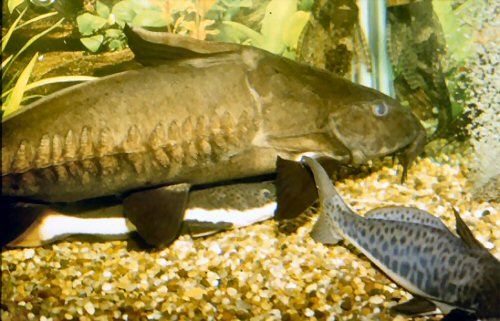


If you would like to contribute an article, please e-mail me. You will of course be credited for your work.
If you would like to donate any denomination of money to the site just click the above link button. All proceeds will go to running the site and hopefully to keep it going for a few years yet.
Print or e-mail this article below


