SCOTCAT.COM
your internet guide to all things catfish
| Synodontis katangae |
by David Marshall |
Introduction
A couple of days later I paid a visit and was able to view this 'new' Synodontis while it was still in the shop. As I have an extremely keen interest in these fish I became excited as to the identity of this particular individual but did not tell Martin exactly what my instincts had told me. I wanted to have the chance to verify this initial recognition through textbook pictures and photographs.
Synodontis katangae
It did not take long for me to get in touch and, after phoning Kevin Webb to check that this Synodontis had small eyes and banding to the tail, confirm with Martin that we had a Synodontis katangae in our midst and that this was the first S. katangae, as far as we know, available to aquarists in the Ryedale area for at least 30 years - if ever. Aquarium care Martin now tells us how this fish is kept:- The S. katangae was placed into a 36"x12"x15" aquarium. This tank is filtered by a Rio Power Filter. I try to keep the pH at 7 but sometimes this, despite my best efforts, does fall and this affects the katangae by making his eyes go distinctly cloudy. Thankfully a quick water change soon puts this right. Although active, I have found the S. katangae to be a peaceful species which lives quite happily in the company of Golden Australe killifish and various Betta species (including Betta picta). He enjoys the peace afforded by a bogwood cave and is an avid consumer of bloodworms. Over the past few months, as David and Kevin will testify, the katangae has put on a good rate of growth. In order for some photographs to be taken I gave the katangae his first 'show bench experience' at the recent Ryedale A.S. Open Show.
Martin and David at the Ryedale A.S. Open Show
Natural History Synodontis katangae is found in the Congo River basin with the largest population occurring in the Luombwa River system of Angola. The largest known specimen had a body length of 240mm. The pectoral fin bones of katangae are said to resemble thick boomerangs. The background body colour goes through a small number of 'life stages' and in adults is light grey-purple. I have seen drawings and photographs of S. katangae that show fish with neat rows of tiny spots upon their bodies, others showing fish with up to18 large black spots spread over their bodies, whereas katangae like Martin's have a much lower number of body spots that are 'bunched' towards the caudal peduncle.. Perhaps the spotting, as in Synodontis zambezensis, changes with age?
Caudal markings of S. katangae
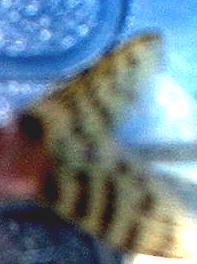
Living specimens are often confused with both Synodontis ocellifer and Synodontis ornatipinnis. To tell the difference between S. katangae and S. ocellifer look at the caudal peduncle, as in katangae you find a bar, which is absent in ocellifer. Also look at the eyes, which in katangae are much smaller. The confusion with ornatipinnis comes through their identical body structures and eyes, but S. ornatipinnis has a zebra-patterned body as opposed to spots. The caudal pattern of S. katangae is also slightly different from that of the other two species. As a river-living Synodontis, reproduction takes place during the rainy season, when rivers flood out into grasslands creating ideal conditions for extra food resources for adults, and microscopic foods for their fry to gorge upon. The majority of riverine Synodontis scatter dark coloured eggs among the vegetation with the hatchling fry left to fend for themselves. The observations that Martin
makes will add to our knowledge of this little-studied
species. |
 everal
months ago a 'mixed bag' of wild caught Synodontis
species arrived at the Petland aquatic retail outlet
at New Earswick (a suburb of York). Martin, whose family
owns the outlet, was 'first on the scene' as these fish
arrived and put aside a beautiful crème coloured
little Synodontis to take home for his own
aquarium.
everal
months ago a 'mixed bag' of wild caught Synodontis
species arrived at the Petland aquatic retail outlet
at New Earswick (a suburb of York). Martin, whose family
owns the outlet, was 'first on the scene' as these fish
arrived and put aside a beautiful crème coloured
little Synodontis to take home for his own
aquarium.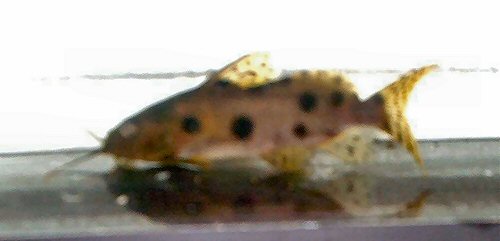


If you would like to contribute an article, please e-mail me. You will of course be credited for your work.
If you would like to donate any denomination of money to the site just click the above link button. All proceeds will go to running the site and hopefully to keep it going for a few years yet.
Print or e-mail this article below


