SCOTCAT.COM
your internet guide to all things catfish
| A Brief History of My Life : Part 1 - A Magnificent Catfish |
by Daphne C. Layley |
My world temporarily ended when it died, and it’s solemn burial in the garden in a little cardboard box lined with cotton wool and toilet paper, was accompanied by hoots of derisive laughter from my older brother and floods of tears from me…
Ameiurus melas - Black Bullhead
So
ignorant Christmas brought me a ’Montrose Minor’ air pump and a tiny booklet on fish keeping called ‘Ditchfield’s Little Wonder Book’ (which I still have) and thereafter the fishy funerals became less frequent. That was just over 50 years ago and during all the intervening years – ponies, teenage traumas, acne, the “birds & the bees”, boyfriends, mini-skirts, mascara, the Rolling Stones, Bob Dylan, vodka & lime, cigarettes, flower-power, marriage, divorce, re-marriage, motherhood and grand motherhood, I can honestly say that I have never been without at least one aquarium and one catfish! Fortunately for the fish, we now have modern technology and I realize how lucky I am when I stand in my fish-room and look around at all the high-tech gear, computerised gizmos and self-priming wotsits that keep my tanks and their inhabitants clean, happy and healthy. A
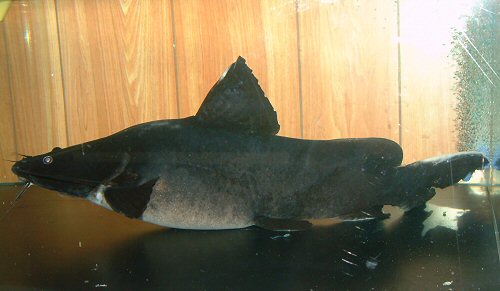
long-term obsession For me, this fish is the absolute ultimate symbol of both beauty and evil in equal proportions. Its body is a stunning, velvety jet black with just a white flash on the top and bottom rays of the caudal fin. However, it’s the eyes that are really spooky – they are like little crystal balls and you get the feeling that you can see right through them and also, scarily, that they can see right through you! Not many freshwater fish have eyes like this, but anglers will know that Zanders’ eyes are the same. Wherever I go in my fish room, they watch me. Where H. wyckii are found, they are called the Crystal Catfish because of their eyes, and the people of the region regard them with a mixture of superstition and awe because they believe that the fish are inhabited by the spirits of their ancestors.
A
little Angel ? - I think not ! Needless to say, this is not a fish to be treated casually and, particularly with large specimens, all in-tank maintenance requires 100% attention if an accident is to be avoided. By large, I mean anything over 12 inches (30cms) and, although various catfish books give differing maximum sizes, the largest specimen I have owned measured 24 inches (60cms) from snout tip to caudal fork. This fish, named Pagan, eventually became quite famous and was originally obtained for me, in the early 1980s, by Dr. David Sands, to whom I shall be ever grateful as no one else in the country could get one at the time. Landscape
artist Water should have a pH of 6.8 – 7.2 and should be regularly monitored for any increase in nitrite or ammonia levels due to the type of food and subsequent excreta. Temperature should be about 75F or 24C and water changes of 20% should be carried out at least every 2 weeks, but more often if necessary. Be prepared to pay about £60 for a 6inch (15cm) specimen and much more for a larger one. It goes without saying that this fish must be kept as a solitary specimen.
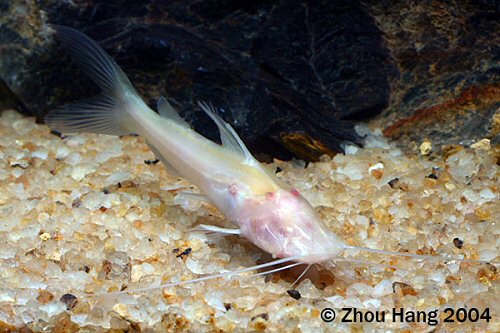
Hemibagrus (formally Mystus) wyckii - albino specimen
This is a beautiful creature but not one for the faint-hearted. You must be 100% dedicated and you must think hard before buying one. If you cannot meet all of the criteria for its welfare as outlined above, please leave it in the shop. I personally don’t believe that we ever really “own” these fish, we are just lucky enough to be guardians of them for the duration of their lives with us and it is incumbent upon us to do our best for them and to give them the quality of life they deserve. My thanks must
go to Chris Ralph of The Southern Counties Catfish Rescue
Society, Richard Hardwick of Wharf Aquatics, Nottinghamshire,
and to Dr. David Sands for their help in the preparation
of this article. Photo
Credits: Top
& Middle : © Allan
James @ |
 n
my sixth birthday, a dear and well-meaning aunt (who,
with the benefit of hindsight had a lot to answer for,
but to whom I shall be eternally
grateful), gave me half-a-crown (12½ new pence)
and told me to go along to the local pet-shop and buy
a goldfish as a present. At the shop, the goldfish did
nothing for me compared with the wonderful little creature
that lurked at the back of the aquarium. It was about
2 inches long and looked like a black tadpole with whiskers.
The label read “Scavenger – 1/9d”.
To me, it was the most beautiful and fascinating thing
I had ever seen and, needless to say, it was soon resident
in a small angle-iron tank in my bedroom, and it rapidly
became the sole object of my attention and affections.
I was even happy to be sent to bed early because of
some minor misdemeanour in order to watch it swimming
about in the half-light. The only food you could buy
were dried ants’ eggs, which it ignored; but it
never refused the earthworms that were dug up from my
father’s vegetable patch!
n
my sixth birthday, a dear and well-meaning aunt (who,
with the benefit of hindsight had a lot to answer for,
but to whom I shall be eternally
grateful), gave me half-a-crown (12½ new pence)
and told me to go along to the local pet-shop and buy
a goldfish as a present. At the shop, the goldfish did
nothing for me compared with the wonderful little creature
that lurked at the back of the aquarium. It was about
2 inches long and looked like a black tadpole with whiskers.
The label read “Scavenger – 1/9d”.
To me, it was the most beautiful and fascinating thing
I had ever seen and, needless to say, it was soon resident
in a small angle-iron tank in my bedroom, and it rapidly
became the sole object of my attention and affections.
I was even happy to be sent to bed early because of
some minor misdemeanour in order to watch it swimming
about in the half-light. The only food you could buy
were dried ants’ eggs, which it ignored; but it
never refused the earthworms that were dug up from my
father’s vegetable patch!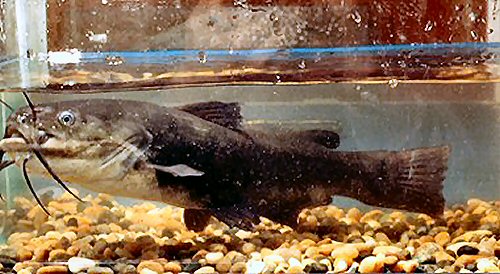
 -
Bottom: ©
Zhou Hang
-
Bottom: ©
Zhou Hang

If you would like to contribute an article, please e-mail me. You will of course be credited for your work.
If you would like to donate any denomination of money to the site just click the above link button. All proceeds will go to running the site and hopefully to keep it going for a few years yet.
Print or e-mail this article below


