SCOTCAT.COM
your internet guide to all things catfish
| My Breeding Experience with Ancistrus sp. L144 |
by Knut Kjesbu |
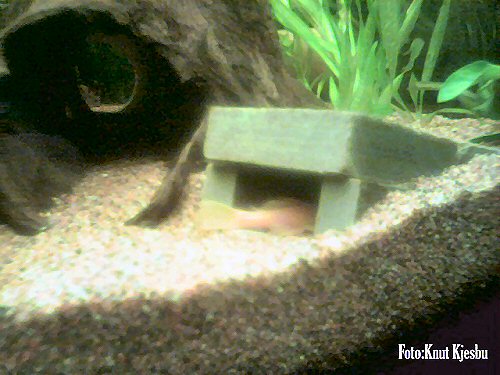
It only took a cold water change with more or less the same hardness to get them going. The first attempt took place in a cave I made for them out of slate. (see pic above). The
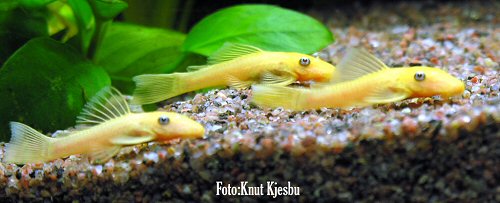
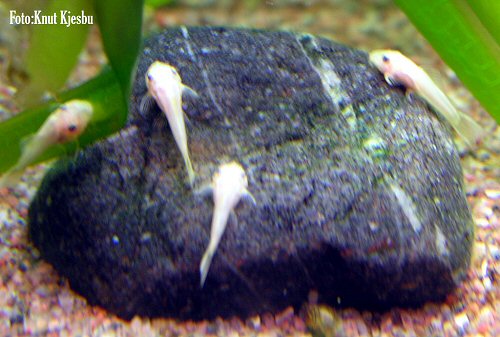
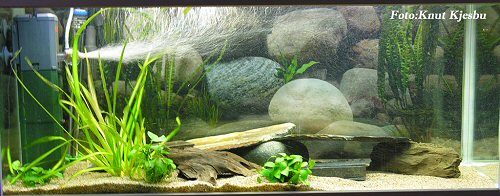
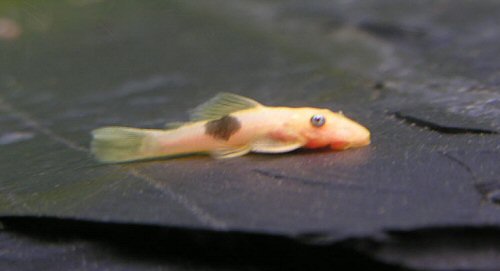
first spawn: At the same time I was considering selling the 6 angelfish since the likelihood of them spawning was slim. The 6 were sold late one afternoon in Dec 2004, and the very next day when the light came on I saw fry all over the tank, on the wood, on the plants and on the glass, in eager search for food. At this time an internal circular pump was added, pumping 2000 L/h. To me they looked like they were about 1 month old, and I could not count them because there were so many of them. Under normal circumstances they would have left the cave 2-5 days after the yolk sack had been absorbed, but the presence of the angelfish had most likely had the effect that the male had kept them in his cave until it was safe enough for them to leave. An obvious conclusion of this is that the male is a good father who is capable of knowing the level of danger before letting his fry out of the cave. Of all the fry from the first attempt only 8 survived. In the tank it was unknown how many they were from the start. The main reason of this loss was the lack of food. Water values in the 92 US gallon tank (350 liters): Ph: 6,5-6,8 Ext filter with a turnover of 1200 L/H and circ. pump 2000 L/H going at half its capacity. (Max 9,14 its Volume)# The picture below show three out of seven from the first breeding attempt. At two months old they were 2 cm in size, aren’t they cute?.
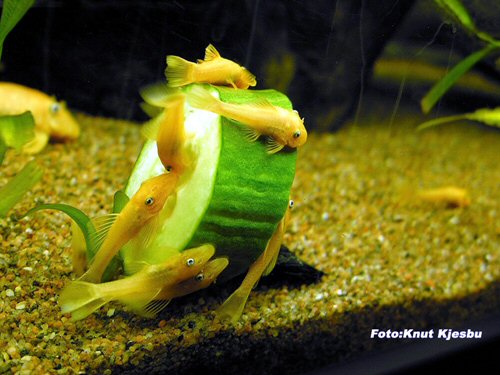
Second breeding attempt: The second breeding attempt was also in the 92 US gallon tank (350 liter), but this time in another cave made by Dr Gribb (user name in Nowegian forum) which was added two days prior. Now the whole spawn left the cave 7-11 days after the hatch, this time most of the fry got lost in the tank due to lack of food. The first month the fry have a rather whitish colour, the yellow colour developed after 4 weeks, those who stay white, or get whiter will eventually die.
The third
spawn: The next day I got my superstition confirmed, all the way inside was the male who was fluttering quite hectic over the eggs. The male did so for 5 days until the eggs hatched. The fry nurture on the yolk sack in 4-5 days. On the fourth day the male was seen outside the cave and then further and further away from the cave. I chose to remove the third and fourth spawn 1-2 days after the yolk sack was used up. The reason for this was I suspected the survival rate would increase by putting them in a tank by themselves. I used water from the main tank, and they did grow faster. Although I lost fewer fry this way, the male gets a little upset when I remove the fry, he hides behind the heater for a week or so, and is anxious of any movement in front of the tank, so moving the fry is not recommended. A 45 L tank was already been put up for them. This is based on personal experience. Each time I counted while I moved them I ended up with over 40 fry all together.
Water
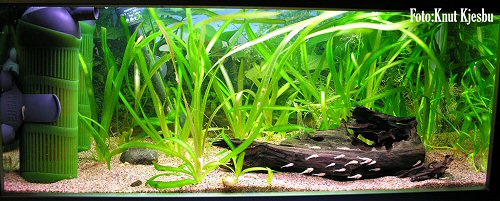
values in the 42 US G tank (160 liters) Ext filter with a turnover of 700 L/H + internal filter 1200 L/H (about 12 times)
Grow out tank 11 US G (45 liters) Ph: 7,1 One Eheim aquaball 2212 with a turnover at 650 L/h and one Eheim aquaball 2208 with 480 L/h (25 times its volume) The pair’s offspring was kept in this little 11-gallon tank with the measurements 60cm x30cmx25cm, with 2 15W T8 tubes. In order to promote algae growth I left the lights on for 14 hours, since algae is a good nutrient, beside that they were only fed crushed tetra tabimin and Sera vipachips. The 11 gallon tank consist of today of 65+ fry, who were moved back in with the parents after 2 months. The fourth spawn consisted of 25 fry + those 3 fry he threw out just after the hatching.
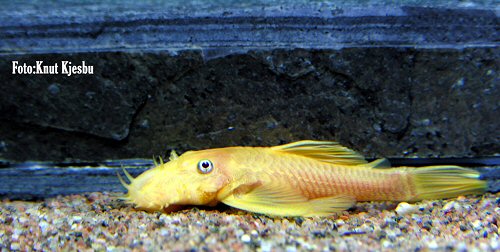
Deviation: Some of the fry I got were born with a brown spot. Some had it on their back, pectoral fins, and nose. I only know of 2 breeders who have experienced this phenomenon. After I inquired about this in a foreign forum, came the confirmation that this has happened to others. The reason for is this a single amelanistic male which was exported from Paraguay and was spawned with the normal coloured female and later bred back with his own daughters to fix the mutation. Amelanistic is an absence of dark colored pigments that results in a tan / yellow colored fish (as in L144) with normal coloured eyes. Now after 8 spawns
of this pair I would say they are rather easy to spawn,
just as easy as the regular Ancistrus species.
Photo Credits: by Author
|
 n
the fall of 2004 I bought a mature male and female.
They had a size of 6-7 cm. none of these had bred before.
They were put in a community tank on 92 US gallon tank
(350 liter); together with 6 wild caught angelfish,
Pterophyllum altum, and 6 wild caught Corydoras
duplicareus. The only filtration the first 2 months
was an external filter with a turnover of 1200 L/H.
It took them exactly 2 months from they were introduced
to their first spawn.
n
the fall of 2004 I bought a mature male and female.
They had a size of 6-7 cm. none of these had bred before.
They were put in a community tank on 92 US gallon tank
(350 liter); together with 6 wild caught angelfish,
Pterophyllum altum, and 6 wild caught Corydoras
duplicareus. The only filtration the first 2 months
was an external filter with a turnover of 1200 L/H.
It took them exactly 2 months from they were introduced
to their first spawn.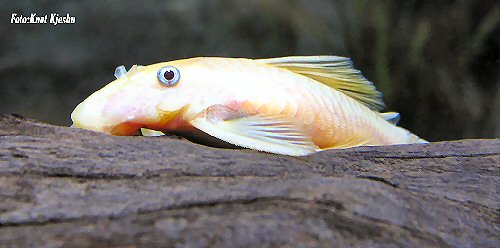

If you would like to contribute an article, please e-mail me. You will of course be credited for your work.
If you would like to donate any denomination of money to the site just click the above link button. All proceeds will go to running the site and hopefully to keep it going for a few years yet.
Print or e-mail this article below


