SCOTCAT.COM
your internet guide to all things catfish
| Pair behaviour of the “Walking Catfish”, Clarias batrachus |
by Wolfgang Ros |
Formation
as pair with evidence of sexual maturity
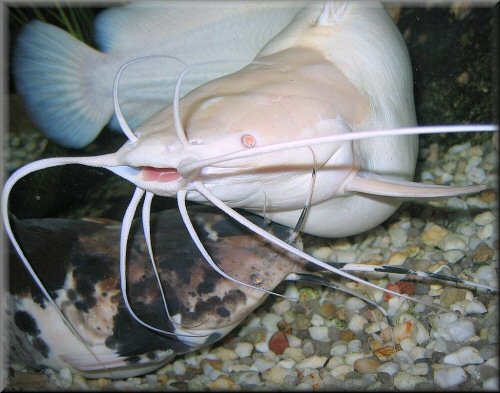
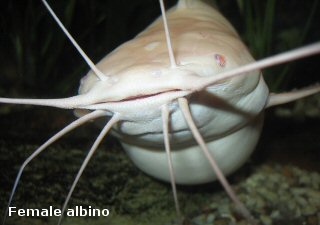
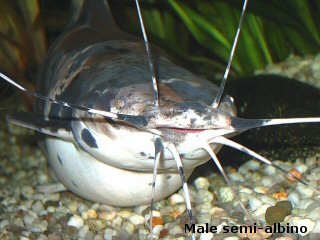
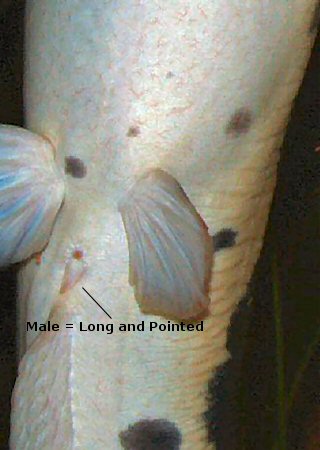
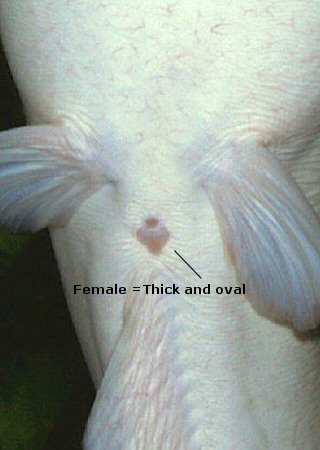
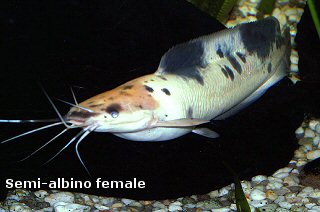
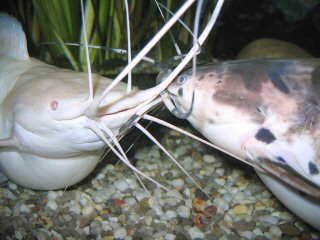
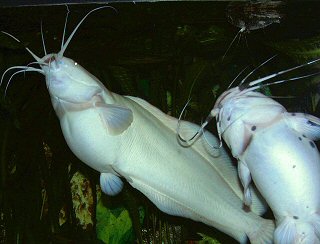
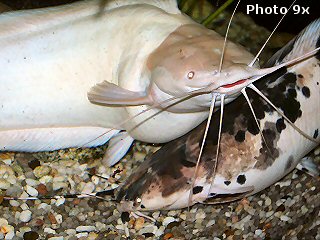
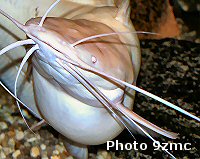
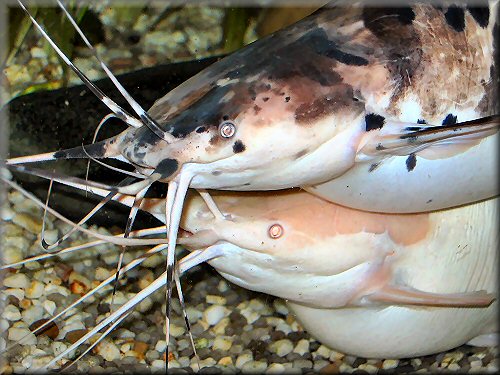
Depending on feeding they can reach this mark after 18 months but already they had exceeded that size. Some months after I had bought my fish (I had bought three originally) it was observed in my tank, the start of sexual maturity. After some tests of strength, courting and mutual pursuing, the present pair finally formed. How the following comparison shows, the sexes can be differentiated with medium sized animals externally: So it is noticeable with a comparison from the front, however in particular from underneath that the body of the male (left in the picture) is altogether slimmer than that of the stronger female, by the way this outside of reproduction time, can not be seen too clearly. However if the animals have attained full growth, an adjustment takes place increasingly, so that this difference in sexes can be even more difficult to ascertain. Therefore to free any doubts the sex can be read off only from the form of the genital papilla, it is the only really secure differentiation. The genital papilla is briefly, thick and oval with the female, with the male being long and pointed at the end.
Air connection
and territorial formation
In addition, they pushed it aside at feeding times. Finally the pair was almost exclusively busy not only banishing the female conspecific from getting to close to the reproduction area, which, should become clear soon as this was to be their future spawning place. Both partners included each angle in the aquarium with their chasing, so that is to be assumed the further breeding area of Clarias batrachus clearly exceeds the mass of a 2 metres tank. Biting traces on the body of the attacked female were to be seen clearly, so that I had to give it away at last. Now the two finally
had the necessary peace to turn to reproduction. Shortly
after the disappearance of the surplus female the
pair spawned for the first time.
The animals inevitably must interrupt the common dwell phases in more or less regular intervals, in order to take up surface air.
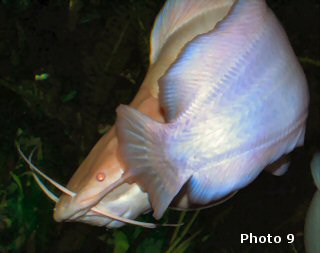
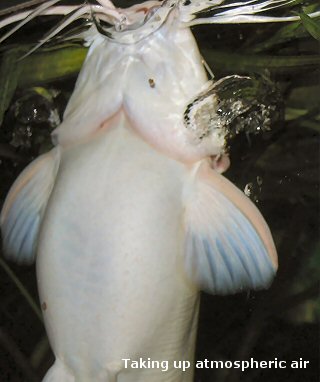
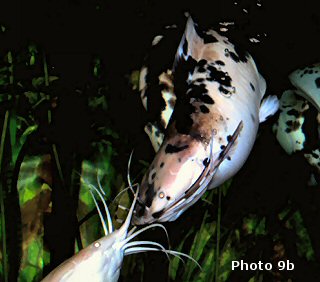
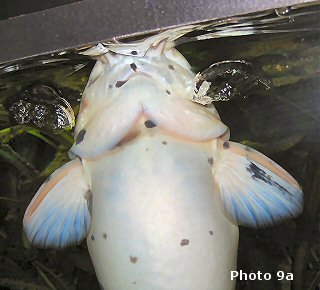
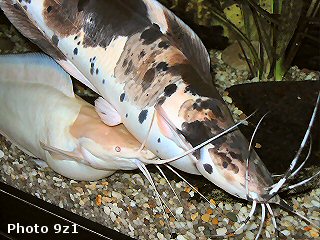
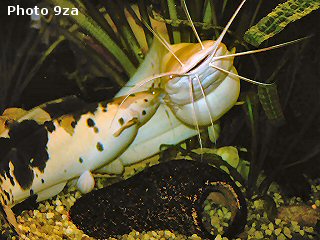
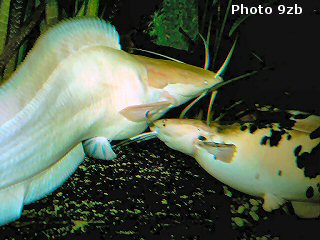
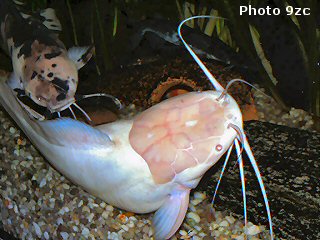
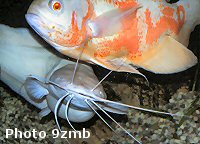
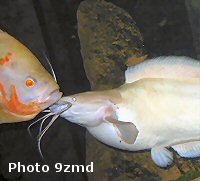
This applies also to the joint swimming phases. Dependently on the water temperature and depending upon activity, but also depending upon the mindfull condition of the catfish with heavy eating and high water temperatures to about five minutes (expressed dwell phase) and thus with my animals, approximately 25 times in one hour on average. Even here for the viewer the animals do not let there be any doubt about their characteristic pairing, since they remain together mostly. If one ascends, in order to take up air at the water surface with its additional breathing bag (in photo to left it is the female with already little opened muzzle), then it usually followed immediately by the male to the water surface. In detail this procedure runs off in such a way: After the first animal has taken up atmospheric air very fast it is to be recognized that they use up the air directly before is delivered to the gills and after filling the bags again, it rises off (photo 9). In these moments they are already ascending or already in the upper third of the aquarium, the partner likewise pushes upward (photo 9a) and complements the air supply for its part, whereupon both meet again within the lower range (Photo 9b) showing this procedure exactly in reverse.
If the catfish are at too distant from each other and if one exchanges its air supply, then this will normally be registered by the other one as well, since it also takes up immediately the surface air and then looks for the proximity of its partner. This rhythm is almost synchronous and sometimes "the getting of air" is to be particularly observed in the forefront and during reproduction time. Above all they keep going if the animals do not feel disturbed by co-inhabitants and also do not notice the owner/viewer, because in such cases they hurry immediately to their hiding place and deviate from the described breathing rhythm.
For the Clarias batrachus pair this behaviour has the advantage that by those approximate same distances when "emerging", they can remain together even in this phase, above all however they do not have to interrupt the common rest periods at the soil, like also the common swimming phases, which follow as represented, often "emerging" more frequently than necessarily. The animals probably lose themselves also in cloudy water, in which they mostly live in their natural environment, anyway not so fast, since they use their high-sensitive barbles for orientation purposes primarily also with no good viewing their small eyes would be no assistance to them! Nevertheless the probability that the catfish would need more time particularly with larger depths of water and from each other independently emerging, in order to find themselves together again thereafter, would be much larger. Instead of recent rest periods at the soil before the often still shorter sections follow the phases of taking up air, in which the animals move around likewise together in the tank. On the one hand this happens in order to look for something to eat, on the other hand this mutual playful pursuing and the body contact is made again and again, likewise it might also be good strengthening for the pair connection and in the long run be a kind of prelude to courting which can be observed before the reproduction. At the latest from this time on, also with the common swimming phases, the admission of surface air with both partners runs off predominantly nearly all at the same time. The mind and active condition of sexually mature Clarias batrachus specimens obviously change in more or less regular intervals. So it can be that the pair sometimes work very lively, another time again rather reservedly, nearly a little shy, and even in the relationship among themselves. If the time periods of the predominantly passive behaviour become shorter increasingly, those of common swimming phases respectively have an increased activity (with it an increased taking up of food is connected!) however clearly longer than this is to be rated as indications of the fact that the animals come into disposition of reproduction. The mind and activity condition and thus in the long run also the reproduction can be affected by the owner directly. Thereby it is different, with one and another coherent factors playing a role. Which steps exactly must be undertaken, in order to induce the reproduction with the “Walking Catfish” in an aquarium, can be detailed and read in the report "Releasing/causing the reproduction with the Walking Catfish", which is published in Datz 4/2006 (see chapter references / links below). Defence
of the breeding area
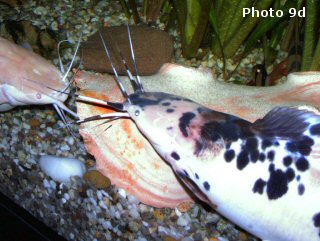
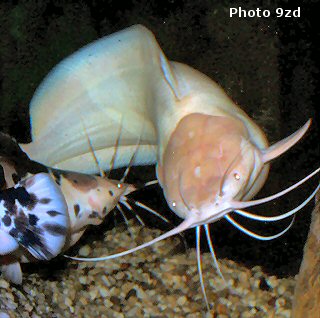
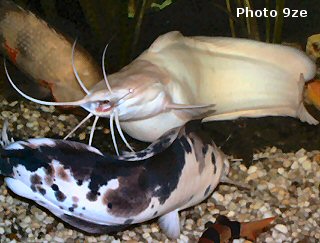
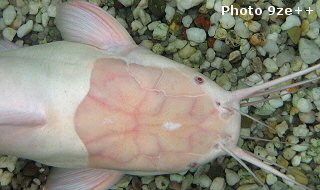
Photo 9c shows the Botia, despite the “Walking Catfish” female resting in its range of vision believe they can get themselves in to their hiding place undisturbed. If the Clarias however approach the cave abruptly they all disappear in it immediately. As in photo 9d to be seen, the female examines whether the Botia are still in its dwelling, and also the male is immediately coming as well. Nothing then is let unattempted to banish the Botia out from its hiding place. Female (photo 9e) like the male even tries to penetrate into the hiding place while the partner takes position above. With the current size of the animals a complete penetration succeeds and if necessary the male animal, and this only with trouble, with the female however it already fails for quite some time at the larger belly extent. If the male creeps into the hiding place, the female animal first sits on him, then however he gets increasingly jerky and finally tries to undermine it with its head from the side and to lift it to support its partner that way. Meanwhile the female however is so strong that it can heave up, if required, the hiding places of the Botia without further ado, in such a case the many more agile "opponents" disappear naturally and immediately in to the next cave. They do not care even then, if the “Walking Catfish” can snatch briefly at them at all and they have visible injuries to show it.
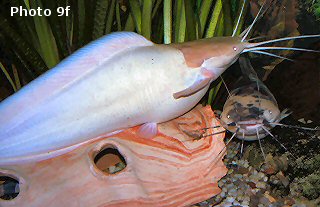
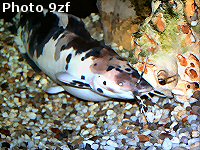
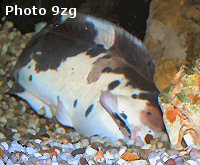
Afterwards the Clarias batrachus pair first of all lie noticeably calmer respectively beside the now empty hiding place (photo 9f). Usually however it lasts not for a long time, and already the first Botia returned again (photo 9g), whereupon this “little game” starts afresh.
The “Walking catfish” accurately differentiate and know therefore exactly, who is "friend" and who is "enemy", because it can be recognized
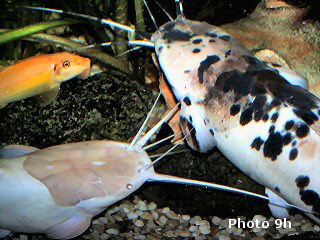
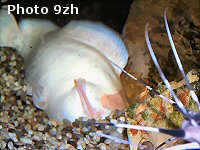
that the Gyrinocheilus aymonieri is allowed to stay even in direct proximity of the pair and it is not attacked even in the phase of spawning and also after the embryos hatched, neither by the male nor by the female, obviously it does not represent a danger for the new generation (photo 9h)
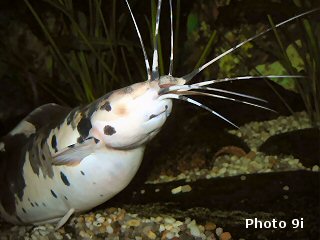
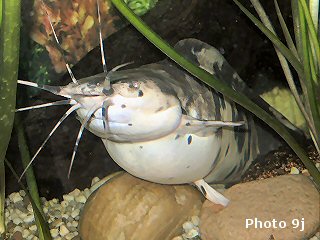
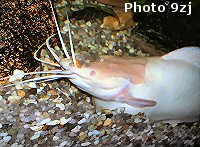
The pair know very well that the Botia species had only for a short time advanced backwards into more distant hiding places and will soon try again to return. In this phase therefore it rests not like other times. Only one partner lies in the usual way, while the other one puts its upper part of its body a little up, partially supported by the ventral fins, and in this posture rattles with its barbels particularly watching the environment (see the male in photo 9i). As an observation post for example a stone or a root are frequented (photo 9j), in such way the possibility of being able to notice the "opponents" from this increased position in time is obviously better. With the approaching of the Botia if the "guard" becomes active, then also the partner becomes increasingly jerky and pursues the intruders likewise. These defense attacks however are to be compared only rudimentary with those of a pair of cichlids; with cichlids they usually take place more co-ordinate and persistent.
Taking
up feeding and feeding contest
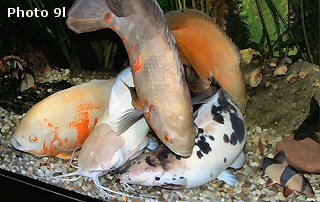
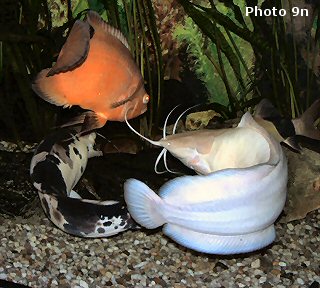
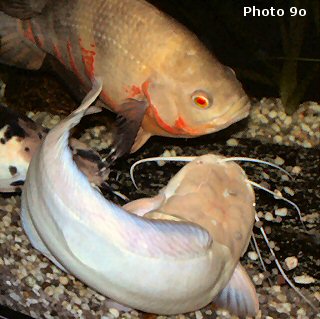
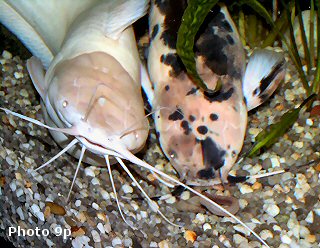
Astronotus ocellatus, with which the “Walking Catfish” pair otherwise gets along quite well and which however want to take up also pellets forelli of the ground (photo 9l), and so try to eat their food portion (photos 9n and 9o). If several worms are given, then a curious behaviour can be observed: First they (as can be seen in photo 9p) are circled and examined by both partners skeptically. Only, if the male snatches and feeds the first worm itself, then the female will eat, which then however usually comes too late, since the astronotus has already “done a good job”.
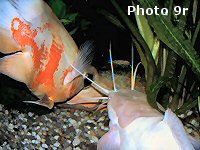
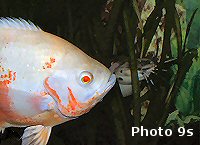
Twice I could observe that the still hungry female together with its already full partner then pressed an astronotus, which would devour its worm,not yet completely for such a long time, until the astronotus finally gives up and leaves the booty to the female (photo 9r, 9s, 9t).
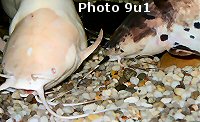
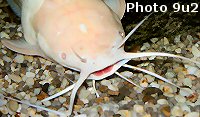
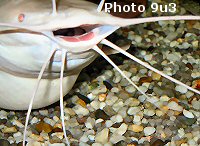
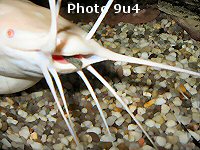
Often the animals dabble/peck for food all together. With the digging for food they locate with their barbles smaller animals such as insect larvae and worms, which could hide themselves in the soil, or as now the gravel has food particles and they are enticed by the smell. Thereby the comparatively small muzzle is partially used like a vacuum cleaner, so with the small animals and/or with the feeding into the pea gravel and then they spit it out afterwards (photos 9u1, 9u2, 9u3, 9u4).
Behaviour
in the mating time
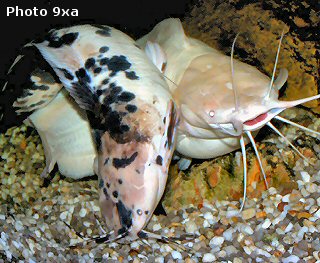
They also push off
from the body of the other one (photo 9xa).
Some of these movements seem to run off after a rigid
sample and always follow recurring rituals. So the animals
head for each other and push with the muzzle against
the body of the partner. Every now and then they bite
themselves also in the tail fins.
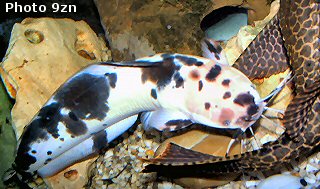
Nevertheless the male does not have the more active part; so the female again and again takes the initiative and with particularly fast movements of the tail fin lures its partner to follow it (photo 9zc). Then the pair gladly visit the coppice of plants in the background, where it comes to further, partly stormy meetings with the size and strength of the now nearly attained full grown animals with all in particular for the new generation of plants have negative consequences! Sometimes the animals circle around each other (photo 9zd), then suddenly move apart again, until recent circling movements bring them together again as to be seen in photo 9ze - here the female, in the indication of excitement opens here mouth a little bit.
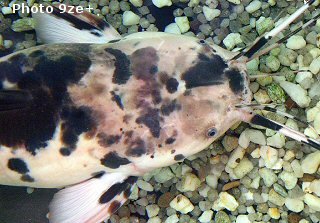
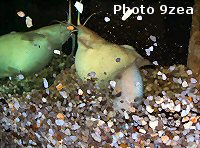
Digging the spawn hollow (photo 9ze+ and 9ze++) male and female at the spawning place, taken up from above in each case) In their natural environment these catfish spawn during the rainy time and then especially in caves, which are in the embankment below the rising water level and which they continue to excavate before the egg deposition for a long time, until a kind of spawning-hollow is developed or they pair themselves in the shallow waters of inundated ranges like flooded rice fields, but even there the eggs are not delivered simply on gravel without further preparation acts. In fact even then, both partners also wag free a well specified place, which before it is selected from them and chosen for being suitable, and thereby completely releasing it of disturbing stones and dead plant
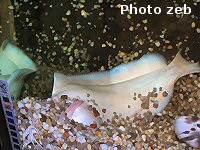
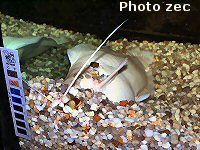
As can be determined with my animals on the basis of the following photographs, males are active as much as females to same extent when digging this spawning hollow. The excavation activities of the female are implemented even more stormily than of the male, little gravel-stones are scattered for a long time in all directions (photos 9zea and 9zeb), then the female has a rest period and remains for some moments. Meanwhile the head can have sunk partly still in the gravel (photo 9zec). If stones are lying in the midst of the pit, then these are pushed with the head to the edge. Interestingly larger obstacles are vacated in this way if required under the highest common effort. In the first case the male tried to place a large stone by pushing and pressing to the edge of the hollow (see photos 9zf and 9zg). Since this however was too heavy, finally under observation of the male also the stronger female assisted (photo 9zh), which then brought the desired success.
Also otherwise always the following division of labour is to be observed with these spawning preparations: As soon as one partner, still exhausted from the excavation activities, rests (photos 9zi and 9zj), the other becomes active. Then the roles are exchanged again. Partially the animals thereby observe themselves also directly mutually, like the respective partner is digging the hollow (photos 9zk and 9zl). Particularly by means of their barbles they seem themselves to agree their own choice, the depth and demarcation of the pit (photo 9zm). Although my “Walking Catfish” pair have several times already have decided the digging of the hollow at another place than the past spawn hollow, and had already begun there with their first excavation activities, it proved then that they nevertheless returned again to the used spawning place and always after stormy courting movements.
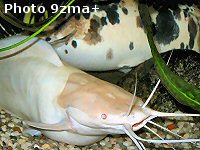
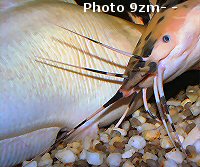
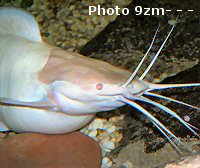
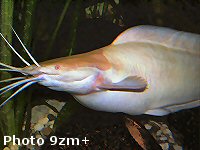
Probably a role plays here, that this place is also during the day comparatively badly illuminated and the animals feel relatively unimpaired there. The excavation of the hollow can last up to several days and depends on whether in the belly of the female, eggs have already formed in sufficient numbers. Not least also by continuing courting movements of the male, however from day to day it gets visibly more spawn (photo 9zma+). Finally the belly of the female nearly seems fit to burst, even the way to the water surface in order to get air now seems to be a problem for it. From then on there are only a few hours up to the reproduction. If with the spawning preparations and finally also during the numerous mating (see photo 9zm--), which can drag on for many hours and with those the female always partly squeezes itself between (photo 9zm---), other fish if they move too close to the spawning place, then they are struck there in this phase (and so different than after the last mating, see the next section) not only by the male, but if required also by the female until they escape.
Clear division
of responsibilities also after spawning
After spawning although the female is keeping watch in some distance from the spawning place, it notices immediately the moment, in which the larvae begin to slip. Because thenceforward it returns several times to the edge of the breeding place, where the male - now no more circling over the spawning place but almost exclusively resting, is watching. There for a short time it comes to the stormy movements of both partners. The male tries everything to prevent its partner coming too near to the spawning place. Thereby both partners take up a threatening position (photo 1 top of page), the male however keeps the upper hand. The division of responsibilities in the defence is also thereafter pulled through invariably for a few days as before. Finally defence with both parents expires, however not abruptly, the aggression in particular of the female against possible larvae predators dies down quite gradually. Hardly aggressions
among themselves Even in mating time, in which the male tends to press the [yet not willing for spawning] female again and again, it only comes to stormy movements, which however with increasing size of the animals are getting wilder and wilder. Surely it might prove here as favourable that - in contrast to many Cichlids - with the “Walking Catfish” the female (although with the described pair the female meanwhile is even slightly smaller than its partner, however furthermore - particularly referred to the first body third - altogether more massively) at least at the first ages is the stronger part and so in physical respect seems to be able to slow down the male and/or if required to determine even the end with the courting attempts of the male. However if the size difference between my animals should become more clearly in future in favour of the male, it cannot be excluded that this balance of power could also turn around once with the consequence that it - then similarly as with some Cichlids, with which the females are not yet willing for spawning - comes up to wild attacks and persecutions of the male “Walking Catfish”. Surely with my two “Walking Catfish” the criteria is important that these from small can grow up together and probably already from there harmonise well and constantly with one another. After several feedbacks of keepers of the “Walking Catfish” the described so far peaceful pair behaviour is not observed in every case. So it is also reported of partly more violent biting attacks, which should arise in irregular distances however only by short duration. A restriction is to be made also by my side: So with each reproduction I could observe brief mutual attacks of the pair at a certain point, namely with the free swimming of the young. However these attacks change nothing in the basically peaceful pair behaviour as described; they might be rather due to the limited size of the aquarium. Because as soon as the young swim freely, from then on broader radius of action of the young, the male for a few days expands its past protection area. In free nature from now on also the female might adapt and accordingly further pulls its protection belt, which however is not possible due to the crowded conditions even in a large tank. Probably only for this reason, precisely because there are laps now with these protection areas, the male, which already before had not allowed the female to approach the spawning place, now takes the female on. This in such cases usually retreats due to the drastic rising aggressiveness of its partner. Who has the possibility, therefore from this time forth can get moved out for a short time into a free tank. Fortunately in this phase the extremely aggressive behaviour of the male is to be observed only temporary since its defender stayed (same applies to that of the female) for only a few continues days anyway. Open questions Once I had already put in a further “Walking Catfish” male for a short time; this how ever was attacked by the pair. The experiment however therefore is a little meaningful because the added male was only about half as large as the two other catfish and, which might play a role also, the three did not grow up together. Keepers of the “Walking Catfish“ have reported to me of the peaceful living together of three or more specimen. This information seems to contradict to my own experiences. On the other hand apart from the usual jostle with feeding with my three “Walking Catfish” up to entrance of sexual maturity there never have been any aggression among themselves. In principle Clarias batrachus at least up to this time, also is not antisocial, so still young “Walking Catfish” gladly look for a hideout in the same cave. Perhaps it concerns in those cases same sex specimens (whereby with the growing up of the animals problems also might arise here) or one female and several males, which would then get along similar to Reinhardt's descriptions to Clarias gariepinus. Another more probable explanation for the peaceful cooperation is probably to be seen in the point that those “Walking Catfish” are still young and did not walk so far for reproduction, so at the latest at this time another change to a pair behaviour as described by me could arise.
Summary Also outside of reproduction
time the described behaviour suggests a certain pair
connection with Clarias batrachus too, which
however might prove more unconstrained in nature, as
in the close area of an aquarium, in which the pair
probably already for lack of the possibility of coming
into contact with further conspecifics equal in size,
more or less also, and after reproduction further on
staying together. Already from there the observations
determined there are not transferable to freely living
specimens. These could temporarily live together also
in smaller groups, could possibly be momentary, perhaps
advanced in years even predominantly solitary and pair
themselves at least in the next reproduction period
and also with other partners. David Marshall: “Clarius - The Walking Catfish“. This article forms a supplement to the article “The Catwalk“, which appeared in the U.K. aquarium magazine “Tropical World“, Issue 5 (December 2004/January 2005), pages 26-28. And also my own articles “Auslösen der Fortpflanzung bei Froschwelsen“ (Datz 4/2006, pages 33-37) Status:
May 2006; text and photos ©
Wolfgang Ros
|
 or
about three years now I have kept a pair of Clarias
batrachus in a 700 liters aquarium. Both animals,
a female albino and a male semi albino, are nearly the
same length with the female 41cm and male, 42 cm. Their
pair behaviour, which expresses itself even outside
of the direct reproduction times is an emotion of togetherness
and it is amazing how it might exist with only a few
catfish of this kind and even within the Clariidae family,
not with all the species. Sometimes the animals seem
to come to an agreement with their actions. Their pair
behaviour can be documented as follows in detail
or
about three years now I have kept a pair of Clarias
batrachus in a 700 liters aquarium. Both animals,
a female albino and a male semi albino, are nearly the
same length with the female 41cm and male, 42 cm. Their
pair behaviour, which expresses itself even outside
of the direct reproduction times is an emotion of togetherness
and it is amazing how it might exist with only a few
catfish of this kind and even within the Clariidae family,
not with all the species. Sometimes the animals seem
to come to an agreement with their actions. Their pair
behaviour can be documented as follows in detail










If you would like to contribute an article, please e-mail me. You will of course be credited for your work.
If you would like to donate any denomination of money to the site just click the above link button. All proceeds will go to running the site and hopefully to keep it going for a few years yet.
Print or e-mail this article below


