SCOTCAT.COM
your internet guide to all things catfish
| Brackish Water Catfish |
by Dr. Neale Monks |
The Salt-allergy
Myth Brackish
water plecs To begin with, there are species of loricariid catfish that are apparently adapted to slightly brackish water habitats. In aquaristic terms, that would correspond to a specific gravity, or SG, of around 1.003 to 1.005. Hypostomus ventromaculatus is one such species, being found primarily in the Amazon estuary and according to FishBase only within the tidal, brackish water region of the river. Another species, Hypostomus watwata, is also common in slightly brackish environments, even being found living among mangrove tree roots. While these fish sound like ideal additions to a low-salinity brackish aquarium alongside things like mollies, gobies, and dwarf cichlids, the problem is that they are not traded much, if at all
Hypostomus plecostomus
Hypostomus plecostomus is another species known to inhabit slightly brackish water, though in this case such observations have often been made outside of its natural range. In Florida, for example, where this fish has become widely established, it is quite commonly found in slightly brackish water. Of course the main problem with using this species in the brackish water aquarium is that while the name Hypostomus plecostomus is commonly used in aquarium books and magazines to refer to the standard issue, common or garden plec, it is hardly ever the species available for sale. You are far more likely to find species of Liposarcus or Pterygoblichthys masquerading as "common plecs" in most aquarium stores. Freshwater
catfish that occur in brackish water Brackish water specialists
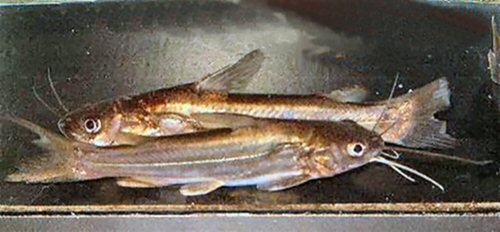
Mystus gulio
Catfish that tolerate brackish water are one thing, but species that actually prefer brackish water conditions are something else. Mystus gulio is one such species. It is a large bagrid catfish known in its natural range (South and South East Asia) as the estuarine catfish, a good indication of its preferred habitat. It is large (45 cm), silvery, schooling catfish that has only rarely been traded as an aquarium fish. Superficially similar in form and habit to the popular Colombian shark catfish (discussed below) it contrasts with that species in requiring slightly rather than strongly brackish water. It is adaptable though, and is common in completely freshwater rivers, and is even sometimes found in the sea. Nonetheless, for optimal health, this fish should be kept in slightly brackish water around the SG 1.005 mark. While not recommended for use alongside scats or monos, which prefer more strongly brackish conditions, this would be a fine companion for large sleeper gobies, green chromides, Siamese tigers (Datnioides spp.), and other large but peaceful, low salinity, brackish water fish. It should be noted that Mystus gulio is unique among Mystus species in being a brackish water specialist; most of the other Mystus species sold as aquarium fish are strictly freshwater animals and should be maintained accordingly.
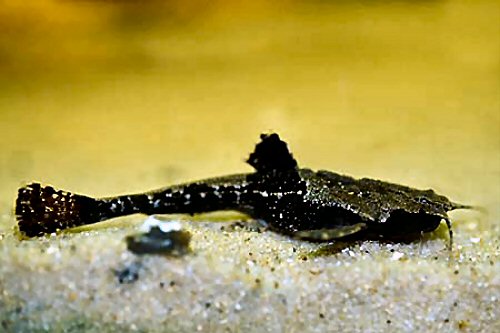
Bunocephalus coracoideus
Another group of catfish primarily associated with freshwater habitats but including a few brackish water specialists are the banjo catfish. The small species, like the ever-popular Bunocephalus coracoideus, are entirely freshwater fish, but it is the larger ones, such as Aspredinichthys, Aspredo, and Platystacus spp., that are the brackish water specialists. These big banjos typically grow to around 20 to 30 cm, but are otherwise very similar to the dwarf species in terms of habits and requirements. In the wild they are normally found in coastal regions, though not always in brackish water, but they are not found in the sea. Like Mystus gulio, a low salinity suits them best, although they can be maintained in freshwater aquaria too, provided the water is not too soft or acid. Marine
catfish
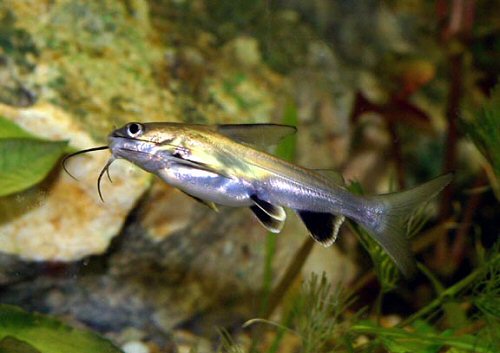
Ariopsis seemanni
This is a large family (around 120 species) with representatives to be found along the coastlines of all the continents except Europe and Antarctica. Australia has a number of species that have secondarily become truly freshwater fish, presumably in the absence of competition from other catfish families, but ariids are otherwise completely marine animals that only migrate into rivers when foraging for food. The Colombian shark catfish, for example, while sold as a brackish water fish, is best kept in a marine aquarium. The Plotosidae are a smaller family (around 30 species are known) that are confined to the Indo-West Pacific. Oddly enough, most of them are strictly freshwater fish found in Australia and New Guinea, where they are known locally as "cobblers" or "tandans". Nonetheless, there's no question that the family evolved in the sea, and many of them still live there. Like the Australian freshwater ariids, the freshwater plotosids have presumably radiated to occupy the ecological niches in Australia and New Guinea that 'true' freshwater catfish occupy elsewhere.
Plotosus lineatus
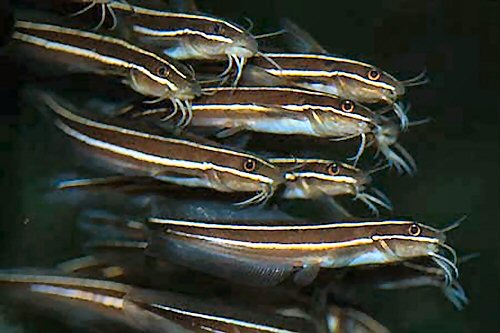
Only a single species of plotosid has had had any impact on the hobby (outside of Australia, at least), Plotosus lineatus. Normally the neatly-marked juveniles are sold as a marine fish, but since the adults are 30 cm long and rather drab by comparison with most other ornamental marine fish, they haven't become at all popular. While they can be maintained in marine aquaria, they will do equally well in mid- to high-salinity brackish water tanks where the specific gravity is maintained at 1.010 or more. Adults in particular seem to be very accommodating, and have even been found in completely fresh water. Plotosus lineatus is a schooling fish when young, but adults are territorial are usually end up being kept alone. They are predators, but will mix fine with fishes too large to eat, such as scats. Summary
Photo
Credits:
|
 eale
Monks is editor and senior author of Brackish Water
Fishes, published by TFH and due out this summer (2006).
He is the brackish water 'expert' in Practical Fishkeeping
Magazine, and has been maintaining a popular FAQ on
the topic for over 10 years
eale
Monks is editor and senior author of Brackish Water
Fishes, published by TFH and due out this summer (2006).
He is the brackish water 'expert' in Practical Fishkeeping
Magazine, and has been maintaining a popular FAQ on
the topic for over 10 years 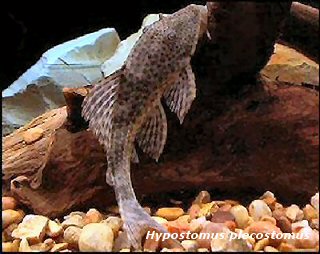

If you would like to contribute an article, please e-mail me. You will of course be credited for your work.
If you would like to donate any denomination of money to the site just click the above link button. All proceeds will go to running the site and hopefully to keep it going for a few years yet.
Print or e-mail this article below


