SCOTCAT.COM
your internet guide to all things catfish
| Breeding the LG6 Whiptail catfish |
by Graham Ramsay |
The first step was to ascertain what species they were and this proved to be no easy matter. They had originally been purchased at a local garden centre and were sold as ‘whiptails’, which wasn’t very helpful. None of the books I had were any use and even seasoned catfish keepers were non-committal. Eventually I posted a picture of the adult male and fry on an internet forum and agreement was reached fairly quickly. They were Loricariinae sp. (1), also known as LG6. Not the most glamorous of names for a rather pretty cat.
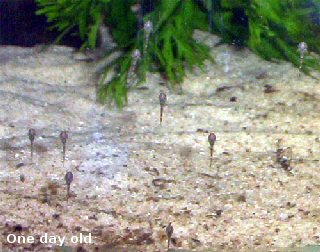
I housed them in an 18”x12”x12” tank with air powered box filter and aquarium sand substrate. A piece of bogwood with some Java fern attached and a couple of clay pipes completed the setup. As I’m fortunate to live in Perthshire, (Scotland) I’m able to use unaltered tap water for all my fish. The water here is very soft (only a couple of degrees hardness) and the pH is neutral. I conditioned the pair on bloodworm, white worm, mixed flake and pellets. I tried various vegetable foods but they ignored them all. It seems that LG6 is a meat eater by preference. Over the Christmas holidays they grew fatter, a bit like their keeper. On the 20th January I observed that the male was guarding a large clutch of dark green eggs on the rear glass. The clay pipes had been ignored throughout and this would appear to be an exception to the rule that Whiptails breed in pipes. I removed the female and let the male get on with looking after his 150 or so eggs. Incubation was 10 days and I did not feed the male during this time. Hatch rate was 100% from what I could see and the hatchlings attached themselves to the side of the glass making it easy to see their green yolk sacs
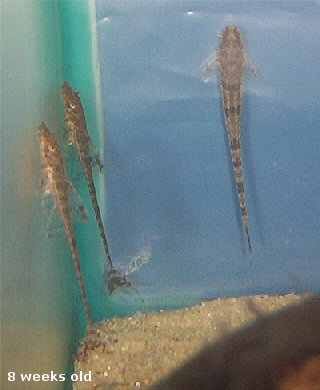
After 3 days the fry started to become mobile so I removed the male and started to feed them. Firstly on microworm and pre-soaked ZM-100 powdered fry food. As with their parents, they ignored all veggie type food. After a week I stopped using the ZM-100 and started using King British Plecostomus tablets. By 1 month they were eating grindal worm, crushed flake and Plecostomus tablets and within 2 months they were eating the same as the adults. From the start I replaced around one third of the water every day with aged water of the same temperature. I continued with daily water changes until I moved them onto their growing out tanks. (2 x 40 gallon)
I didn’t have enough room to raise over 100 catfish so I started giving away fry at an early age. Unfortunately success with moving such small fry was always going to be poor and few survived the change in conditions. I kept about 80 to grow on and when they were about 2 months old I began to trade them with friends. At this age most fish survived the move and I was confident enough to sell them at auction and to local fish shops from 3 months old. They grow fairly quickly and by 3 months they were about 5-6cm long including their tail. At the time of writing they are 14 weeks old and the largest fish are about 10cm. I would say that this fish would be regarded as intermediate in terms of difficulty; easy to spawn, but the fry can be tricky to raise. These would be the key points to consider if you are trying to breed this fish: • Open breeders,
a pipe is not required In summary this was an enjoyable and rewarding species to breed; the fry are easily sold and the adults are attractive enough to live in a community tank. I would recommend this fish to intermediate hobbyists who are looking to move on from the easier species. Remarks:
The Loricariinae sp. LG06 which has been around in
the hobby and has also been bred is now been mooted
as being Rineloricaria
parva. Fair City Aquarist Society 2006 |
 ust
before Christmas of 2005 I was given a breeding pair
of these cats by a fellow member of the Fair City Aquarist
Society. They were regarded are straightforward to spawn
and had been spawning about every two weeks. However
raising fry had caused problems. I was determined to
give them a go.
ust
before Christmas of 2005 I was given a breeding pair
of these cats by a fellow member of the Fair City Aquarist
Society. They were regarded are straightforward to spawn
and had been spawning about every two weeks. However
raising fry had caused problems. I was determined to
give them a go.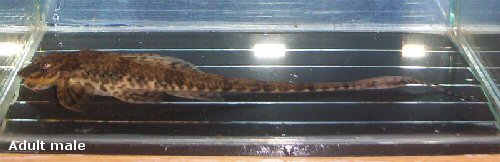

If you would like to contribute an article, please e-mail me. You will of course be credited for your work.
If you would like to donate any denomination of money to the site just click the above link button. All proceeds will go to running the site and hopefully to keep it going for a few years yet.
Print or e-mail this article below


