SCOTCAT.COM
your internet guide to all things catfish
| The Chaca's | ||||||||||||||||||||||||||||||||||||||||||||||||||||
by Steven Grant |
||||||||||||||||||||||||||||||||||||||||||||||||||||
Click on the images below for a larger image.
Chaca
chaca (Hamilton,
1822)
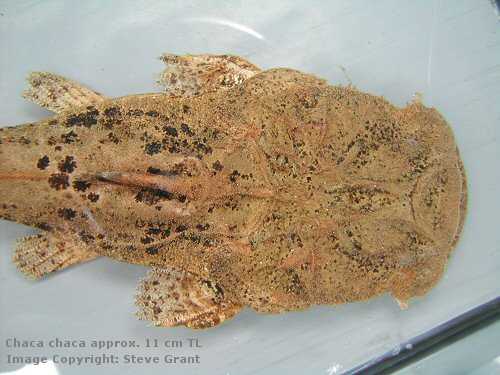
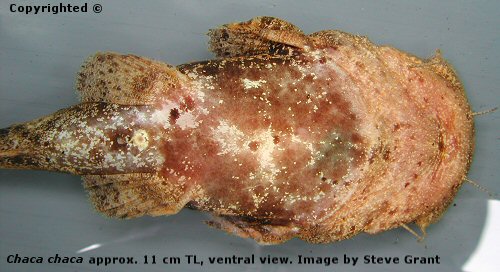
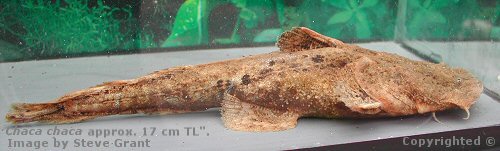
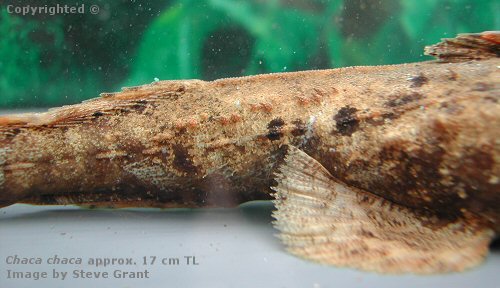
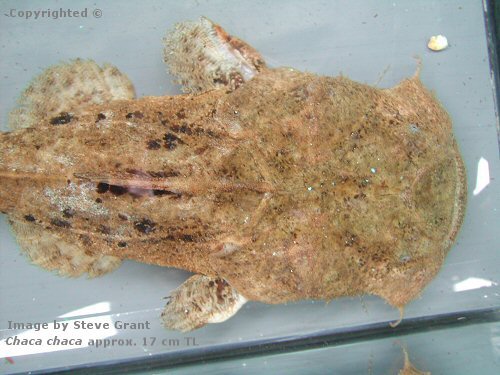
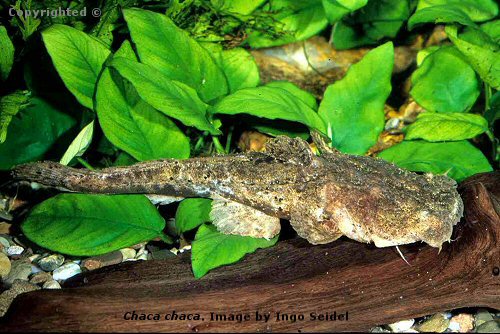
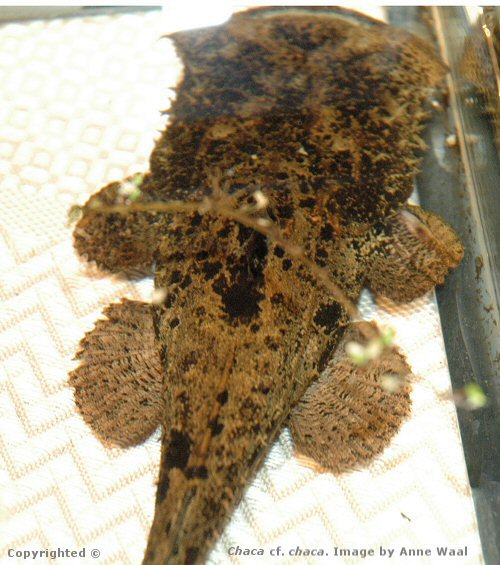
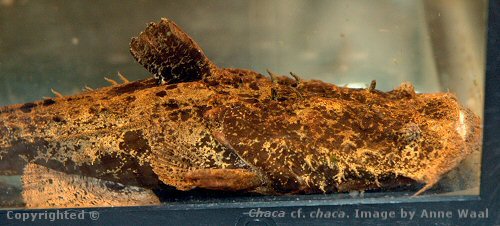
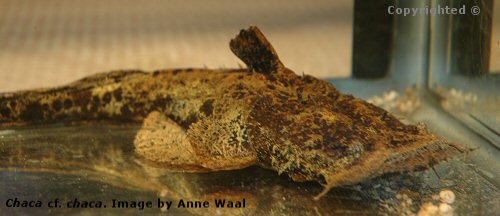
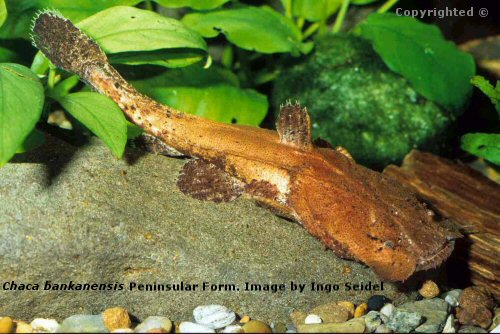
The specimens pictured by me were imported direct from India. The bizarre specimen pictured by Anne Waal (which I have only tentatively identified as chaca) has numerous cirri on the head and body, some of them being very thick. Even though these appear to be (currently) technically the same species they differ greatly in: colour, the extent of the cirri or papillae on the head and body, and also the fact that Anne’s specimen has much more conspicuous cirri around the eye, than in my specimen and the one pictured by Ingo Seidel. However, its colour and pattern does match that given by Hamilton. The specimen was purchased as a C. burmensis by Anne from an aquarium shop, and at first glance its colouration appears reminiscent of C. burmensis. However, based on the great extent of the cirri on the head, and the fewer cirri along the inside fringe of the lower lip, I have tentatively identified it as a C. chaca.
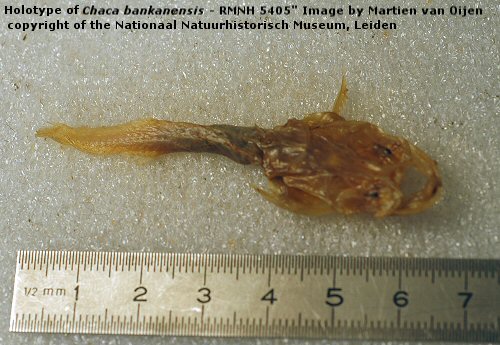
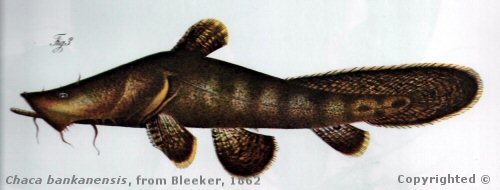
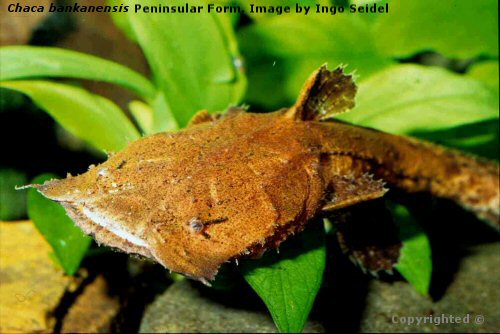
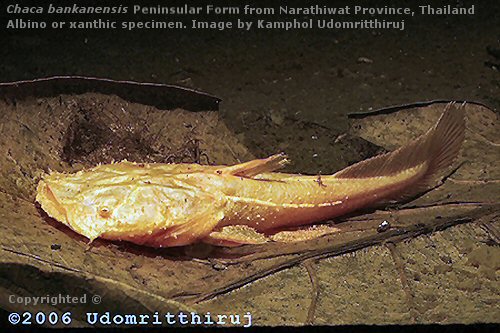
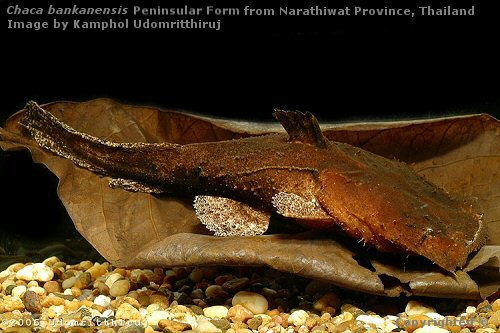
Chaca bankanensis Bleeker, 1852 Chaca bankae Giebel, 1857 (emendation or mistake for C. bankanensis?) I now had well over 200 fry and more eggs to hatch out. Incredibly the adults showed no inclination to cease spawning but the eggs where smaller and I decided to separate the sexes and move them into other tanks. I now had more than enough fry to grow on and had to dedicate two 18” x 12” x 12” and a 36” x 12” x 12” for that purpose.
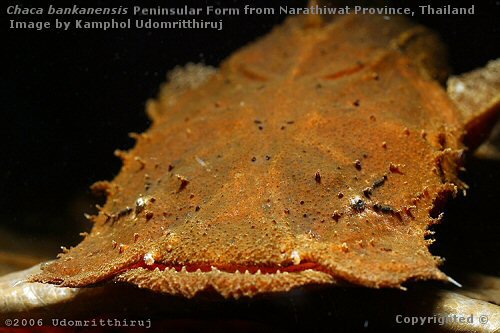
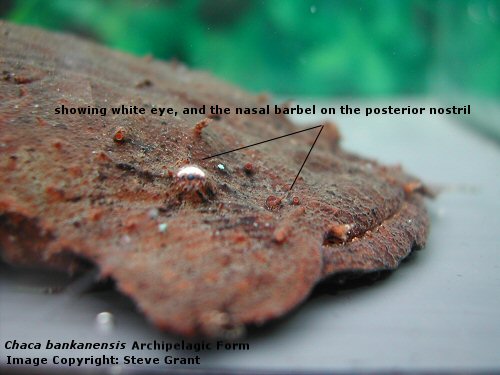
As reported in Ferraris (1991), some specimens have white eyes, (see image). The white appears to be confined to upper part of the cornea, and/or sclera, and not to the iris, therefore I do not think that this makes them blind. One of Kamphol’s photographs appears to show an albino or a xanthic (yellow) specimen.
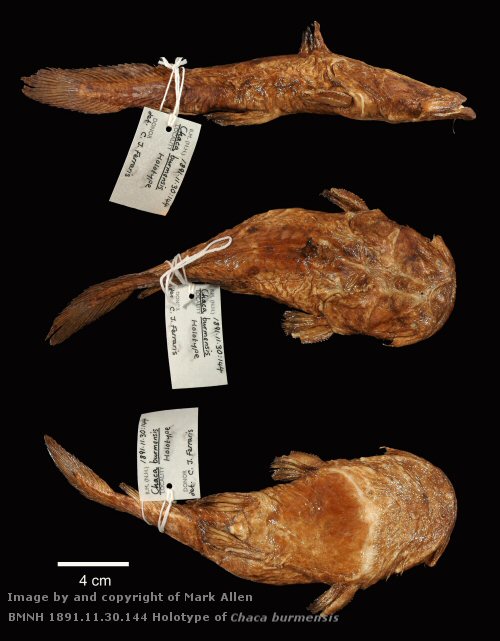
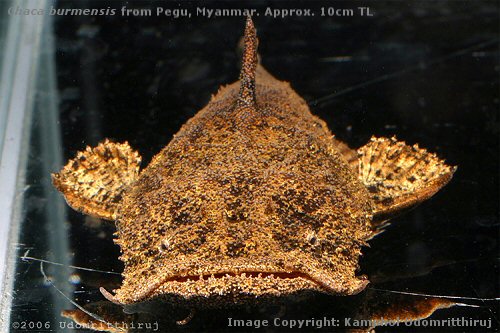
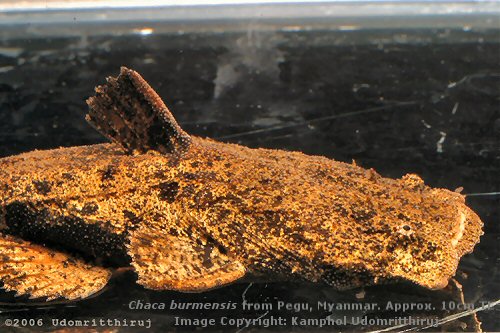
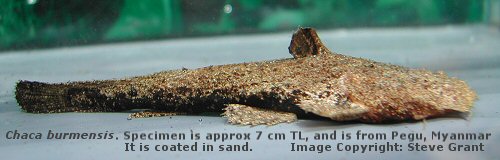
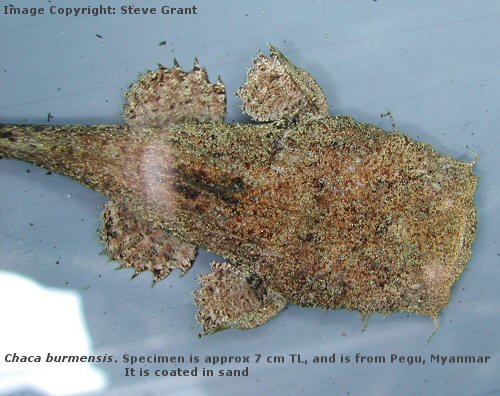
Chaca burmensis Brown & Ferraris, 1988
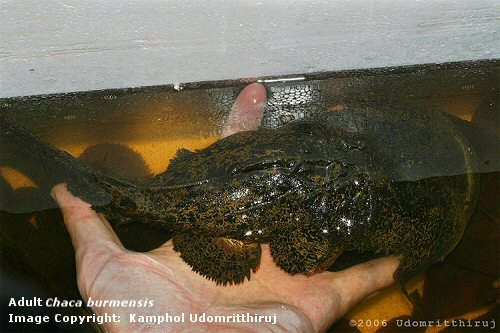
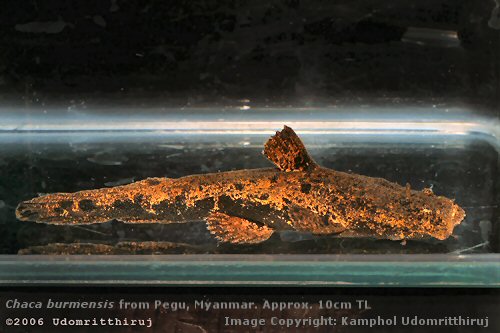
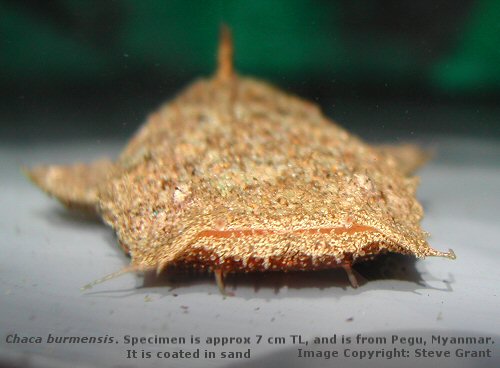
The shape, and outward appearance of this species are more similar to chaca than to bankanensis. It tends to be a dark / black base colour, mottled with light brown to tan colour, which can be the case for some C. chaca. I have found that a small (approx. 7 cm TL) specimen from Pegu, Myanmar, killed two Hypostomus and almost killed two Bunocephalus species within a week of being put in their tank (which was approx. 12 inch by 10 inch). The Hypostomus died first, and at the same time the Bunocephalus started to develop open sores/burns in their skin and were hanging in upper water, but within a day of removing the burmensis and doing a 25% water change, they quite obviously started to pull round and return to normal. I considered whether it was the water parameters crashing, but the burmensis was absolutely fine, so I consider that it was releasing a poison into the water. Roberts (1982) states that there is an axillary (pertaining to the axilla- literally the ‘armpit’, so in fishes, near the junction of the pectoral fin and the pectoral girdle, more specifically the cleithrum - Diogo et al 2004) pore in all Chaca’s but there was no evidence to show that it secreted a poison. Based on my observations I would guess that it does. He does state that earlier authors had written that the “natives” consider its flesh poisonous, although this report probably relates to bankanensis. Ferraris (1991) reports that certain feeder fish tend to die if not eaten, and in the early 1990’s in the Catfish Association of Great Britain magazine, I also reported this in a tank of chaca and bankanensis that I had.
Differentiating the species As mentioned earlier, colour and/or pattern alone is not a reliable indicator. Ferraris & Brown give some characters, but some of them can only be accurately used by utilising dead specimens and having knowledge of their anatomy (for which Diogo et al 2004 is useful).
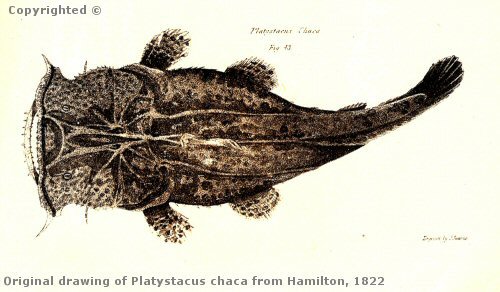
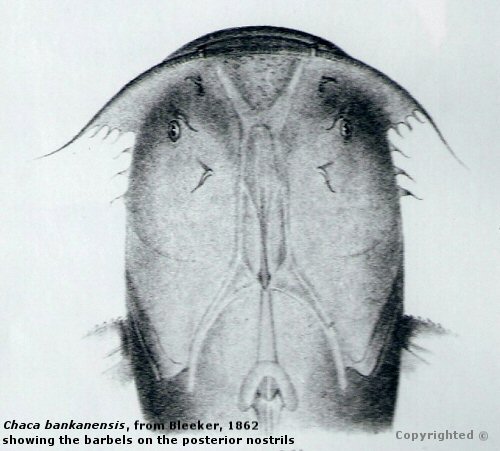
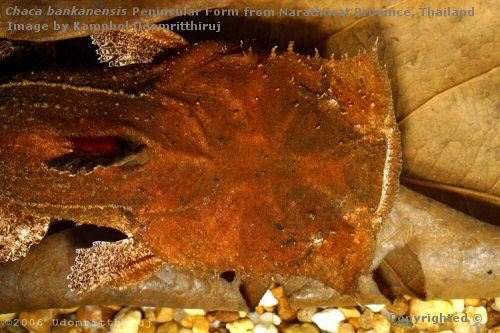
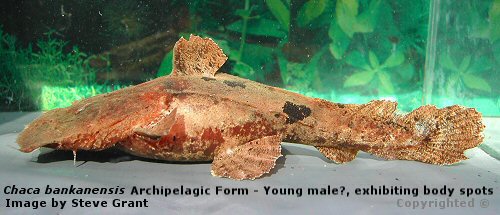
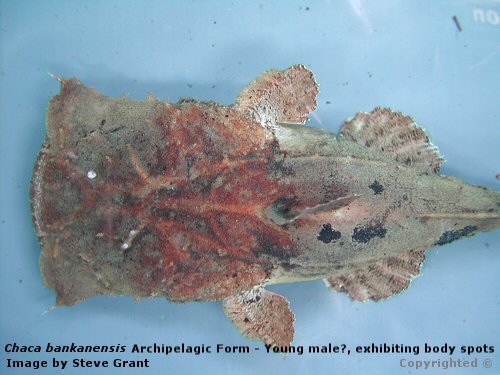
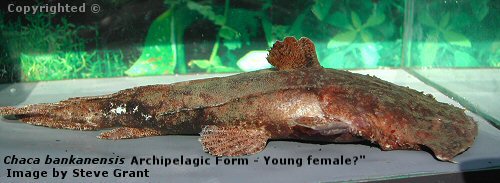
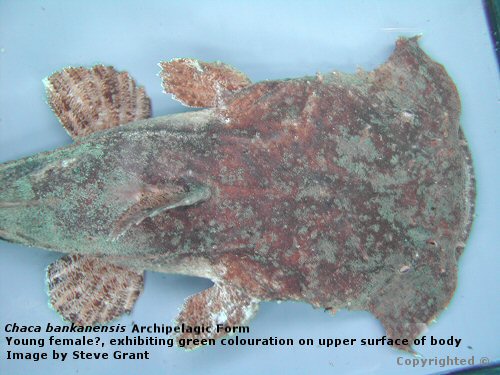
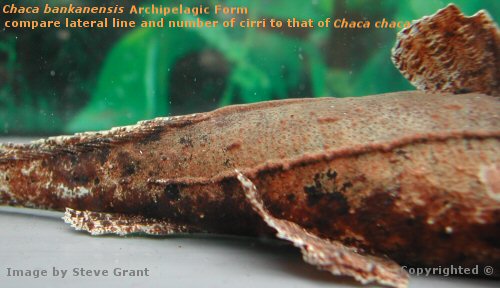
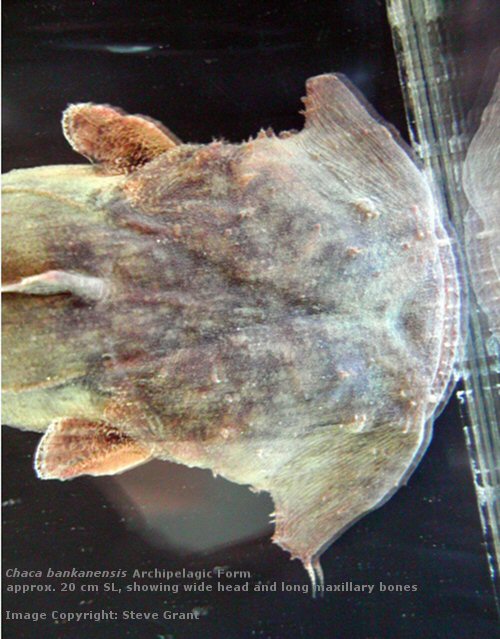
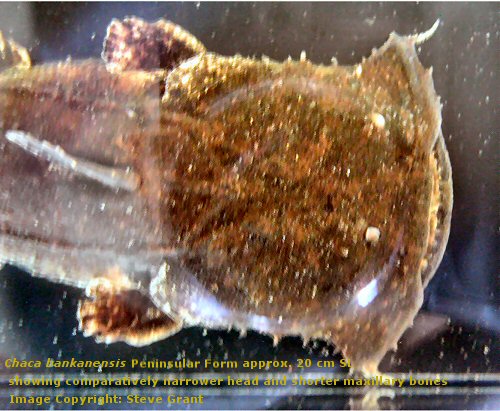
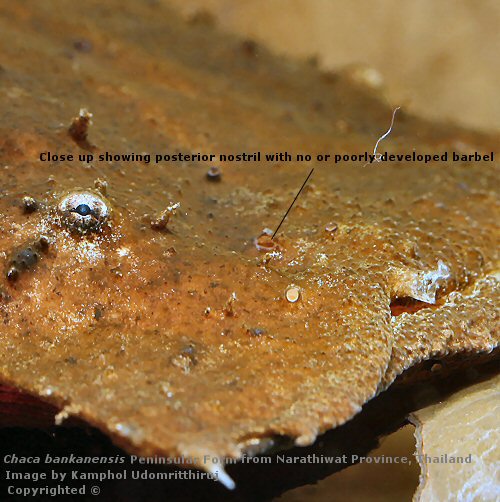
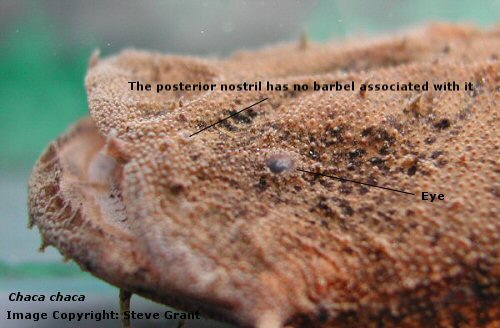
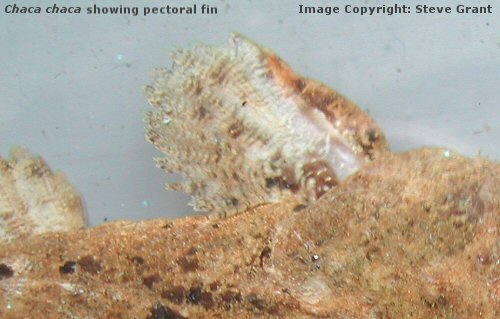
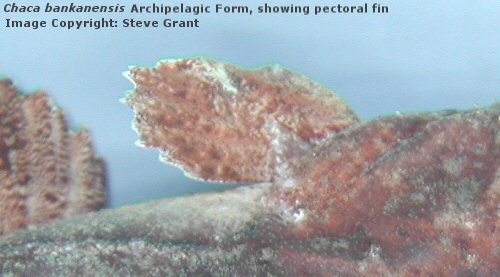
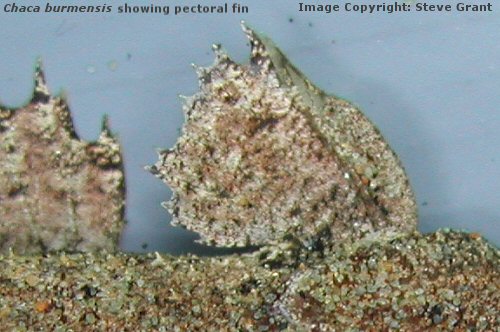
Roberts visually differentiated C. chaca from C. bankanensis by the fact that C. chaca has 5 soft pectoral fin rays, versus 4. This can quite easily be seen if you look at the fish from above (see images), even without counting the rays you can see the different shape and relative size of the fin. Unfortunately burmensis can also sometimes have 4 rays, so the number of rays themselves are not indicative. The first indicator to use then, is to look for the tiny barbel on the rim of the posterior nostril (see image). C. chaca and burmensis do not have this, but unfortunately some Peninsular Form bankanensis don’t either, so if the fish has no posterior barbel, also then look at the shape of the pectoral fin when viewed from above. If it has a posterior nostril barbel, or the shape of the fin is that in the image above, you have a bankanensis. There are some other minor visual differences that are sometimes quoted, but I find it more reliable to use the ones I have given.
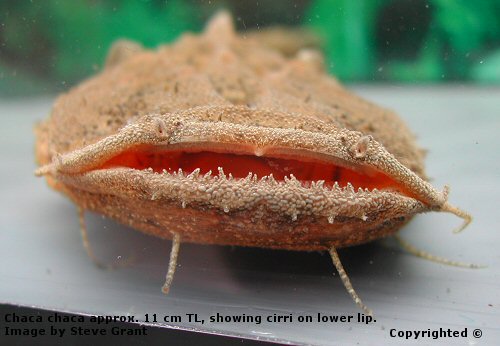
Differentiating chaca from burmensis using the naked eye is not as easy. Most of the differences listed in Brown & Ferraris use information inaccessible for aquarists using live fish. The number and extent of cirri is very variable in chaca, so although burmensis appear generally to have less, some chaca do also. C. burmensis tend to have a blacker base colour, but again this can be seen in chaca also. Brown & Ferraris state that “On the head, flattened flaps of skin, usually branched at the tip, occur laterally in the region of the cheek and opercle. None is found along the dorsal surface of the head or immediately posterior to the eye, as in C. chaca”. However, in some C. chaca, there aren’t any flattened flaps of skin on the head, or associated with the eye either (although there are cirri, but there are also some cirri in burmensis). The easiest way I have found to differentiate them using live specimens, is to look at the number and relative size of the cirri along the inner edge of the lower lip. In the C. burmensis I have seen, they usually number around 10 or 11 small cirri, and they don’t tend to have them near the corners of the mouth. In the C. chaca that I have seen, they tend to number at 14+ and tend to be relatively longer and/or thicker.
Kamphol Udomritthiruj,
Ingo Seidel, and Anne Waal for the kind permission
to use their images. Roy Blackburn for permission
to photograph his fish, and Mr & Mrs Pygott for
permission to photograph their fish. Martien van Oijen
of the Nationaal Natuurhistorisch Museum, Leiden for
the images of the holotype of Chaca bankanensis.
Mark Allen, for permission to use his image of the
Holotype of Chaca burmensis. To Dr Carl Ferraris
for his advice References Rahman,
A. K. A., 1989. Eschmeyer, W. et al, 2006 Catalog of Fishes - Web version. www.calacademy.org Bleeker, P., 1852. Bijdrage tot de kennis der ichthyologische fauna van het eiland Banka. Natuurkd. Tijdschr. Neder. Indië v. 3: 443-460. Bleeker, P., 1862-63. Atlas ichthyologique des Indes Orientales Néêrlandaises, publié sous les auspices du Gouvernement colonial néêrlandais. Tome II. Siluroïdes, Chacoïdes et Hétérobranchoïdes. Amsterdam. 1-112, Pls. 49-101. Brown, B. A. and C. J., Jr. Ferraris, 1988. Comparative osteology of the Asian catfish family Chacidae, with the description of a new species from Burma. Am. Mus. Novit. No. 2907: 1-16. Ferraris, C. J. Jr., 1991. Catfish in the Aquarium. Tetra Press. 1-199. Roberts, T. R., 1982. A revision of the south and southeastern Asian angler-catfishes (Chacidae). Copeia 1982 (no. 4): 895-901. Roberts, T. R., 1989. The freshwater fishes of western Borneo (Kalimantan Barat, Indonesia). Mem. Calif. Acad. Sci. No. 14: i-xii + 1-210. Talwar, P. K. and A. G. Jhingran, 1991. Inland fishes of India and adjacent countries. In 2 vols. Oxford & IBH Publishing Co., New Delhi, Bombay, Calcutta. Inland fishes, India v. 1-2: i-xvii + 36 unnumbered + 1-1158, 1 map. Kottelat, M., A. J. Whitten, S. N. Kartikasari and S. Wirjoatmodjo, 1993. Freshwater fishes of Western Indonesia and Sulawesi. Periplus Editions, Hong Kong. i-xxxviii + 1-259, Pls. 1-84. Lim, K. L. P. & P. K. L. Ng, 1990. A guide to the freshwater fishes of Singapore. Singapore Sciences Centre. 1-160. Shrestha, J., 1994. Fishes, fishing implements & methods of Nepal. Craftsman Press, Bangkok. 1-150. Diogo, R. & M. Chardon, P. Vandewalle, 2004. On the osteology and mycology of the cephalic region and pectoral girdle of Chaca bankanensis Bleeker, 1852, with comments on the autapomorphies and phylogenetic relationships of the Chacidae (Teleostei: Siluriformes). Animal Biology, Vol. 54 No. 2, pp. 159-174. Vidthayanon, C. (2004). The Freshwater Fishes of Thailand. 1-232.
|
||||||||||||||||||||||||||||||||||||||||||||||||||||
 his
is a discussion on the identities of the species of
the genus Chaca Gray, 1831. After a brief run down of
each species, and images of them, there is a section
on how to try and visually differentiate the species.
his
is a discussion on the identities of the species of
the genus Chaca Gray, 1831. After a brief run down of
each species, and images of them, there is a section
on how to try and visually differentiate the species.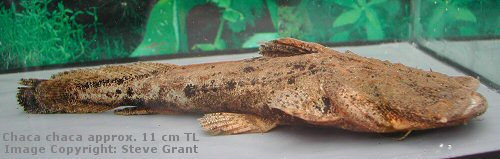

If you would like to contribute an article, please e-mail me. You will of course be credited for your work.
If you would like to donate any denomination of money to the site just click the above link button. All proceeds will go to running the site and hopefully to keep it going for a few years yet.
Print or e-mail this article below


