SCOTCAT.COM
your internet guide to all things catfish
| An attempt to spawn upon demand? |
by Adrian Taylor |
Hoplisoma paleatum
One fish that I have had little trouble in spawning over the years is the peppered cory Corydoras paleatus (now Hoplisoma paleatum), and due to this, I decided to use this small South American catfish as the subject in ‘an attempt to spawn, upon demand’, which also happens to be one fish that is readily available at most local fish stores, and one which I already had in my possession, that being a small group of five fish, two females and three males, The largest female used was 45mm SL, and the largest male used was 40mm SL. In mid June I transferred these fish to an unheated 25-gallon (UK) capacity tank, which had been placed in an area that received plenty of natural sunlight, and that had been ‘seeded’ with a small amount of daphnia the previous month, this tank also was bereft of any filtration. Due to an unusual prolonged hot summer the temperature hardly ever dropped below 20ºC even during the evening, on occasion the temperature reached 32ºC, but for the most part during the months of July and August the temperature ranged between 23ºC and 26ºC; and apart from the daphnia that were already present in the tank I only fed them one catfish tablet once a week, I never gave these fish a water change, although on occasion I topped up the water to counter the effects of evaporation, however; I did keep a close eye on them, to make sure that they were not showing any signs of distress, illness or malnutrition, although these fish never showed anything to be concerned about, the fish did seem to show more intense colouration and markings during this period. With the weather becoming cooler toward the end of August I decided that they should be moved into a tank, that was heated, and an attempt to spawn them started. The water parameters taken of the un-heated tank at the time of the transfer were: - pH 7.65, GH 9º & a temperature of 17ºC. The tank into which they were placed had a capacity of 9-gallon (UK) that contained mature aged water, filtered via a large box filter, that had the following water parameters: - pH 7.2, GH 6º and a temperature of 23ºC. I duly caught the five catfish and placed them into a polythene bag that contained water from the tank that they had been living in for the past couple of months and floated it in the proposed spawning tank. After an hour or so I emptied one third of the water from the polythene bag and replaced this with water taken from the designated spawning tank, I repeated this over the next few hours and then I released the fish into the spawning tank. For the next four days I fed these fish on a diet of bloodworm and grindal worm in the morning and just prior to turning the fish house lights off in the evening I dropped into the tank half of a proprietary catfish tablet, and every morning I gave the tank a 10% water change using tap water that had stood for 24 hours or more which had water parameters of: - pH 6.6, GH 0-3º and a temperature of 18ºC. On the fifth day I carried out a 40% water change that effectively dropped the temperature to 20.4ºC and added a nylon-spawning mop. That evening I noticed that some of the fish had started to rapidly move up and down certain places on the glass sides of the tank, but although I sat in attention for the next hour or so there were no other signs that one could take as an indication that they were about to spawn, so I folded up my chair and locked down the fish house for the night.
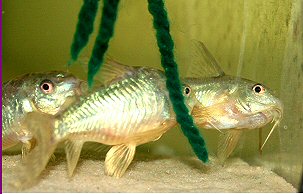
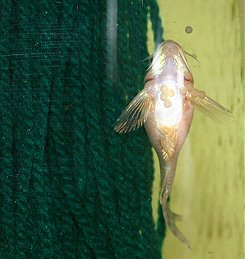
The next morning I carried out another 40% water change, fed the fish and went about my daily routines. In the early evening I re-entered my fish house and thought ‘yippee’ their spawning as one female had two males in close attention. Upon closer inspection I noticed that she also had her two ventral fins clasped together, so grabbing my camera and unfolding my chair, I sat down to observe them spawning! But there was a slight problem, although the male(s) and female(s) were assuming the classic “T” mating position and that the females had their ventral fins clasped together, I could not discern any eggs either on the glass sides of the tanks, in the nylon spawning mop or indeed upon investigation, between the clasped ventral fins. This activity continued on and off during the rest of the evening with not a sign of an egg being laid, so I locked down my fish house for the evening and retired. The next day I only carried out a 15% water change, reasoning that the water parameters must be very close to the optimum spawning conditions and that I didn’t want this to change too much. It was later that day that I noticed that the males and females were again assuming the classic “T” mating position but this time I saw about four to five eggs in the pouch created by the clasping of the females ventral fins, also after a quick glance around the tank I noticed that there were a dozen or so eggs attached to one of the sides of the tank, so again I grabbed my camera, unfolded my chair and settled down to observe them spawning, It was during this period that I checked and made notes of the water parameters, which were as follows: - pH 6.7,GH 3ºC and a temperature of 23ºC,and took some photographs, over the next 24 hours I collected a total of 124 eggs and placed them into hatching trays. Due to limited ‘growing on space’ at the time, I effectually stopped the spawning by moving the fish into another tank which had a higher temperature, and a neutral pH, and that contained varied other fish. The eggs hatched some 36 hours later, and after a further day and with their yolk sac no longer evident I moved them from the hatching trays into a small 3 gallon (UK) growing on tank, and fed the fry on a diet of liquid fry food and micro worms. After five days I stopped feeding the liquid fry food and fed the fry micro worms fine flake powder in the morning and newly hatched brine shrimp every evening, carrying out a 10% water change on the fry tank, using aged water that had the same pH and temperature of that of the fry tank, daily each morning, this continued for two weeks and as the fry were growing rapidly they were moved into a larger ‘growing-on’ tank.
So eggs attached to one of the sides of the tank, so again I grabbed my camera, unfolded my chair and settled down to observe them spawning, It was during this period that I checked and made notes of the water parameters, which were as follows: - pH 6.7,GH 3ºC and a temperature of 23ºC,and took some photographs, over the next 24 hours I collected a total of 124 eggs and placed them into hatching trays. Due to limited ‘growing on space’ at the time, I effectually stopped the spawning by moving the fish into another tank which had a higher temperature, and a neutral pH, and that contained varied other fish. The eggs hatched some 36 hours later, and after a further day and with their yolk sac no longer evident I moved them from the hatching trays into a small 3 gallon (UK) growing on tank, and fed the fry on a diet of liquid fry food and micro worms. After five days I stopped feeding the liquid fry food and fed the fry micro worms fine flake powder in the morning and newly hatched brine shrimp every evening, carrying out a 10% water change on the fry tank, using aged water that had the same pH and temperature of that of the fry tank, daily each morning, this continued for two weeks and as the fry were growing rapidly they were moved into a larger ‘growing-on’ tank. The main things that I advocate are: - Good water quality, a balanced diet, healthy fish, time and patience. Good water quality, diet, and healthy fish explain themselves, time and patience is down to the individual. I chose Corydoras paleatus for this study in spawning by design, not only because I had a small group already in my possession but because as I have said, I find that I can usually get these to spawn without great difficulty, although I have to say, that I used to have another group of C. paleatus many years ago that I could spawn readily, as long as it was between September and November; they simply refused to spawn in any other period, no matter what I tried, and this where time and patience comes into it. One has to be willing to wait and not expect instant success, if one thing doesn’t work try something else, if by carrying out cold-water changes doesn’t happen to trigger a spawning; try altering the pH at the same time, or altering the hardness, the tap water in my area is soft, whereas in other areas, the tap water is hard, so changing the hardness may work on certain types. What apparently works for me might not necessary work for you, but remember only change one thing at a time, and be patient, give each change time to maybe take effect. But remember also that It is a hobby and no matter how good one thinks he or she is at breeding tropical fish you won’t become a millionaire, so just enjoy your fish and delight in any successful spawning that come along. Other Corydoras catfish that I recommend for aquarists wishing to try their hand at breeding, along side H. paleatum are, Osteogaster aenea and Gastrodermus pygmaeus.
All images by author Update: Placed in Lineage 6 which has always been classified as Corydoras (Lacépède, 1803) so a new genus would need to be described and a new type species when a new revision is carried out. As of the latest revision (Dias et al 2024) Corydoras paleatus has now been placed in Lineage 9 and has the new genus name of Hoplisoma and a change to the specific name to paleatum.
|
 s
someone who over many years have had some success in
spawning many species of tropical fish, I always get
a little nervous, when asked the question, “How
do you breed a certain species”? As answering
this sort of question, no matter how sincere one is;
can be a tad precarious. There are some people who think
that there is a magic formula and that you are keeping
it to yourself. I tend to look at things as “You
are keeping water not fish”, get the water conditions
right and the fish will for the most part be healthier,
and more willing to spawn, all that is needed, is a
healthy diet for some, while others need these things,
plus a “triggering” event in order for them
to spawn, one such event can be a water change using
cooler water.
s
someone who over many years have had some success in
spawning many species of tropical fish, I always get
a little nervous, when asked the question, “How
do you breed a certain species”? As answering
this sort of question, no matter how sincere one is;
can be a tad precarious. There are some people who think
that there is a magic formula and that you are keeping
it to yourself. I tend to look at things as “You
are keeping water not fish”, get the water conditions
right and the fish will for the most part be healthier,
and more willing to spawn, all that is needed, is a
healthy diet for some, while others need these things,
plus a “triggering” event in order for them
to spawn, one such event can be a water change using
cooler water.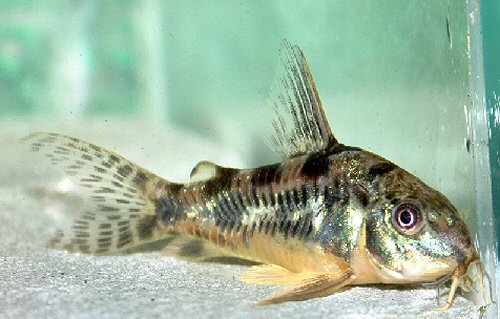

If you would like to contribute an article, please e-mail me. You will of course be credited for your work.
If you would like to donate any denomination of money to the site just click the above link button. All proceeds will go to running the site and hopefully to keep it going for a few years yet.
Print or e-mail this article below


