SCOTCAT.COM
your internet guide to all things catfish
| Our house catfish, Clarias angolensis | |||||
by Reinhold Wawrzynski |
|||||
Clarias batrachus
The catfish came into a 40 litre aquarium at our home. What had I bought actually there? Yes, it was obviously, for certain a predator catfish. In the literature mentioned before, I found the suitable description, too: Clarias batrachus from the family of the gill bag catfishes, also called walking catfish in Germany. Being from Africa and Asia natively this family owes its name to an additional air breathing organ, the gill bag. One can approximately quite roughly compare the breathing of the animals with the Labyrinther/Anabantoidei. The catfishes can similarly live also in waters with very little oxygen content, so the fish do not seldom go ashore in nature at night and walk into food rich biotopes. In their natural habitat they eat anything they can cope with. The introduction of C. batrachus is forbidden strictly in the USA. Released or escaped gill bag catfishes have increased into the Everglades of Florida on a massive scale and provide a dying out of many local species. Snails, worms, frogs and other amphibians are not safe from them either, so I had a little monster sitting in my aquarium now. The tank had a cave construction and a possibility for the animal to hide.
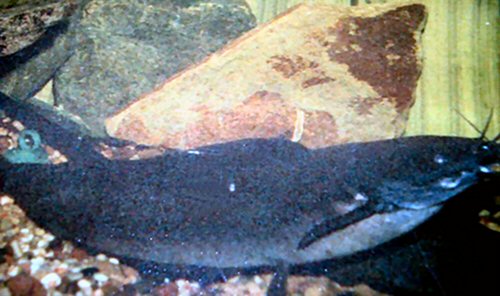
Clarias angolensis
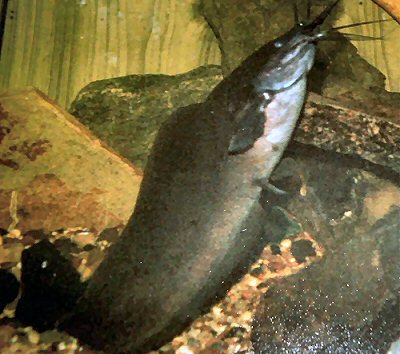
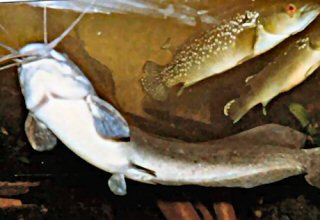
At first the Clarias was rather shy, but the gluttony came through soon at which time, we offered Tubifex lumps, earthworms, flour worms and tadpoles which it could not resist. The fish grew and grew and the tanks got bigger and bigger with time. The Clarias got more and more trusting and snatched beef hearts soon from my fingers. After two years he was 35 cm long and only a little bit broader. Due to its proportionally small size and special colouring I found the right name in the more versatile and technical literature which was now available. It was Clarias angolensis from Africa and the length of 35 cm was definitely correct. The up to 45 cm great batrachus comes from Sri Lanka, Eastern India as well as Malaysia. This is brought over mostly as an albino or female piebald in the trade. The colour dress of angolensis is grey, brownish to anthracite. White small points go diagonal through the lateral line. Albinos are seldom offered and the wild colour is mostly seen on the market.
Clarias angolensis
The care of the two species is approximately the same: Tank for fully-grown catfishes 200 litres for individual keeping, and for socialisation at least 400 litres. Best you take dark soil, stable plants and at least a big cave. The aquarium must still be protected well, weigh the lid down (walking catfish!!). The oxygen is not a strong filtration so this is not too important. Gill bag catfishes are also diurnal, they accumulate, however, to the top of the water at night. The substrate is searched continuously for food and is ploughed constantly.
Temperature: Room temperature, 15-30 ° without problems. These catfishes are not interested in water values at all. When keeping them one should take their gluttony into account. Food tablets green and brown, great flakes, pellets of trout, beef heart, food fish to 10 cm and mussel meat is taken away from you by fully-grown specimens with great pleasure. About 1977 the C. angolensis was in top form. A Clarias batrachus albino was offered to me at a show in South Germany. At the price of 40 DM I could not stand (again I may well been cheated at that time in 1977 with this price!!!) The fish definitely had to come along with me!. The catfish at that time lived alone in a 350 litres tank and I then moved the albino into the tank alongside the angolensis. This was already a splendid sight: angolensis/grey/anthracite and batrachus a little ghostly, albino white with red eyes. The size of the animals was 35 and 45 cm. the batrachus still surpassed its colleague in gluttony. The animal was so avaricious in its assumption that it even bit itself into the tail fin and this tore to pieces while it was busy with its spoils. In the long run this did not turn out all right as the C. angolensis was found one morning with its whole body wounded in a corner of its aquarium with almost all of its fins torn. I wanted to give it a mercy killing but however I did not have it in my heart. The fish was put in another tank and carefully watched and cared for, and after a couple of days the angolensis had recovered a little again and it was getting better, the fins grew again and after some weeks it got back to its old self again. The albino was then picked up by a catfish freak from the Ruhr district after an advertisement at the DATZ. In the course of the years I had my house catfish also socialising with other fish. It did not give any problems with great South American Cichlids like Cichlasoma, Malawi cichlids, 25 cm kissing Gouramis (Helostoma temminkii) or 20 cm Rutilius rutilius. I could state some unusual features during the years of keeping: If he had overeaten, the animal "was" sick and then did not eat for many days after. Three times in the year the fish changed his colour twice. The monochrome grey then turned into a white/cloudy colour drawing over the whole body for 1-2 days (spawn colouring?), then over months it became monochrome again. One should use smooth vessels like 10 litre buckets or very big plastic bin bags when catching these catfishes. In all nets the candidates jam themselves with their very strong pectoral fins, the specimen will then beat very strongly and wildly around itself. Once you catch the fish out of water then you get a quite beautiful shower. The catfish then gives clattering noises, similar as thorn catfishes in the net. When I had not weighed down the glass lid once correctly, little “Clare” went ashore at night!. I found it under a cupboard the next day half dried up, he looked mummified, but he was normal again within the next few days after being reintroduced back to its aquarium. Something like that could similarly happen in nature perhaps once, too.
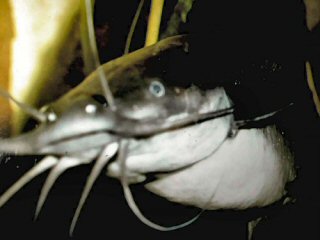
Clarias angolensis
More than 18 years the catfish was my/our domestic animal. Caused by a professional, short-term change of address to Hanover I could not accommodate all my aquaria in the new smaller flat. I reluctantly submitted the animal to a friendly catfish enthusiast. After a year the fish died at my friends for unknown reasons in its tank. The blow perhaps had hit him. I have kept in the following years other catfishes, also bigger species. But I did not have as much joy as I had with my Clarias angolensis, not with any fish... Perhaps you have come onto the taste a little, now one also can keep "sturdy boys" quite good. However, one should be conscious: This care then must go on for years, therefore not for for "flash in the pan natures". I have by the way seen a whitely/blackly spotted kind of Clarias at my last visit in a book in America 2000. Meanwhile you can buy this specimen quite often. Perhaps some time I will fall back to C. batrachus or C. angolensis. Many thanks for
your attention. |
 t
was love at first sight!. I saw this fish for the first
time in the summer of 1972. I had admired it before
in the black and white photos in Dieter Vogts small
book about catfishes and also in the Sterba book. It
was in front of me now in a garden centre in a bare
100 litre tank. It was being kept together with about
50 goldfishes . The incompetent assistant from the fresh
flower department was quite enthusiastic that I wanted
to buy the non-seller. “You can have this one
for 5 DM. in another tank he has already eaten up all
the neon fish" she said. We got out fast with our
purchase.!
t
was love at first sight!. I saw this fish for the first
time in the summer of 1972. I had admired it before
in the black and white photos in Dieter Vogts small
book about catfishes and also in the Sterba book. It
was in front of me now in a garden centre in a bare
100 litre tank. It was being kept together with about
50 goldfishes . The incompetent assistant from the fresh
flower department was quite enthusiastic that I wanted
to buy the non-seller. “You can have this one
for 5 DM. in another tank he has already eaten up all
the neon fish" she said. We got out fast with our
purchase.!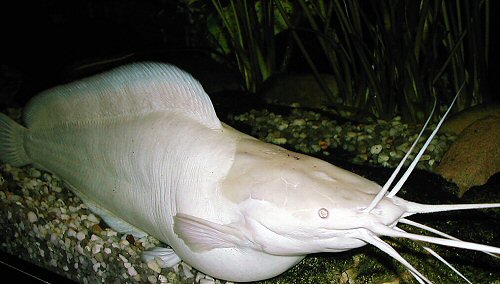



If you would like to contribute an article, please e-mail me. You will of course be credited for your work.
If you would like to donate any denomination of money to the site just click the above link button. All proceeds will go to running the site and hopefully to keep it going for a few years yet.
Print or e-mail this article below


