SCOTCAT.COM
your internet guide to all things catfish
| Initiating reproduction with the Walking Catfish (Clarias batrachus) | ||||||||||||||||||||||||||||||||
by Wolfgang Ros |
||||||||||||||||||||||||||||||||
Clarias batrachus
What had happened?
Was the spawning season for the animals, at least
in my aquarium, at an end? Were there otherwise any
differences (on-due dates)?. The couple were still
in top form: Male, like the female, were avaricious
eaters and otherwise did not show any deviations in
their behaviour and the pair-bonding was unchanged.
The initial situation for another spawning seemed
to be therefore favourable for me but obviously there
was a lack of certain circumstances to push forward
again the courting formality so often to be watched
and to initiate (activate) a further reproduction.
An alternative discussed in an Internet catfish forum, namely the sole reduction in the water-level about ten centimetres under retention of the usual temperature of 24° degrees Celsius, also did not lead to any success. Further attempts of which I brought respectively additional factors in the game and varied them, finally provided the desired result - my Walking Catfish pair spawned once more!. In the morning at eight o'clock the female after many hours of courting they ejected eggs. A number of further matings, which dragged on up to the early afternoon, followed after more than about six hours. At first and to the end of the spawning act, only about 100 eggs were given. Within the hours between this however, it was also 500 and more.
With this mating, about 500 eggs are ejected.
With on an average given to about 200 eggs per mating and at least four matings in a hour this 40 centimetres long female almost dropped 5.000 eggs. This is remarkable in this respect, as the female has grown in the last nine months, a further two centimetres, however the number of eggs at that time had been considerably under 1.000. The animal ( female Clarias batrachus) however has strongly grown in the breadth at this time especially the first half of the head and belly. In its length it has been growing since the last 18 months, only about two centimetres, and obviously seems to be more massive than before. This indicates that eggs must have developed constantly in the belly of the female (now 5.000 eggs, before only 1.000!). These eggs, however, would have not been ejected not until later without the stated changes. But I will come back to that later. In the meantime after another three, in the interval of approximately a month, successful tests of sticking to the same "recipe“ I have arrived at the conclusion that the reproduction, specifically of Walking Catfish's, can be initiated in relatively short intervals of a few weeks if the following framework conditions are created or changed gradually. They simulate at large the natural environmental changes as the results show, especially during the monsoons with their long continuing strong rains and following inundations in the native countries of these animals. All factors together lead to spawnings in inundated areas like paddy fields, in which the water is already, due to the low level, warms up quickly to 28 or even 30°c. There the older animals which have lived before in the most different water conditions, a food area opens itself up which is rich in insect larvae, worms and so on and also where their descendants in this regard were looked after very well and additionally the young catfishes there can find possibilities of shelter. The experiences introduced here can presumably be also used for other Clarias species, if not even transferring it to some other catfish families or motivating to think a little in this direction. General
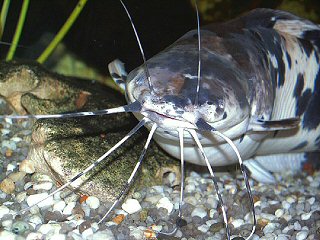
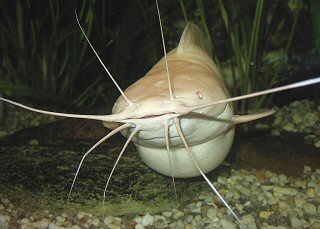
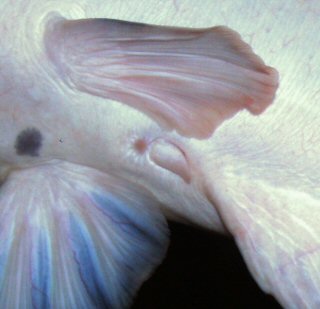
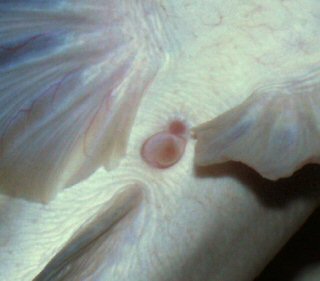
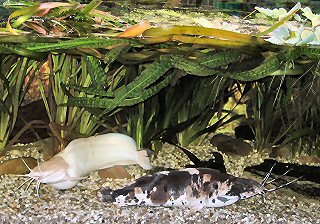
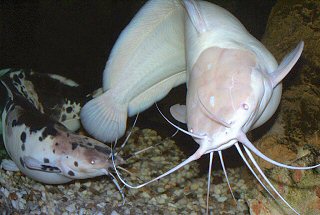
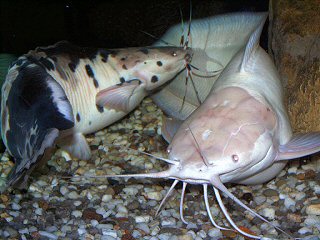
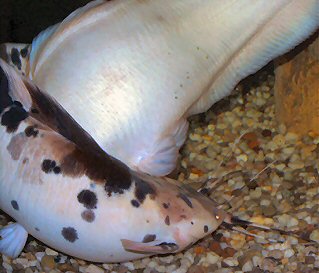
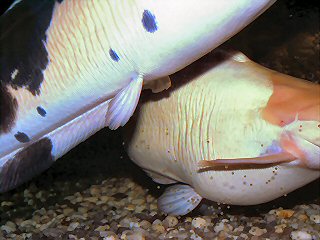
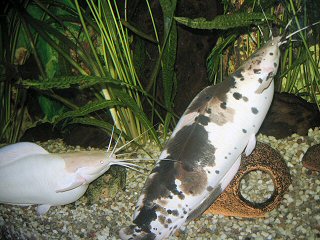
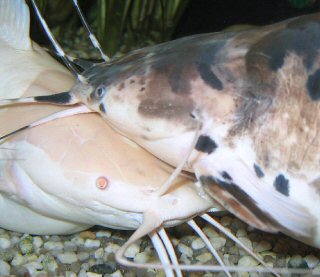
conditions: If one is not able to distinguish the sexes due to their appearance - the female is more corpulent and more massive than the male. Also outside the spawning season – one can observe the differences with a length of about 20 centimetres due to the form of their genital papilla. The male is sharpened at the end, with the female however short and oval.
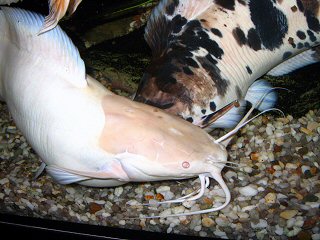
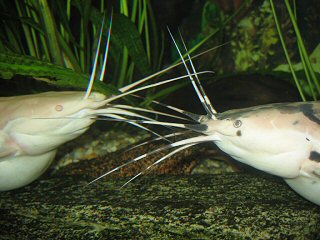
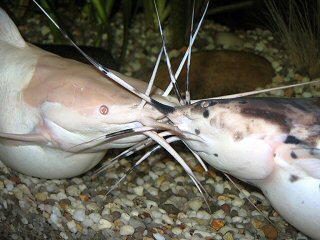
A couple well harmonizing with each other is really looking for the proximity to each other. The animals conspicuously frequently go "on physical contact". They rest approximately in such a way that they make and keep in touch with each others fins or barbels. First
preparations: At this time one should refrain from the serving of living food and confine oneself alone on cichlid sticks, tablets, Forelli (Trout feed) and similar. The animals also should get food only once a day and then only so much food so that they are always still hungry. The usual water changes of about 25 per cent have to be carried out like always at regular intervals. Important
changes: By the way, what the animals eat best depends which food was given to them in their youth. Clarias batrachus keepers have confirmed that animals raised in aquaria to which exclusively several ready convenience food mixtures had been given exclusively in the first months of life soon ate those avariciously. This food, whether food tablets, Acipenser pellets or cichlid sticks, are able to "recognize" the food even after a long time. In such a way raised Walking Catfish then used to their preferred convenience food clearly over even living food, which they have not got until later and which is offered as a trial.
Parallel to the food rearrangement a generous water change is carried out by approximately half of the volume within the next days. The supplied cooler water can even lead to another, merely short-term reduction in the temperature of about one to two degrees. Feigning an inundated area of the tank contents by supplying a good water preparation by filling up again by about 85 per cent of the total volume and lowered again by about ten per cent on the day after the water change so that the water level is only 45 centimetres in the end at a height of 60 centimetres. Anyway if the aquarium is only 50 centimetres high, then a lowering at five centimetres each in of these two steps to about 40 centimetres is recommended. The leaving out of the top of the filter can lie over the surface so that the water can audibly flow well into the tank from above. To increase the flow effect in this place further, a more efficient internal filter should still be placed if necessary.
In the end the temperature is increased to 28° degrees Celsius gradually within the next three days after the variations in the cooling which the rains bring about in nature been lowered to the described 21 to 22° degrees Celsius. Since due to this warming and the more active way of life, the appetite of the animals still grow. They are then further fed extensively with their favourite foods.
First
spawning preparations:
Many a reader may smile now but this effect can still be strengthened by a background noise like loud music for one to two hours on the day. These sounds in connection with the stronger flow are apparently an indication for the catfishes that the rainy season with their monsoon thunderstorms, or that the rising of the waters is coming, or has already started. Both partners start with the first dig activities which are clearly different from those of the animals when they rummage the bottom for food. They are concentrated on a certain place, namely the latest spawning place and are accompanied mostly by the wafting movements of the chest and tail fins which becomes particularly clear when digging of the pit by the male.
If the pit is dug, the first mating's follow at which however no eggs are delivered. From time to time the animals take breaks of several hours over a few days which are however interrupted by intense courting and recent mating's again and again. These "feignedly mating's" might accelerate the formation of further eggs.
The first matings without ejecting eggs
Then it
is ready!
Nevertheless at such precautions a larger portion of eggs becomes fungal, particularly after about 15 hours. Due to the variety of the fungal eggs - from the calculated 5.000, 10% would hatch, and therefore over 4.500 threatened to ruin the water - the water starts to become cloudy which can only be stopped with a very good filtration. I warn against a water change in this phase. Due to the disturbances connected with that it can said be that the male does not return to the spawning place any more and stops the care of the offspring, the clutch is then ruthlessly exposed to possible spawn predators. Already a couple of Botia lohachata or Chromobotia macracanthus are able to track down unerringly the few young fish hatched out and to consume them.
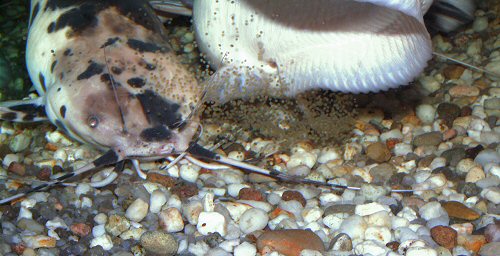
Some of the large number of eggs at the bottom of the shallow pit
The very high contingent of fungal eggs could be explained with my animals in that the spotted male originated from a hybridization and has only a restricted fertility rate. The number of the eggs from which young fish can develop also after fertilization would then already be very low, however this is an assumption. Under circumstances the change of other water parameters or use of another product against spawn-fungal could bring better results, however to do this it requires additional tests.
Here the first eggs already have fungussed after 12 hours
However it already now seems to be sure that the eggs of Clarias batrachus are generally more delicate against fungal infection. A British aquarist reported to me of a coincidental spawning of his semi albino Walking Catfish couple. There a large portion of the eggs also fungussed after 20 hours and only a few larvae hatched out. With an experimental attempt carried out in Indonesia in 1990 to transport the eggs of Walking Catfishes (here it can only have been the wild form) into aquaria and to let them develop in those tanks, separated from the parent animals, they indicated explicity the fungal infection of the jelly-like mass which surrounds the eggs. In an abstract given at FishBase/LarvalBase it is recommended to water the eggs immediately after the spawn act for five minutes in a one per cent sodium sulphite solution, to wash them three times into tap water and not until then to give them back to a separate tank, so a fungal can be avoided. However, this procedure may be left to these persons who actually want to raise young animals in a larger number and who are already clear in their minds where to distribute them later. Flexible
females:
Here the female feels very secure, lots of eggs are ejected on this spawning day, with all matings altogether about 5.000
Some notes:
Water level raised again, then it was again lowered, after two more changes the pair spawned
As recently as with the slipping of the fry the female returns a few times to the edge of the nest. It comes to rapid movements of both animals there. The male tries to push the female away immediately by "rebelling" vertically in front of his partner, taking a threatening attitude with an open mouth and beating with the tail fin against the body of the female. However since the aggressiveness of the female animal suddenly increases at the same time once again, it can be that, especially when pursuing other fish, it penetrates unintentionally into the immediate nest area whose guarding of is incumbent alone for the male. The male will then fend it off with hectic, extremely fast swimming movements. These are, however, so stormily carried out with such a speed that, especially big animals, thereby (rub the wrong way up to filters, stones and so on, without biting each other) are able to suffer injuries of the fins and barbels.
However the keeper does not have to worry because of this yet because Clarias batrachus are quite robust and seldom affected by illnesses, like almost all catfishes. Injuries of the fins have already healed completely after a few weeks. Even damaged and almost whole snapped off barbels have regenerated itself again at this time. The fish are however more delicate of injuries on the skin. These can infect quickly, and cure themselves comparatively slowly, even at the best water care and the use of a special mucous membrane protecting water preparing product.
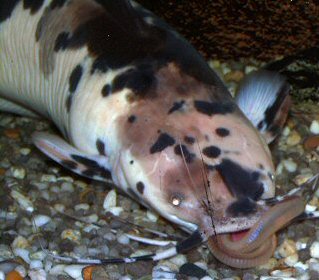
Walking Catfish with three damaged barbels which already have begun to regenerate
If the couple has stopped the care of the brood after some days, the temperature can be lowered to about 24° degrees Celsius again gradually. After a break of some weeks one can keep this value as a temperature before a recent change of the factors stimulates a further reproduction. Already sexually mature but even younger animals can more frequently reproduce in comparison with fully-grown specimens and undercut even the four week distance, though altogether the number of eggs per spawn act with older females is higher about a multiple. Since mine are only two years old and with its 40 centimetres, not quite fully-grown, in the end attainable numbers from 8.000 to 10.000 eggs should be realistic. How is it with the maximum size of the animals in the aquarium at all?. At least the albino and partial albino specimens who are offered now and then in the ornamental fish trade usually don’t get much bigger than 40 centimetres in size and according to feedbacks of Walking Catfish keepers even after many years, do not exceed the mark of 45 centimetres (in one case however there is a reported specimen of 52 centimetres). Therefore different from the predatory catfishes of South America who nearly almost get bigger, one can keep this species in the long run in a one and a half and up to a two metres long tank.
Summary: Surely it is not advisable
to persuade the animals continually spawning by
a permanent change of the factors influencing their
reproduction. Spawn acts too often provoked in this
way might in the long run even weaken them. The
use appropriately makes sense if even adult pairs
have not reproduced yet at the otherwise optimal
keeping conditions. My thanks apply
here for the Datz editorship and their editor-in-chief,
Rainer Stawikowski, who gave me kind permission
to publish the article on ScotCat.
Here is the original text, only some photos have
been updated and new ones added.
|
||||||||||||||||||||||||||||||||
 have
already reported about the spawning of my Walking Catfish
pair in Datz 7/2004 and
at that time the animals without my assistance spawned
four times in a period of only five months. Then their
reproduction interest disappeared very sudden for some
time and didn’t want to wake up again even after
several months.
have
already reported about the spawning of my Walking Catfish
pair in Datz 7/2004 and
at that time the animals without my assistance spawned
four times in a period of only five months. Then their
reproduction interest disappeared very sudden for some
time and didn’t want to wake up again even after
several months.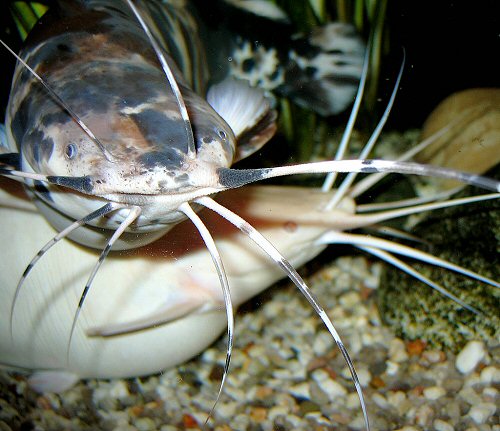






If you would like to contribute an article, please e-mail me. You will of course be credited for your work.
If you would like to donate any denomination of money to the site just click the above link button. All proceeds will go to running the site and hopefully to keep it going for a few years yet.
Print or e-mail this article below


