SCOTCAT.COM
your internet guide to all things catfish
| Not So Angelic (us) | ||||||||||||
by David Marshall |
||||||||||||
Background
Synodontis
angelicus
Synodontis angelicus
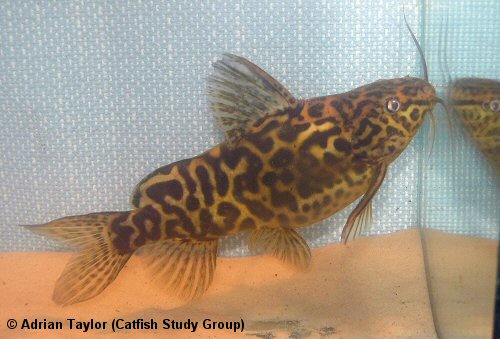
Synodontis
schoutedeni
Synodontis schoutedeni
The
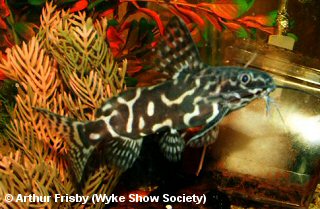
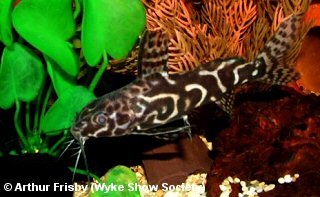
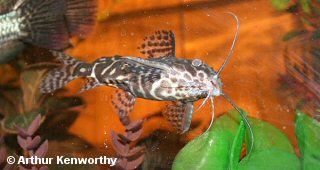
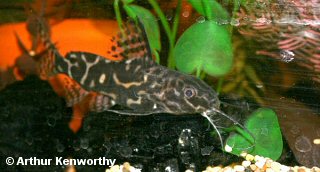
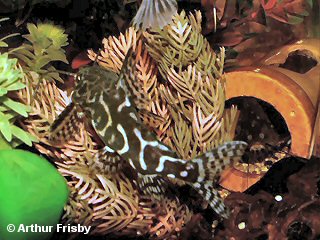
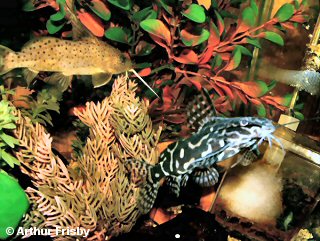
hybrid A few weeks later, and at a different outlet, my eyes were drawn to a label that proclaimed ‘Synodontis species’. When the beautiful little fish emerged from its favourite tube I realised that it was something different and the patterning of the fins (clearly angelicus) and foreground white waves on the body (clearly schoutedeni) gave away the hybrid identity. The assistant quickly had it caught and ‘bagged’ for me.
On arriving home the angelicus hybrid, as I refer to it, was placed into a 60x30x30cm aquarium with a Synodontis petricola x nigrita hybrid, a small Mystus gulio, several young Ancistrus and 2 male and 5 female Dutch Pearl Mouthbrooders (themselves a hybrid specie of Oreochromis) from my 4th generation of these lovely fish. As the photographs show (above) the body of my angelicus hybrid has a typical young angelicus shape with fins to match. The foreground shows no spotting but has a lovely bright white (sometimes taking on a golden hue) schoutedeni pattern.
Synodontis petricola x S. nigrita hybrid
I have no idea as to exactly what the young S. angelicus hybrid was fed with in Eastern Europe but with me it would only eat vegetable-based flaked foods (as can be the case with both wild caught and aquarium bred Synodontis decorus). Today this little beauty takes all types of flaked foods, granular foods, catfish pellets and small pieces of both prawn and Thai crabstick. Growth has been on par with a young S. schoutedeni. In behaviour ‘his’ actions are less boisterous than angelicus and he hides away much less than can be expected from S. schoutedeni. Now in a 90x30x30cm aquarium, and in more mixed company than when ‘he’ first arrived, he is not a complete model of good behaviour but is more placid than many of the Synodontis hybrids of Eastern European origin.
Talking with several aquatic retailers revealed that all of the first ‘batches’ of this angelicus hybrid were identical in colour pattern etc. to the fish in my care but the situation is now changing with a whole range of patterning showing through in new ‘batches’. How is the hybrid
created? Little wonder then that on ethical grounds the production of hybrid Synodontis is a very thorny issue that causes great differences and debate among aquarists. Personally I feel that there is a need to catalogue as many of the hybrid Synodontis (which is not a ‘one person project’ as some seem to appear in one area of the World and not in others depending on where a particular consolidator has customers) as we can as some, for example ‘species Ice' (an S. ocellifer variant) and the brightly coloured S. njassae crossed with ‘Czech pardalis’, seem to arrive with us as ‘one time only shipments’ and it is not to say that the production of any form of hybrid fish will continue in the long term. Finally I do not think that anyone looking at the photographs that accompany this article could argue that the S. angelicus crossed with S. schoutedeni hybrid is not a beautiful fish.
Text by
David Marshall (Ryedale Aquarist Society) |
||||||||||||
 e begin our article with a look at two species
of Synodontis that are very popular in the
aquarium hobby.
e begin our article with a look at two species
of Synodontis that are very popular in the
aquarium hobby.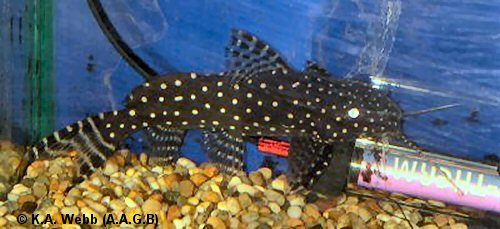


If you would like to contribute an article, please e-mail me. You will of course be credited for your work.
If you would like to donate any denomination of money to the site just click the above link button. All proceeds will go to running the site and hopefully to keep it going for a few years yet.
Print or e-mail this article below


