SCOTCAT.COM
your internet guide to all things catfish
| Bullheads - as of today and times gone by |
by Reinhold Wawrzynsk |
Ameiurus nebulosus
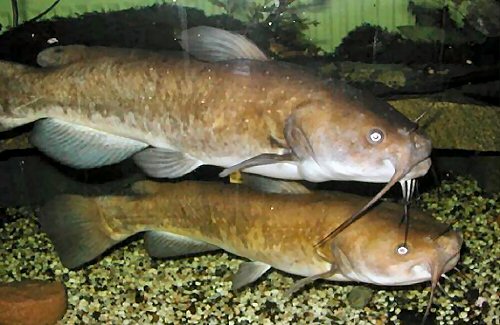
The female above is fundamentally plumper and more compact than the slimmer male
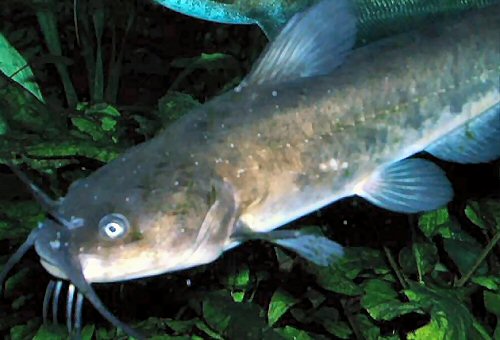
Unfortunately, which species I kept in my youth does not have to be stated any more. It was probably Ameiurus melas, (Black Bullhead) but experienced catfish experts in these days could hardly distinguish between the two species. A. melas is a deep black as a juvenile while A. nebulosus is a more charcoal-grey. With progressive age the animals then get more and more greyish with earthy brownish nuances. The belly is bright, often whitish to a plain or a cloudy grey colour. Many small white spots often round off the colour phenotype. In my younger days these catfish, with 15 up to 20 cm length, grew too big for me, so in former times the usual aquarium size was just too small and the price of large aquariums were too prohibitive. Today aquariums with three or four hundred litres are definitely affordable so one can now offer the catfish a sensible tank size.
Adolescent catfish, about 2 years old
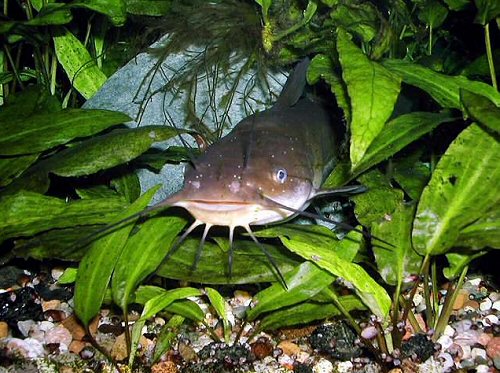
My two animals have achieved a size of 30 to 34 cm over the last four years. In the last year they has been no more growth in the length, at this time they got plump, higher and much sturdier, they are looking really good now. The aquarium is not heated, yes bullheads are cold water fish. Water temperatures can be between 18 to 25° nevertheless in the field of good airing and filtration this does not cause the animals any problems. One should, however, watch and provide cooling on time in summer. In the heat the good old water change has still proved the best option. Aquarium heaters are just too dirt-cheap against the utopian prices of good refrigeration machines. The catfish tank is not illuminated either, what catfish loves the glaring light?. A north window is about 1.50 metres away and brings in sufficient light to the fish. The catfish ambiance is filtered by the generous so called, Hamburg mat filter. One often reads in the literature that this catfish does not like a water flow but this does not disturb my two and the water is always crystal clear. These catfishes do not dig in the aquarium substrate as one knows from the Clarias species. The aquarium contains the normal aquarium gravel of rough granulation and some round stones but one should offer caves as a shelter in every case. Deep seated or stuck stone plates are best suited so that there is no slippage and the animals do not hurt themselves.
Male of about 8 cm of length
As young fish all catfishes lie best of all in a cave, later in old age they prefer individual accommodations. Some Vallisneria gigantea in flowerpots round off the picture. Of course they must be exchanged from time to time because of the lack of light. A strong growing of algae on stones and other decorative material does not look unnatural. Even algae of the species Florideophyceae Nemaliales Rhodochorton can look decorative. There are algae countries also in nature and whoever keeps bigger catfishes would not like to have or get a Dutch planted tank.
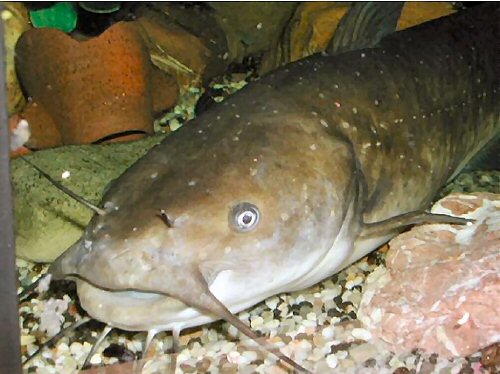
My biggest specimen
With food my fish are easily satisfied. They love food tablets, green or brown with or without Spirulina. Great flakes also are eaten and “Forelli”- pellets are taken gladly, however one should feed them extremely thriftily because of the strong pollution danger. The known red, black and white frozen mosquito larvae are also taken with pleasure. Of course half a panel is consumed fast for a meal there. With water-fleas and other little food one does not make yourself popular with the animals. Earthworms, self found are a delicacy for catfish, however, caution is advised e.g. with bought worms again out of angler business's. Feeder fish whether living or dead I do not offer A. nebulosus, I have tried it with guppies once but tablets are apparently more delicious anyway!. By the way I have had adolescent Ancistrus species swim in the same tank without having being eaten by the bullheads. For the aquarist who is interested in their cultivation, it is said that reproduction is extremely rare even in the greatest aquaria. Probably it seems to be important to have a quite cool wintering period. Young catfishes are frequently offered in spring as pond fish in garden centres and specialised dealers, use this opportunity and you will be pleasantly surprised by the prices.
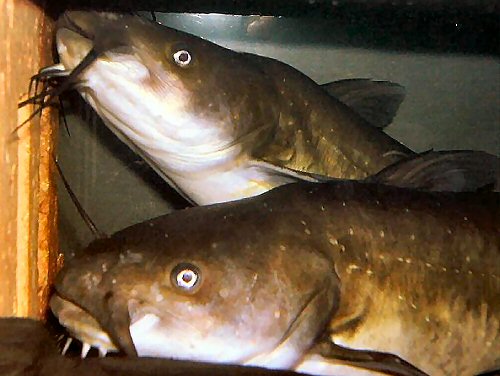
A couple shares a cave, a rare matter in old age
But please do not keep bullheads in a garden pond, the animals often die because of the voracious rivalry of food from the likes of Koi-Carp and Goldfishes. If these catfish survive one can hardly watch them since they live in the darkest corners of the pond. These marvelous animals are kept much better in a spacious aquarium, where one can watch them correctly. But do not buy too many animals, consider the final size!.
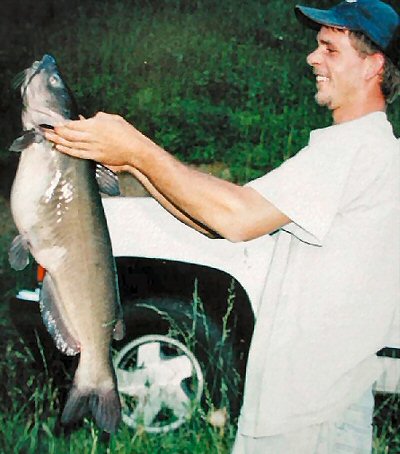
Fishing in the USA, Ictalurus punctatus, clearly recognised by the split tail fin
Bullheads natively come from North America where a lot different species live. Some get quite big and are popular fishing-fish in the states. Also I was lucky enough some years ago to fish for bullheads in the USA. Ameiurus nebulosus becomes about 40 cm in nature and in the past in the USA, bullheads had to serve as a meal, often for slaves.
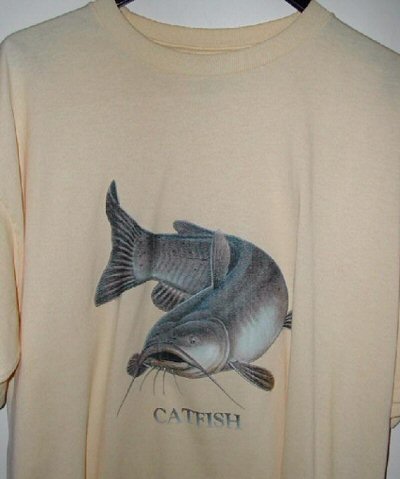
I. punctatus is even shown on T-shirts
In Germany bullheads were imported approximately from the year 1900 and released into native waters. Even today in many areas there are frequented. Fortunately bullheads never became the great adventure for friends of fishing and in aquariums this species is also much better than in the frying pan!. It’s a cheap fish for individualists who are seeking the special and don’t want fashion fish. At the acquisition one should at once prepare for long standing care and keeping because catfishes are not fish for one season.
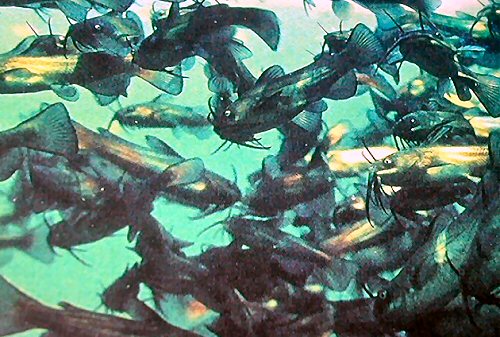
Young fish are often offered as pond fish in masses in the spring
See also report in
DATZ 11/04, pages 10
|
 ractising aquarists of the 1960s
or even still older have often kept in their childhood
or youth one or more catfish together with their goldfishes.
This was often the way of getting into aquaristics and
this was also the same with me. Although I am still
a couple of years older than the 1960s period, I too
had fall in love with those black goblins at that time.
And as this is so, old loves never die. Also today I
have kept again for a couple of years now some Ameiurus
nebulosus, the so called "Brown Bullhead".
ractising aquarists of the 1960s
or even still older have often kept in their childhood
or youth one or more catfish together with their goldfishes.
This was often the way of getting into aquaristics and
this was also the same with me. Although I am still
a couple of years older than the 1960s period, I too
had fall in love with those black goblins at that time.
And as this is so, old loves never die. Also today I
have kept again for a couple of years now some Ameiurus
nebulosus, the so called "Brown Bullhead".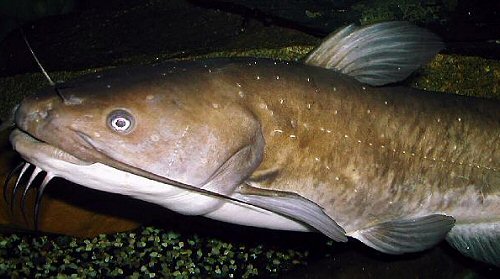

If you would like to contribute an article, please e-mail me. You will of course be credited for your work.
If you would like to donate any denomination of money to the site just click the above link button. All proceeds will go to running the site and hopefully to keep it going for a few years yet.
Print or e-mail this article below


