SCOTCAT.COM
your internet guide to all things catfish
Ictalurus
punctatus or "Getüpfelter Gabelwels |
by Reinhold Wawrzynski |
|
I. punctatus in his juvenile colours
It is difficult to get the Channel Catfish here in Germany but I was lucky in June 2007 to get one specimen at “Köllezoo” in Stuttgart, there my friend Wolfgang Ros had him reserved for me. The mite was only about 6 cm long and I already feared problems for the long drive to Hanover where I live. The kind employee of this shop however packed the catfish into a gigantic plastic bag and filled it with oxygen. So everything turned out all right anyway.
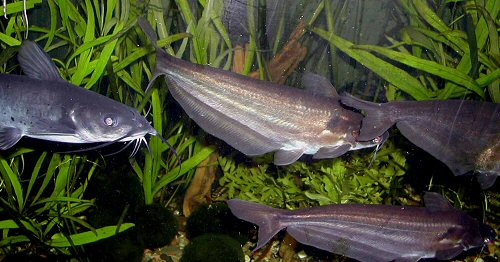
The animal has grown until today, approx. 9 cm. I know what is coming to me as the final length should reach 70 cm later or perhaps longer, however since I’m also keeping other big catfishes in big aquariums I am already used to it. Of course for a normal community tank this fish is not the right one. He only can be kept in a species tank. Probably this species can be kept with other Ameiurus catfishes or other big fish species. My Ictalurus punctatus is swimming in a 300 litre tank and he is used to following a swarm of Silver catfish (Schilbe intermedius). The colouring and and the kind of fins are a little similar but though not the same. He seems to feel quite settled.
Again and again you can see Ictalurus punctatus swimming in the swarm with Schilbe intermedius
|
 find
the American name "Channel Catfish" much more
appropriate than our German name for this species "Getüpfelter
Gabelwels". This catfish anyway is known to be
a challenge for every experienced catfish keeper.
find
the American name "Channel Catfish" much more
appropriate than our German name for this species "Getüpfelter
Gabelwels". This catfish anyway is known to be
a challenge for every experienced catfish keeper.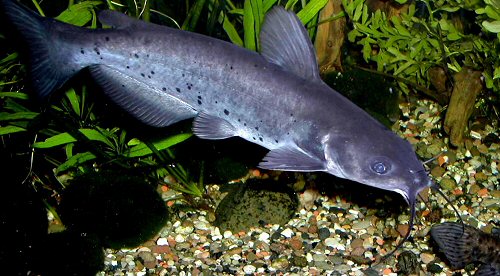
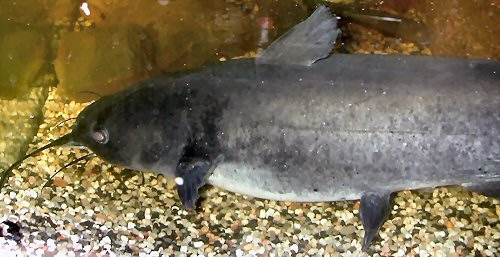
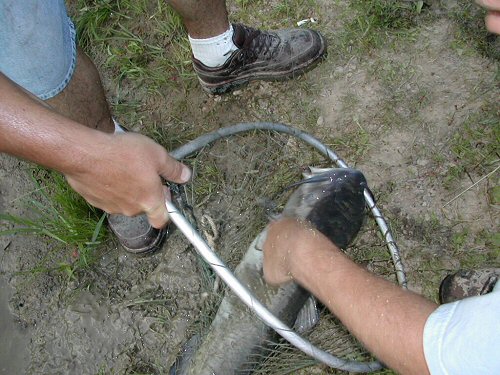
Fishing in Kentucky, getting a big I. punctatus
Although in the specialist literature shaded tanks are recommended my fish swims in an aquarium well planted and with quite normal light. Of course one must offer caves and hiding-places. The tank is without a heater and the temperature is about 22° c. A great “Juwel Jumbo” filter keeps the water crystal clear. The water is changed every 14 days around about one third. Ictalurus punctatus eats great flakes and food tablets without any problems, frozen mosquito larvae is also taken. This catfish however is also quite greedy like my other blue catfishes (Ameiurus nebulosus) if there are given fresh earthworms. Different frozen fish fillets, divided of course into pieces, are also offered. There is also
an albino form besides the wild colour which is kept
with pleasure in garden ponds in the USA and Great
Britain. The trend could come also towards Germany
too. The bright colour variant is taken with pleasure
because one can hardly find the natural colour in
a pond.
|
Text
(status: October 2007) and pictures: Copyright Reinhold
Wawrzynski Edited by Allan James. |

If you would like to contribute an article, please e-mail me. You will of course be credited for your work.
If you would like to donate any denomination of money to the site just click the above link button. All proceeds will go to running the site and hopefully to keep it going for a few years yet.
Print or e-mail this factsheet below


