SCOTCAT.COM
your internet guide to all things catfish
Platystacus cotylephorus (Bloch, 1794) |
Image contributors to this species: |
Klaus Dreymann (2) Allan James (1) Johnny Jensen's Photographic Library (2) |
ScotCat Sources: |
|
|


Other Sources: |
|


Relevant Information: |
Aquarium Care: Very peaceful species which will do well in a quite community tank where the tank mates are non-aggressive. Spends most of the day buried in the sand substrate. Provide sand as a substrate and a planted dark area to make them feel more secure in their surroundings. Can be kept in fresh or brackish water systems. The males are more colourful than the females and also possess a longer dorsal and pectoral fins. Reproduction: The eggs stick to the females abdomen after spawning. Short stalks appear with the eggs attached and only disappear when the eggs hatch. Diet: Live and frozen foods such as mosquito larvae, tubifex, earthworms, whiteworms and small crustacea. Tablet foods and sunken flake that lies on the bottom is also taken. Etymology: The genus name platystacus: Platys = broad; acus = needle. The specific name cotylephorus: meaning sites for the attachment of developing embryos, refering to the eggs hanging from the ventral area. |
Common Name: |
Mottled Eel-Tailed Banjo Catfish |
Synonyms: |
Aspredo cotylephorus, Silurus hexadactylus, Cotylephorus blochii, Aspredo sexcirrhis, Aspredo spectrum, Platystacus nematophorus |
Family: |
Aspredinidae |
Distribution: |
South America: Coastal waters and lower portions of rivers of northern South America, from Venezuela to northern Brazil. |
Size: |
30.0cm. (12ins) |
Temp: |
22-25°c (71-77°f.) |
p.H. |
|
6.5-8.0. |
Reference: |
Baensch, H.A. and R.
Riehl 1985 Aquarien
atlas. Band 2. Mergus, Verlag für Natur- und
Heimtierkunde GmbH, Melle, Germany. 1216 p. |

Family: Aspredinidae Back to Ident-A-Cat Click on Thumbnails |
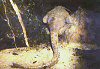 Platystacus cotylephorus
 |
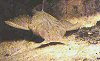 Platystacus
cotylephorus Platystacus
cotylephorusHead view |
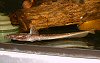 Platystacus
cotylephorus Platystacus
cotylephorus |
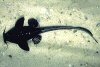 Platystacus
cotylephorus Platystacus
cotylephorusDorsal view |
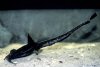 Platystacus
cotylephorus Platystacus
cotylephorus |
 Platystacus
cotylephorus Platystacus
cotylephorusHead view |
If you would like to contribute to the monthly factsheets with an article, information or photos, please e-mail me. You will of course be credited for your work.

If you would like to donate any denomination of monies to the site just click the above link button. All proceeds will go to running the site and hopefully to keep it going for a few years yet.

