SCOTCAT.COM
your internet guide to all things catfish
Acanthodoras spinosissimus (Eigenmann & Eigenmann, 1888) |
Image contributors to this species: |
Steven Grant (2) |
ScotCat Sources: |
|
|


Other Sources: |
|


Relevant Information: |
Description: Similar to Acanthodoras cataphractus but is rarer in aquarium imports. The main differences are the lateral body plates of the caudal peduncle in A. cataphractus tend to meet above and below (except the last one), whereas in A. cataphractus the last four or five pairs are separated. A. spinosissimus also has a broader and spinier humeral process. and A. cataphractus also tends to be a more slimmer fish. Aquarium Care: No problem inhabitants of a medium to large community aquarium. Provide plenty of hiding places for this species as they are crepuscular catfishes and will very rarely venture out in daylight or bright light. Their fins can inflict a nasty wound if you handle them the wrong way as they can clamp their pectoral fins around the fingers. They can omit croaking sounds, hence the common name, which is applied by them rotating their pectoral spines in their sockets. Diet: Sinking tablet food, worm foods and most aquarium fare. Etymology: The specific name spinosissimus: Latin for very spiny or thorny, presumably referring to “short sharp” spines on humeral process, “a series of which near the lower margin, is enlarged”. |
Common Name: |
Chocolate talking catfish |
Synonyms: |
Doras brunnescens, Doras spinosissimus |
Family: |
Doradidae |
Distribution: |
South America: Amazon and Essequibo River basins. Type locality: Upper Essequibo [Guyana]. |
Size: |
15.0cm. (6ins) |
Temp: |
22-26°C (71-79°F) |
p.H. |
|
6.5-7.2. |
IUCN Red List |
Despite the little information available on this species, it has a wide range and no apparent threats. Therefore, it is assessed as Least Concern. (IUCN 2023). |
Reference: |
Burgess, W.E.
1989 An atlas of freshwater and marine catfishes.
A preliminary survey of the Siluriformes. T.F.H. Publications,
Inc., Neptune City, New Jersey (USA). 784 p. |

Family: Doradidae Back to Ident-A-Cat Click on Thumbnails |
 Acanthodoras spinosissimus
 |
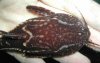 Acanthodoras
spinosissimus Acanthodoras
spinosissimusDorsal view |
If you would like to contribute to the monthly factsheets with an article, information or photos, please e-mail me. You will of course be credited for your work.

If you would like to donate any denomination of monies to the site just click the above link button. All proceeds will go to running the site and hopefully to keep it going for a few years yet.

