SCOTCAT.COM
your internet guide to all things catfish
FACTSHEETS: December 2007 - no. 138
Akysis longifilis Ng, 2006 |
Akysis
longifilis
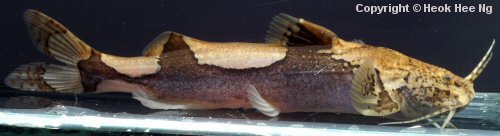
+ Akysis prashadi The type specimens of A. longifilis were caught in Pyu stream, which is a tributary of the Sittang River, 18°29'N, 96°26'E, Pyu township, Bago division, Myanmar. The number of described species of Akysis has grown considerably over the last few years, primarily because of the work of Heok Hee Ng and others. The number of species imported for the hobby has also grown and some species are very similar to others, sometimes making identification difficult for the untrained eye. However, although it is similar to a few described species thankfully it is easily differentiated from those we currently see in the hobby. The easiest method of identification is its pattern (see images above). Please note however that on my image, the marks on the body are not showing up as dark as they normally do.
Akysis longifilis
Akysis are easy to keep for any decent fishkeeper. The fish in my images are owned by my friend Roy Blackburn. His fish are kept in small tanks (30cm wide x 20cm high x 30cm deep) with a sand bottom, small pipes, and caves. They will either bury themselves in the sand or hide in caves and pipes. They are not usually active during the day but will spring to action and eat voraciously and crazily if food is put in the tank. All in all these are beautiful little catfish and one I can recommend.
|
 his
beautiful but secretive catfish has been available
over the last few years in a select few aquarist shops.
The name initially given to the fish initially was
Akysis pictus Günther, 1883, which has
a similar colour and pattern, and is also from the
region of Myanmar that these fish were being caught.
However, it wasn’t until 2006 that the species
was described as a new one by Heok Hee Ng, and the
differences between it and A. pictus were
pointed out. To date I haven’t seen a live
A. pictus, but Ng states “Akysis longifilis
possesses two distinct light saddle-shaped spots on
the upper surfaces of the postdorsal region, while
A. pictus possesses a very long light saddle-shaped
spot in the same region”.
his
beautiful but secretive catfish has been available
over the last few years in a select few aquarist shops.
The name initially given to the fish initially was
Akysis pictus Günther, 1883, which has
a similar colour and pattern, and is also from the
region of Myanmar that these fish were being caught.
However, it wasn’t until 2006 that the species
was described as a new one by Heok Hee Ng, and the
differences between it and A. pictus were
pointed out. To date I haven’t seen a live
A. pictus, but Ng states “Akysis longifilis
possesses two distinct light saddle-shaped spots on
the upper surfaces of the postdorsal region, while
A. pictus possesses a very long light saddle-shaped
spot in the same region”.
Common Name: |
None |
Synonyms: |
None |
Family: |
Akysidae |
Subfamily: |
Akysinae |
Distribution: |
Asia: Sittang River drainage, southern Myanmar (Burma). |
Size: |
5.5cm (2¼ins) |
Temp: |
18-23°C (63-73°F) |
p.H. |
6.7-7.2. |
Characteristics |
Dorsal fin with one hard spine and 3-5 rays; Caudal fin 1 principal ray and 6 rays on each lobe; Anal fin with 3 simple rays and 5-6 branched rays; Ventral fin with one simple ray and 5 branched rays; Pectoral fin with 1 spine and 6 branched rays. Four pairs of barbels; lateral line complete. |
Colouration |
Dorsal surface and sides of head ranging from a sandy to golden tan colour, with few darker brown spots randomly scattered throughout. Dorsal surface and sides of body dark brown. Belly, chest and ventral surfaces of head and body light brown. Dorsal half of body with two elongate saddle-shaped light to dark brown or even blackish spots: first on body at anterior three-quarters of adipose-fin base, second more elongate and between posterior fifth of adipose-fin base and caudal flexure. Ventral half of body with two similar saddle-shaped, light to dark brown or even blackish spots: first between anal and pelvic fins and second between posterior base of anal fin and caudal flexure. Anterior ventral spot largely coalescent with light brown coloration of ventral surfaces. Proximal two thirds of dorsal fin chocolate brown. Anal and pelvic fins hyaline with very few brown spots forming indistinct transverse band through middle of fin. Proximal half of pectoral fin with reticulate brown band; rest of fin hyaline. Caudal fin chocolate brown with distal one third of both upper and lower lobes with large, mostly hyaline spot (with scattered melanophores). Adipose fin dark greyish brown, except where lighter brown saddles-shaped spots on body run through fin. Barbels light brown, maxillary pair sometimes with few brown rings proximally. |
Aquarium Care & Compatibility |
| We have found them to generally be a peaceful catfish, including amongst themselves. Having said this I wouldn’t necessarily trust them with anything small enough to fit in their mouths. |
Reproduction |
Although some fishkeepers have found eggs, I am not aware of any successful hatching and rearing of fry of this species. |
Sexual differences |
Males appear longer and narrower in the body to the bulkier females, although even males can get large if fed too much. |
Diet |
| They will eat bloodworm, chopped earthworms, whiteworm, daphnia, and sinking pellets (although they seem to prefer live or frozen food). |
Glossary of Terms |
Proximal:
toward the center of the body; the region, the border
or the point adjacent to the place of attachment of
a projection or appendage; the opposite of distal. |
Etymology |
| Akysis:
A
= without; kysis = bladder, in reference
to the lack of a swimbladder. |
IUCN Red List |
Not Evaluated. |
References |
Ng, H.
H., 2006. Akysis
longifilis, a new species of catfish (Teleostei:
Akysidae) from Myanmar. Zootaxa 1150: 19-30 (2006). |
Photo Credits |
© Steven Grant
@ © Heok Hee Ng |
|

If you would like to contribute to the monthly factsheets with an
article, information or photos, please e-mail
me. You will of course be credited for your work.
If you would like to donate any denomination of money to the site just click the above link button. All proceeds will go to running the site and hopefully to keep it going for a few years yet.
ScotCat Sources
 Etymology-genera
Etymology-specific
name
Online Sources
 Search
 Fishbase
 Wikipedia
 Catalog of Fishes
 GBIF
GBIF
 Fishnet2
 iNaturalist

