SCOTCAT.COM
your internet guide to all things catfish
FACTSHEETS: December 2023 - no. 330
Ameiurus catus (Linnaeus, 1758) |
Ameiurus catus
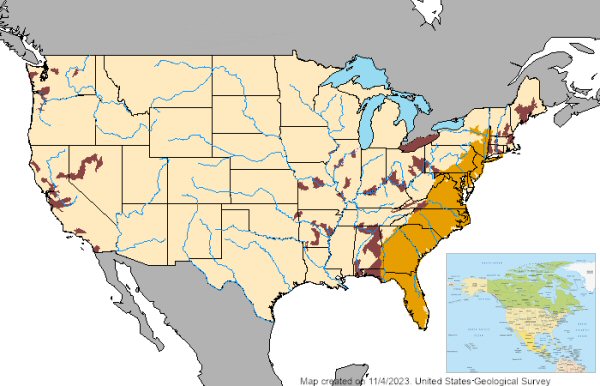
The white bullhead is native to river systems of the
Eastern United States from the Hudson River in New
York to the Peace River in Florida and west to the
Apalachicola River, Florida. White bullheads may have
migrated naturally into Connecticut rivers as a result
of the white bullhead's salt tolerance. Elsewhere,
the white bullhead has been widely introduced as a
food and game fish, notably into California waters
as a result of intentional stocking near Stockton
in 1874. It has additionally become established in
the Columbia River basin and in Puerto Rico as an
introduced species. It was reportedly introduced to
the Philippines but did not become established there.
Escapees from fee-fishing ponds and stocked lakes
have led to the establishment of the white bullhead
in Missouri (Wikipedia).
The White Catfish, a native of Atlantic coastal streams, lakes and ponds, was introduced in Arkansas lakes and ponds around the state because it is reportedly easy to catch and attains a desirable size. The native range
encompasses Atlantic and Gulf slopes of North America,
from southern Maine to the Peace River drainage, Florida,
and west to the Mobile Bay drainage, Mississippi (Page
and Burr 2011). This catfish has been introduced widely
outside its native range. This species is of local
importance as a game fish.
|
 t
is the last month of 2023 and before we enter 2024
we pay a visit to the North American catfish family,
Ictaluridae, and the "White Catfish" Ameirus
catus. This species is similar looking to
t
is the last month of 2023 and before we enter 2024
we pay a visit to the North American catfish family,
Ictaluridae, and the "White Catfish" Ameirus
catus. This species is similar looking to 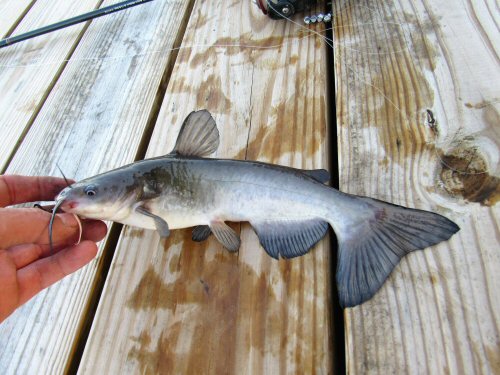
Common Name |
White Catfish |
Synonyms |
Ictalurus catus, Silurus catus |
Family |
Ictaluridae |
Subfamily |
- |
Distribution |
North America: Atlantic and Gulf coast drainages from Hudson River to Pascagoula River, Mississippi; introduced elsewhere. |
Size |
95.0cm. (38ins) TL. |
Temp. |
18-25°C (63-77°F) |
p.H. |
6.5-7.5. |
Characteristics |
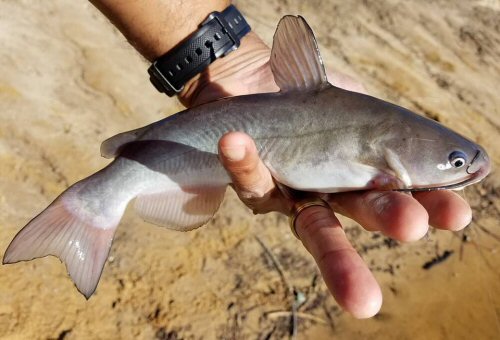
Broad head with a moderately forked caudal fin, short rounded anal fin with 22-24 rays, and the upper jaw projecting beyond the lower jaw. Anal fin base short, usually 4.3-5.2 times into SL. A gap in the body ridge between the head and dorsal fin consistently present. |
Colouration |
Body blue-black and frequently mottled, although no discrete black spots along sides. Fins lightly coloured, without dusky borders. Chin barbels white. |
Aquarium Care & Compatibility |
| Not really a candidate for the home aquarium as they grow too large and not recommended as with the smaller bullheads such as A. melas, A. natalis or A. nebulosus. |
Reproduction |
Spawning occurs from April to July when the water temperature ranges between 65-75 F. A gelatinous mass of eggs is deposited in a cavity created by hollow logs or undercut banks. The male guards the nest and incubates the eggs by continually fanning fresh water over them. |
Sexual differences |
Not recorded |
Diet |
| Feeds on wide variety of fishes, insects and crustaceans. |
Glossary of Terms |
Anal
fin: The median, unpaired,
ventrally located fin that lies behind the anus, usually
on the posterior half of the fish. |
Etymology |
| Ameiurus:
a-, without; meiosis, to reduce; urus, tailed, literally
“not curtailed,” referring to absence
of deep notch in caudal fin compared to forked tail
of Ictalurus. |
IUCN Red List |
This species is listed as Least Concern in view of the large range extent, very large population size, and lack of significant decline, (IUCN 2013 needs updating). |
References |
Britton, J.R. and
Davies, G.D. (2006), First record of the
white catfish Ameiurus catus in Great Britain. Journal
of Fish Biology, 69: 1236-1238. |
Photo Credits |
©
Tim Aldridge |
|

If you would like to contribute to the monthly factsheets with an
article, information or photos, please e-mail
me. You will of course be credited for your work.
If you would like to donate any denomination of money to the site just click the above link button. All proceeds will go to running the site and hopefully to keep it going for a few years yet.
ScotCat Sources
 Article
 Etymology-genus
Etymology-specific name
Other Sources
 Search
 Fishbase
 Wikipedia
 Catalog
of Fishes
Catalog
of Fishes
 GBIF
GBIF
 FishNet2
 iNaturalist
 IUCN
IUCN

