SCOTCAT.COM
your internet guide to all things catfish
FACTSHEETS: August 1998- no. 026
Anarhichas lupus Linnaeus, 1758 |
Anarhichas lupus
As you might be aware by now this is not a tropical (cat)fish but a marine fish that is confined to the temperate and boreel waters of the northern hemisphere. There are in fact three species that occur in northern European seas, A.lupus, A.minor and A.denticulatus. A.lupus has a long dorsal and anal fin with a very small truncate caudal. This genus does not posses ventral fins and has huge dog-like teeth in the front of the jaws and rounded crushing teeth in the sides and palate. These teeth are used to break up mollusc's. It lives close to the sea-bed in moderately deep water with a depth range of 1 - 500m., and on occasion are caught by sport fishermen. Its flesh seemingly is well flavoured and firm and its skin can be prepared as leather.
|
 his
fish is technically not a catfish even although it
does goes under the common name of "Sea Catfishes"
with two other species, A. denticulatus and
A. minor. It is in fact related to the blennies
and not to the true catfishes (no barbels and has
scales) The name Sea Catfish gave me a good excuse
to include this "only its mother would love it"
character and its other more popular name of the Wolf
Fish gives its true character away as a bit of an
"ugly duckling" but we catfish folk can
put up with our charges not being too facially challenged.
his
fish is technically not a catfish even although it
does goes under the common name of "Sea Catfishes"
with two other species, A. denticulatus and
A. minor. It is in fact related to the blennies
and not to the true catfishes (no barbels and has
scales) The name Sea Catfish gave me a good excuse
to include this "only its mother would love it"
character and its other more popular name of the Wolf
Fish gives its true character away as a bit of an
"ugly duckling" but we catfish folk can
put up with our charges not being too facially challenged.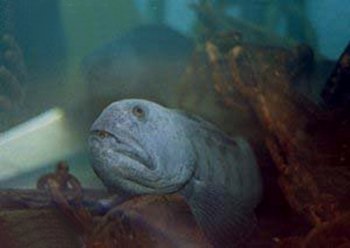
Common Name: |
Sea Catfish, Wolf-Fish |
Synonyms: |
Anarhichas lupus marisalbi, Anarhichas vomerinus, Anarhichas strigosus |
Family: |
Anarhichidae |
Subfamily: |
- |
Distribution: |
Iceland, in the seas of Iceland and the Faroes. Norway, in the seas of Norway. United Kingdom, around the British Isles. |
Size: |
1.25m (49¼ins.) |
Temp: |
Cold and very cold! |
p.H. |
7.0 and above.
|
Characteristics |
Pectorals: very large , lobe-like. Gill membranes united to isthmus. Only spinous dorsal fin present. No pelvic fins, pelvic girdle vestigial. Small or pointed caudal fin. Jaws bearing strong conical canine teeth at the front; large molariform teeth at the sides. |
Colouration |
Ground colour usually greyish-green but almost black or reddish -brown. Body with 10-15 transverse, dark bars extended to the dorsal fin. |
Aquarium Care & Compatibility |
| An aquarium fish, I don't think so!, unless some native marine keepers know better, as it can grow to a quite considerable size (see size). The specimen in the photograph was pictured in a public aquarium in the Sea-Life Centre in Oban, Argyll, Scotland. |
Reproduction |
Spawns in the winter with the eggs being deposited as a ball-like clump on the sea-bed. The larvae stay at the bottom until their yolk-sac is used up. They are then found to swim in the mid to surface layers of the ocean until late autumn when they retire back to the sea-bed. There has been a reported spawing in captivity in a Public Aquarium. Macduff Marine Aquarium in Aberdeenshire, Scotland reported that the parents laid a clutch of pink eggs in the early part of 2009 and the babies are being raised in a seperate aquarium. |
Sexual differences |
It is said that the females underside is a dirty white colour whereas the males have a flecked pattern. |
Diet |
| Adults and juveniles feed on crabs, sea urchins, mussels, whelks and scallops. |
Etymology |
| Anarhichas: anarrhichesis from the Greek, to climb, the action of climbing. |
References |
Wheeler, Alwyne. Key to the Fishes of Northern Europe 1978. |
Photo Credits |
© Allan James
@ |

|

If you would like to contribute to the monthly factsheets with an
article, information or photos, please e-mail
me. You will of course be credited for your work.
If you would like to donate any denomination of money to the site just click the above link button. All proceeds will go to running the site and hopefully to keep it going for a few years yet.
Online Sources
 Search
 Fishbase
 Wikipedia
 Catalog of Fishes
 GBIF
GBIF
 Fishnet2
 iNaturalist

