SCOTCAT.COM
your internet guide to all things catfish
FACTSHEETS: February 2003 - no. 080
Ancistrus claro Knaack, 1999 |
Ancistrus claro - female
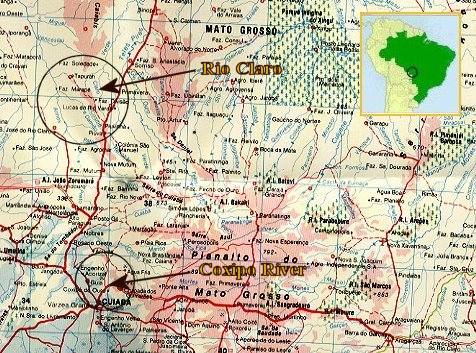
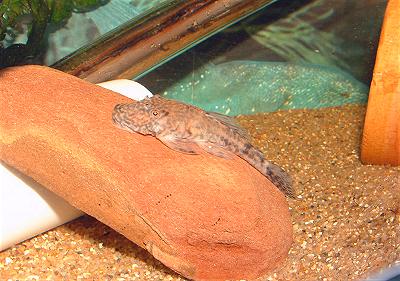
The common name of the "Gold Marble Bristlenose Catfish" is I think a bit misleading as if you have ever kept this species they change colour on a regular basis, whether they are resting on the substrate, on a piece of wood or rockwork. They seem to take their colouration from their surroundings and a better common name would be " The Chameleon Bristlenose Catfish" As mentioned earlier, they reside in the Rio Claro and the type locality mentions "above the bridge in the direction of Chappada dos Guimaraes", this is not not far from the town of Cuiaba . It has been collected in the Coxipo River and other western tributaries and the Copixo is the area that is stated in the type locality. Its habitats consist of fast flowing waters with little vegetation among and under rocks. This description of its habitat gives us an insight on how best to keep this species, providing plenty of water movement and caves/pipes with plant life only as a personal addition to the aquarium.
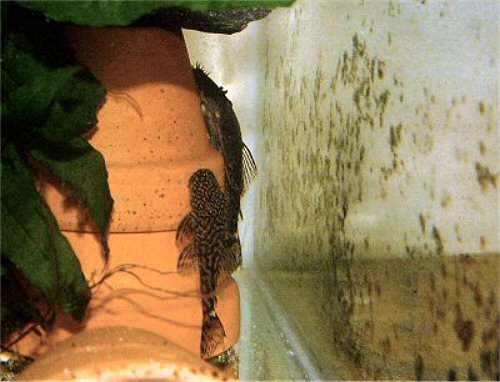
Ancistrus claro - in the aquarium
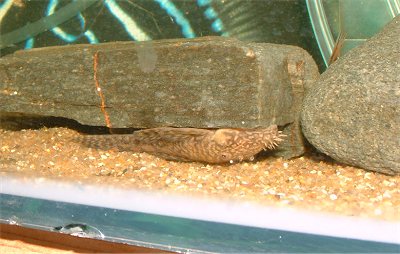
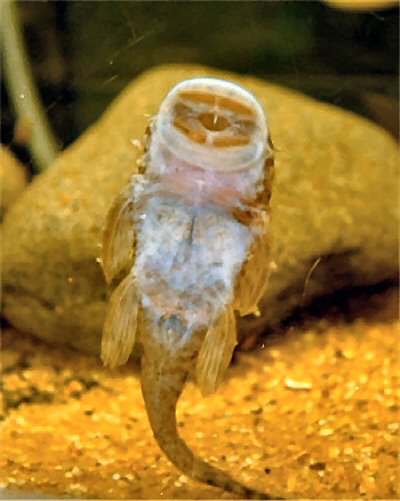
The above picture shows a young pair with the male to the front with the marble markings to the body and head area. The female is darker and has more of a spotted pattern and has small bristles compared to the young male who will eventually sport the more traditional male Ancistrus head dress of larger and branched bristles. This is an Ancistrus species which you will see quite often during the day, either clamped to the tank walls or sitting on or underneath their favourite position of flat stonework. Click on the thumbnails below for further images.
|
 new
kid on the block, so to speak, is this small pretty
Ancistrus from the Rio Claro in the Mato
Grosso area on the South Western tip of Brazil. You
will find this species in the Aqualog all L-Numbers
as LDA08 and was first imported into Germany in 1993
and subsequently was given this moniker by the German
publication "Das Aquarium". The holotype
resides in the Berlin Zoological Museum.
new
kid on the block, so to speak, is this small pretty
Ancistrus from the Rio Claro in the Mato
Grosso area on the South Western tip of Brazil. You
will find this species in the Aqualog all L-Numbers
as LDA08 and was first imported into Germany in 1993
and subsequently was given this moniker by the German
publication "Das Aquarium". The holotype
resides in the Berlin Zoological Museum.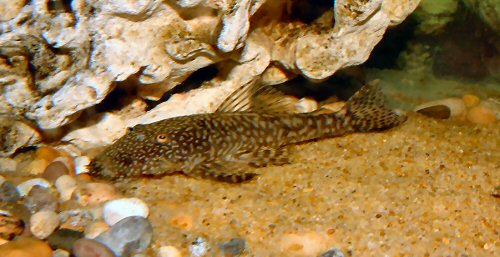
Common Name: |
LDA08, Gold Marble Bristlenose Catfish. |
Synonyms: |
None |
Family: |
Loricariidae |
Subfamily: |
Ancistrinae |
Distribution: |
South America: Brazil, The Mato Grosso, in the Rio Claro and Coxipo River and other western tributaries. (see location map) |
Size: |
8.0cm. (3¼ins) |
Temp: |
24-28ºC (75-83°f) |
p.H. |
6.0-7.0. |
Characteristics |
Typical Ancistrus shape with both sexes sporting bristles to the head area with the male having the larger and more impressive tentacles. |
Colouration |
Base colour of brown with gold marble reticulations in the male. The female has a darker colouration which comprises of a more dotted pattern. Both sexes have banding to the caudal, dorsal and pectoral fins and a white ventral region. |
Aquarium Care & Compatibility |
| Quite an easy species to keep as long as there is adequate aeration in the aquarium and giving them a choice of pipes, stones or rockwork. |
Reproduction |
As per the Ancistrus family in neutral to mildly alkaline water. Will spawn in caves/pipes and the eggs are yellow, large, and can number to about 40 in a good spawning. |
Diet |
| They are mostly omnivores with a liking for most foods. I find that they will eat courgette(zucchini) but they are not as keen on it as your usual bog standard Ancistrus species are. Will eat most flake and worm foods and have a particular fondness of algae discs. |
Etymology |
| Ancistrus:
With barbed hooks, (hooked spines). |
IUCN Red List |
Ancistrus claro is distributed in the Claro River basin, a tributary of the Cuiabá River, in the Paraguay River basin, in Brazil, where it is abundant and frequent. As no significant threats to its population have been identified, Ancistrus claro has been categorised as Least Concern (LC), (IUCN 2022). |
References |
Chico
Mendes Institute for Biodiversity Conservation (ICMBio).
2022. Ancistrus claro. The IUCN Red List
of Threatened Species 2022. |
Photo Credits |
© Allan James
@ |

|

If you would like to contribute to the monthly factsheets with an
article, information or photos, please e-mail
me. You will of course be credited for your work.
If you would like to donate any denomination of money to the site just click the above link button. All proceeds will go to running the site and hopefully to keep it going for a few years yet.
ScotCat Sources
 Etymology-genera
Etymology-specific
name
Online Sources
 Search
 Fishbase
 Wikipedia
 Catalog of Fishes
 GBIF
GBIF
 iNaturalist
 IUCN
IUCN