SCOTCAT.COM
your internet guide to all things catfish
FACTSHEETS: July 2005 - no. 109
Auchenoglanis occidentalis (Valenciennes, 1840) |
Auchenoglanis occidentalis
This "Bagrid" can grow to an impressive 46cm (18¼ins) but it is basically a gentle giant and can be trusted with anything that can not fit into its small mouth. Its long pointed snout is well adapted to "sook" up worms and detritus in the sandy substrate and as such you should provide your specimen(s) with a sand floor to your aquarium with an external power filter that has a good flow rate. It goes without saying of course that you will need to provide this catfish with a spacious tank considering its adult size. It is very tolerant to most water parameters and as such you can keep it in a low p.H. (6.5) with larger Characins or Barbs or even in a Lake Tanganyika setup with Cichlids from that lake in harder water, but my choice would be to stick with the former soft and acidic conditions for a more contented individual(s).
Auchenoglanis occidentalis
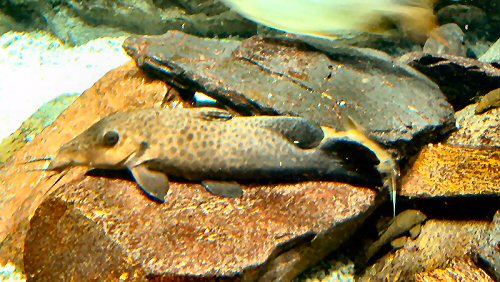
Above you can see a specimen that I photographed from the Port Doree Public Aquarium in Paris, France which was captioned as A. occidentalis but it may represent another close member of this family, Parauchenoglanis punctatus. Update 2010: Teugels et al. (1991) considered the genus Auchenoglanis to be comprised of two valid species: A. biscutatus and A. occidentalis. Due to the work carried out recently (2010) by Michael Retzer there are now 8 in this genus with six new species, A. acuticeps, A. biscutatus, A. occidentalis, A. sacchii, A. senegali, A. tanganicanus, A. tchadiensis and A. wittei. The main description for A. occidentalis is that it can be differentiated from all other congeners (except A. tchadiensis) by having a uniformly coloured body. It differs from A. tchadiensis by having oval-shaped tooth patches on the upper jaw vs.triangular for A. tchadiensis. Update 2021: The taxonomic history of the African catfish genus Auchenoglanis includes eight nominal species, with two of these, Auchenoglanis biscutatus and Auchenoglanis occidentalis, being recognised as valid by most authors. The validity of all eight species was recently established based on mainly pigmentation-related characters and the shape of the premaxillary tooth plates. As these results opposed previous works but lacked any mention of these, the species diversity in the genus was re-evaluated based on biometric, meristic and other morphological data. It reconfirms the status of only two valid species within the genus. Auchenoglanis occidentalis ranks among the African fish species with very large distribution areas, being present from Senegal to Tanzania. Auchenoglanis biscutatus is distinguished from A. occidentalis by a postorbital head length that is greater than the preorbital head length, an adipose fin that rises abruptly, and a maxillary barbel with a tip not darker than the head colour (Geerinckx & Vreven 2013).
|
 e
stay on the African continent this month but instead
of sticking with the Mochokidae family from last month
(June 2005) we move on to a newish family, Auchenoglanididae.
The genera of the Auchenoglanididae were originally
assigned to the spiny catfish (Bagridae, or to the
subfamily Auchenoglaninae), later they were assigned
to the Claroteidae as the subfamily Auchenoglanidinae.
In the fourth edition of Fishes of the World, a standard
work on fish systematics, they form an independent
family. Common features of the family are the rounded
to emarginate caudal fin and the position of the posterior
nostrils on the sides of the upper lip. It contains
the three genera Auchenoglanis, Parauchenoglanis
and Notoglanidium.
e
stay on the African continent this month but instead
of sticking with the Mochokidae family from last month
(June 2005) we move on to a newish family, Auchenoglanididae.
The genera of the Auchenoglanididae were originally
assigned to the spiny catfish (Bagridae, or to the
subfamily Auchenoglaninae), later they were assigned
to the Claroteidae as the subfamily Auchenoglanidinae.
In the fourth edition of Fishes of the World, a standard
work on fish systematics, they form an independent
family. Common features of the family are the rounded
to emarginate caudal fin and the position of the posterior
nostrils on the sides of the upper lip. It contains
the three genera Auchenoglanis, Parauchenoglanis
and Notoglanidium.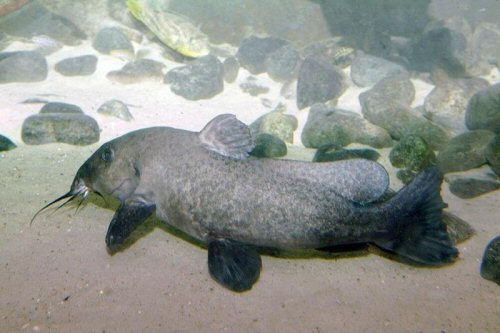
Common Name: |
Giraffe Catfish |
Synonyms: |
Auchenaspis biscutata, A.biscutatus, A.occidentalis, Auchenoglanis biscutatus, Pimelodus occidentalis, A. biscutatus occidentalis, Auchenoglanis occidentalis occidentalis, Oxyglanis sacchii, Auchenoglanis occidentalis var. tanganicanus, A. occidentalis tchadiensis, A. tchadensis, A. scutatus, A. acuticeps, A. wittei, A. occidentalis tanganyikanus, A. vittatus, A. acuticeps, A. tanganyikanus. |
Family: |
Auchenoglanididae |
Subfamily: |
- |
Distribution: |
Africa: Senegal, Casamange and Gambia river drainages in western Africa.. Type locality: Sénégal. |
Size: |
46.0cm. (18¼ins) |
Temp: |
21-25°C (69-77°F) |
p.H. |
6.5-7.8. |
Characteristics |
Dorsal spines (total): 1; Dorsal soft rays (total): 7-8; Anal spines: 3-4; Anal soft rays: 7-8. Head large with heavily built body. The upper jaw has oval-shaped teeth. |
Colouration |
The main description for A. occidentalis is that it can be differentiated from all other congeners by having a uniformly coloured body. |
Aquarium Care & Compatibility |
| Best suited to the larger aquarium. Peaceful large catfish which will do well in company of larger characins from Africa and large Barbs. |
Reproduction |
No reports on the breeding of this species in captivity as it would need a very large tank with a number of individuals. In its natural habitat the nested eggs are guarded by the male. Furthermore, the male plays host to eggs and young of Dinotopterus cunningtoni, a member of the Claridae catfish family, which takes advantage of the already prepared nest and feeds on the host brood. |
Diet |
| Will eat a variety of foods. Tablet and pellet foods with a good quality flake and frozen bloodworms. Also relishes live worms such as the common garden worm, making sure that there has been no weedkiller on the premises, and white worm. |
Etymology |
| Auchenoglanis:
Auchen; auchenos = neck; glanis = catfish. |
References |
Froese,
R. and D. Pauly.
Editors. 2009. FishBase. World Wide Web electronic
publication. www.fishbase.org, version (10/2009). |
Photo Credits |
© Johnny Jensen
@ |


|

If you would like to contribute to the monthly factsheets with an article, information or photos, please e-mail me. You will of course be credited for your work.
If you would like to donate any denomination of money to the site just click the above link button. All proceeds will go to running the site and hopefully to keep it going for a few years yet.
ScotCat Sources
 Etymology-genera
Etymology-specific
name
Online Sources
 Search
 Fishbase
 Wikipedia
 Catalog of Fishes
 GBIF
GBIF
 Fishnet2
 iNaturalist

