SCOTCAT.COM  

your internet guide to all things catfish
≡
  • HOME
  • FACTSHEETS
    • By Month/Year
    • By Family
    • by Genus
    • by Common Names
    • By Specific Names
    • By Continent
      • Index
      • Africa
      • Asia
      • Australasia
      • Europe
      • North America
      • South America
  • GALLERIES
    • Photo Gallery
    • Art Gallery
    • Movie Gallery
    • Stamps Gallery
  • FAMILIES
    • A-B
      • Ailiidae
      • Akysidae
      • Amblycipitidae
      • Amphiliidae
      • Anchariidae
      • † Andinichthyidae
      • Ariidae
      • Aspredinidae
      • Astroblepidae
      • Auchenipteridae
      • Auchenoglanididae
      • Austroglanididae
      • Bagridae
    • C-D
      • Callichthyidae
      • Cetopsidae
      • Chacidae
      • Clariidae
      • Claroteidae
      • Cranoglanididae
      • Diplomystidae
      • Doradidae
    • H-I
      • Heptapteridae
      • Heteropneustidae
      • Horabagridae
      • Ictaluridae
    • K-L-M
      • Kryptoglanidae
      • Lacantuniidae
      • Loricariidae
      • Malapteruridae
      • Mochokidae
    • N-P
      • Nematogenyidae
      • Pangasiidae
      • Phreatobiidae
      • Pimelodidae
      • Plotosidae
      • Pseudopimelodidae
    • R-S-T
      • Ritidae
      • Schilbeidae
      • Scoloplacidae
      • Siluridae
      • Sisoridae
      • Trichomycteridae
  • ARTICLES
    • Index
    • Breeding
    • By Author
    • Cat-Articles
    • General
    • Numbered List
    • Ichthyology
    • Travel/Collecting
  • IDENT-A-CAT
  • RESOURCES
    • Citation
    • Etymology
    • Fishhouse
    • Glossary
    • Scientific Papers
    • ScotShop
  • SITE MAP
  • FB GROUP
  • HELP
    • Index
    • Catfish Anatomy
    • Convertors
    • FAQ
    • Ident-A-Cat
    • Water Chemistry

FACTSHEETS: August 2024 - no. 338

 Belonoglanis brieni  Poll, 1959


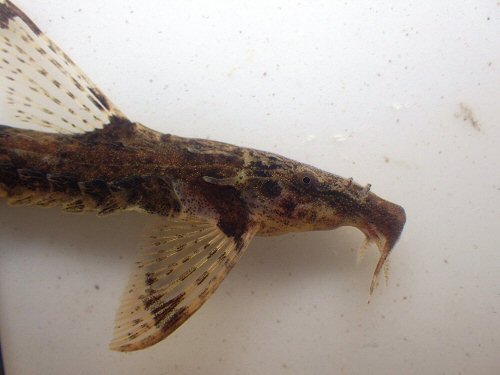
embers of the African Amphiliidae genus are long and slim and reminds one of the "whiptail" species of South America. The common names of this family are "Loach catfishes" because of their flattened like appearance. B. brieni possesses a long caudal peduncle but it is shorter than the other species in this genus,
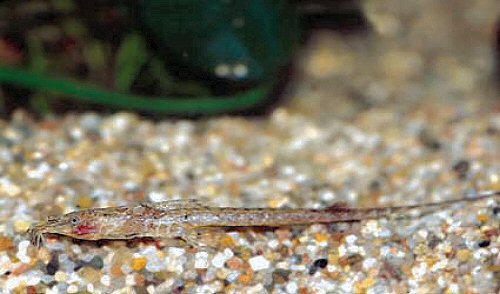
Belonoglanis tenuis which is the type species. The caudal fin is also large. These catfish are quite difficult to keep for a length of time and are rare in the hobby.


Belonoglanis brieni

   Belonoglanis brieni

In their natural habitat they prefer the marginal fringes of swift-flowing streams so this could be taken in mind when setting up a tank for this species.

The sub-family Doumeinae includes the genera Andersonia Boulenger, 1900, Belonoglanis Boulenger, 1902, Doumea Sauvage, 1879 (type genus), Phractura Boulenger, 1900 and Trachyglanis Boulenger, 1902. This subfamily is clearly monophyletic and morphologically distinct from each of the other two Amphiliidae subfamilies, being diagnosed by the unambiguous distribution of eleven characters present in all doumeins and absent in all other taxa represented on the cladogram, and two characters also absent in the latter taxa but reverted, among Doumeinae, in genera Trachyglanis and Andersonia respectively.


Belonoglanis brieni - head view


  Belonoglanis brieni - head view


The author of B. brieni, Max Fernand Leon Poll (21 July 1908 in Ruisbroek – 13 March 1991 in Uccle) was a Belgian ichthyologist who specialised in the Cichlidae. In the years 1946 and 1947 he organised an expedition to Lake Tanganyika. He was a member of The Royal Academies for Science and the Arts of Belgium, professor at Université Libre de Bruxelles, and conservator at Musée Royal du Congo Belge in Tervuren and he was an honorary member of the American Society of Ichthyologists and Herpetologists.


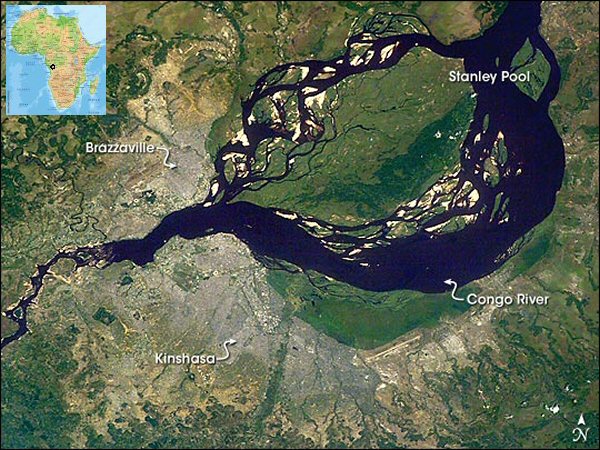
Stanley Pool


Distrbution: Satellite picture of Brazzaville (north bank), Kinshasa (south bank), and the lake-like Malebo (Stanley) Pool of the Congo River.
In the Republic of Congo (north of river) and Democratic Republic of the Congo (south). Type Locality:
Stanley Pool, Rivière N'Djili


Mbamu (also: M´Bamou and Bamu) is an island in the Pool Malebo, a large lake formed by a widening of the River Congo. The island is territory of the Republic of the Congo (Congo Brazzaville). Mbamu is a demilitarized zone under the neutral regime established in the Franco-Belgian Convention of 1908, when these two countries exerted colonial rule over the territories on either side of the River Congo.

The Pool Malebo has a surface area of 180 km2.[2] Two national capitals are located down river: to the northwest along the river is Brazzaville, capital of Republic of the Congo. To the south of the pool and river is Kinshasa, capital of the Democratic Republic of the Congo (Congo-Kinshasa), (Wikipedia).

The Ndjili River (French: Rivière Ndjili) is a river that flows from the south through the capital city of Kinshasa in the Democratic Republic of the Congo, where it joins the Congo River. It separates the districts of Tshangu and Mont Amba. The river gives its name to the Ndjili commune and to the Ndjili International Airport.


Common Name

None

Synonyms

None

Family

Amphiliidae

Subfamily

Doumeinae

Distribution

Africa: N'Djili River, Stanley Pool, Congo Dem. Rep. Congo Rep. Type locality: Stanley Pool, Rivière N'Djili

Size

5.0cm. (2ins)

Temp.

20-25°c (67-77°f.)

p.H.

6.5-7.2.

Characteristics

On the dorsum there is a single row of broad bony plates from the dorsal fin to the caudal peduncle alongside two rows of bony plates on the sides of the belly. These plates unite on the caudal peduncle.

Colouration

Yellowish, irregularly spotted with brown. The fins are sprinkled with dark dots and both the caudal and adipose fins are brown right to the edges (Seegers, L. 2008).

Aquarium Care & Compatibility

This genera prefer water with a bit of movement as they are found at the margins of swift-flowing streams. Sand substrate with algae covered rocks if possible.

Reproduction

Not recorded.

Sexual differences

Not recorded

Diet

Algae, vegetable foods such as peas, frozen mosquito larvae and tablet food. In their natural habitat they feed on bacteria that grows on plants at the sides of fast flowing streams.

Glossary of Terms

Adipose fin: Fleshy finlike projection without rays, behind the rayed dorsal fin.
Barbels: Whisker-like structure on the heads of most catfish.
Caudal fin: The tail.
Caudal peduncle: The narrow part of a fish's body to which the caudal or tail fin is attached.
Clade: A group defined by at least one shared derived character or synapomorphy inherited from a common ancestor; a monophyletic higher taxon, a branch on a cladogram.
Dorsal fin: The primary rayed fin(s) on top of the body.
Dorsam: The upper (dorsal) surface of the head or body.
Monophyly: The term monophyly, or monophyletic, derives from the two Ancient Greek words µóvoç (mónos), meaning "alone, only, unique", (phûlon), meaning "genus, species", and refers to the fact that a monophyletic group includes organisms (e.g., genera, species) consisting of all the descendants of a unique common ancestor.
Taxon: According to the Code, any formal taxonomic unit or category of organisms (species, genus, family, order, class, etc.). Taxa (pl.).

Etymology

Belonoglanis: Composed from Belon, an ichthyiologist + Greek, glanis = a fish that can eat the bait without touching the hook; a catfish.
brieni: ln honour of friend and zoological colleague Paul Brien (1894-1975), Université libre de Bruxelles (Belgium), a member of expedition that collected type, and who was the first to observe the behavior of this genus in the wild (aligning their bodies along the stems of riparian grasses, feeding on epiphytic microorganisms).

References

Baensch, H.A. and R. Riehl 1995 Aquarien Atlas. Band 4. Mergus Verlag GmbH, Verlag für Natur- und Heimtierkunde, Melle, Germany. 864 p.
Diogo, Rui. (2003). Anatomy, Phylogeny and Taxonomy of Amphiliidae. Laboratory of Functional and Evolutionary Morphology, Institut de Chimie, Bât. B6, Université de Liège, B-4000 Sart-Tilman (Liège), Belgium.
Seegers, L. 2008 The catfishes of Africa. A handbook for identification and maintenance. Aqualog Verlag A.C.S. GmbH, Germany. 604 p.

Skelton, P.H. and G.G. Teugels, 1986. Amphiliidae. p. 54-65. In J. Daget, J.-P. Gosse and D.F.E. Thys van den Audenaerde (eds.) Check-list of the freshwater fishes of Africa (CLOFFA). ISNB, Brussels; MRAC, Tervuren; and ORSTOM, Paris. Vol. 2.
The ETYFish Project Fish Name Etymology Database © Christopher Scharpf.

IUCN Red List

Belonoglanis brieni has most recently been assessed for The IUCN Red List of Threatened Species in 2009. Belonoglanis brieni is listed as Data Deficient.

Photo Credits

© In honour of the late Birger Kamprath an expert on African catfish especially the genus Synodontis.
© 
Russell Brian Tate

Map: Wikimedia Commons, the free media repository.

Donate towards my web hosting bill!


If you would like to contribute to the monthly factsheets with an article, information or photos, please e-mail me. You will of course be credited for your work.

If you would like to donate any denomination of money to the site just click the above link button. All proceeds will go to running the site and hopefully to keep it going for a few years yet.


ScotCat Sources

Etymology = Genus Etymology-genus name

Etymology = Specific name Etymology-specific name


Other Sources

Search  Search

FishBase Fishbase

Wikipedia Wikipedia

Catalog of Fishes Catalog of Fishes

Global Biodiversity Information Facility GBIF

iNaturalist iNaturalist

IUCN IUCN

  • Facebook about us + contact us + citation + translate + site map + scotshop + glossary + etymology +
  • help YouTube

©2025 SCOTCAT.COM