SCOTCAT.COM
your internet guide to all things catfish
FACTSHEETS: January 2001 - no. 055
Brochis splendens (Castelnau, 1855) |
|
Brochis splendens
There is actually a good excuse for compiling this months factsheet (Jan. 2001) as this was one of the fish that I had collected on my Peru 2000 trip in July alongside a few other U.K. catfish enthusiasts including good friend Jools Dignall of Planet Catfish fame. We caught semi adults (picture above) at about 6cm in length in a small cocha (small lake cut of by the main River) in the Rio Orosa just downstream from the Madre Selva Forest Preserve. We also caught them in the banks of the main river as they seem to prefer slower moving waters and plenty of vegetation, and this is certainly different from the C. elegans that we had caught earlier in the day in a small red clay bottomed stream that was not too far away from this location.
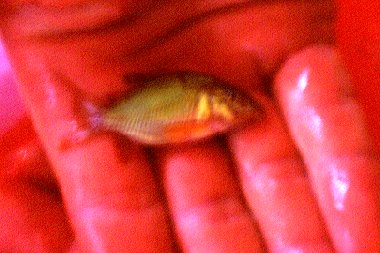
Brochis splendens - just captured
They have a nice bronze/green body colouration and when caught in the wild (picture above) the colours stand out magnificently and you can see why their common name is the “Emerald Catfish” but they do fade slightly when brought home. We found this in most of the fish that we caught as there must be something to do with the diet and or water parameters that we can't seem to impersonate in our own tanks. You can still sometimes see this fish sold in the aquatic outlets as Brochis coeruleus, a synonym which was used to describe the juvenile version of this fish which was superficially different to the adults in colouration and thus led to this confusion. UPDATE (2020): Brochis was synonymised with Corydoras by Britto in 2003 but in time there will be a revision which will resurrect Brochis (Cope, 1871) to full genera again so in the meantime we are sticking with Brochis as there is marked differences with the both genera. Brochis is included in Lineage 8 (sub-clade 1) with the "intermediate long-snouts" with deeper bodies.
|
 t first glance you could be excused of thinking that
this was a Corydoras species, but one look
at the broader based dorsal and you can then see why
this is in another genus, and along with another two
species, B. britski and B. multiradiatus
form the genus, Brochis. They look superficiality
like a large bodied Cory but whereas the Cory's have
between 6 and 8 dorsal ray counts Brochis splendens
has 10-12, B. britski has between 15/18
and B. multiradiatus, with has also a longer
snout, has 17 (see update at bottom of Factsheet).
t first glance you could be excused of thinking that
this was a Corydoras species, but one look
at the broader based dorsal and you can then see why
this is in another genus, and along with another two
species, B. britski and B. multiradiatus
form the genus, Brochis. They look superficiality
like a large bodied Cory but whereas the Cory's have
between 6 and 8 dorsal ray counts Brochis splendens
has 10-12, B. britski has between 15/18
and B. multiradiatus, with has also a longer
snout, has 17 (see update at bottom of Factsheet).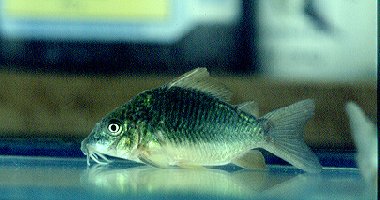
Common Name: |
Emerald Catfish |
Synonyms: |
Brochis coeruleus, Brochis dipterus, Callichthys splendens, Chaenothorax bicarinatus, Chaenothorax semiscutatus. |
Family: |
Callichthyidae |
Subfamily: |
Corydoradinae |
Distribution: |
South America: Brazil, Rio Tocantin. Peru, Upper Amazon near Iquitos, Rio Ambyiacu, Rio Orosa. Ecuador, Rio Napo. |
Size: |
8.0cm. (3¼ins) |
Temp: |
22-27°c (72-81°f.) |
p.H. |
6.5-7.0. |
Characteristics |
Dorsal 1/10-12; Anal 1/6-7; Pectoral 1/7-9; Ventral 1/5; 21-22 bony scutes in the upper lateral series, 20-21 in the lower. More strongly compressed than the Corydoras spp., from which the genus Brochis is further distinguished by the longer-based dorsal fin and the armoured snout. Males are a little shorter than females and slimmer and its ventral fins are slightly pointed. |
Colouration |
Ground colour of head and body can vary from dull brownish/grey to bluish or greenish metallic coloured. The lower half of the ventrolateral body scutes can be light yellow to light pink. Dorsal, adipose and caudal fins greyish, reamaining fins without pigmentation, except for the pectoral fin spines. In some specimens there are dark grey spots on the dorsal fin rays, sometimes forming one or two rows. |
Aquarium Care & Compatibility |
| Keeping Brochis splendens in the aquarium does not present too much of a problem as long as you provide good water conditions and a few good hiding places to make them feel more secure in their surroundings. You are also better keeping at least 6 of this species as they are never very happy kept as individuals. A planted tank can also enhance their well being. |
Reproduction |
This catfish is not the easiest to spawn but you can see a full report on the breeding of the Emerald catfish on the breeding section of the ScotCat articles page. |
Diet |
| The usual fare for adult Corydoras, a good quality flake food, tablet food, frozen bloodworm, grindal worm and whiteworm used sparingly. |
Etymology |
|
Brochis:
A sling, (a reference to the structure of the barbels). |
References |
Baench;
Aquarium Atlas 1. |
Photo Credits |
|
Allan
James @
|

|

If you would like to contribute to the monthly factsheets with an article, information or photos, please e-mail me. You will of course be credited for your work.
If you would like to donate any denomination of money to the site just click the above link button. All proceeds will go to running the site and hopefully to keep it going for a few years yet.
ScotCat Sources
 Etymology-genera
Etymology-specific name
Other Sources
 Search
 Fishbase
 Wikipedia
 Catalog
of Fishes
Catalog
of Fishes
 GBIF
GBIF
 Fishnet2
 iNaturalist

