SCOTCAT.COM
your internet guide to all things catfish
FACTSHEETS: October 2006 - no. 124
Cetopsis coecutiens (Lichtenstein, 1819) |
Cetopsis coecutiens is one of the largest of the so called species of “Candiru” and is viewed with some trepidation amongst a number of catfish enthusiasts. Unfortunately or fortunately depending upon your personal views, Cetopsis coecutiens is not commonly available to the hobbyist. When this unusual catfish is available, expect to pay £20-£25 per fish. In their natural habitat these catfish are very much opportunist parasites feeding upon other fish, literally biting chunks of flesh from the body of their unfortunate victim. These catfish are often found inside the body cavities of larger fish such as the Red tail catfish – Phractocephalus hemioliopterus and Tiger shovelnose – Pseudoplatystoma fasciatum! These catfish are found in relatively large numbers in their natural habitats.
Cetopsis
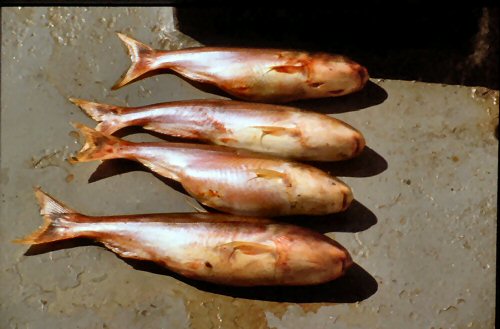
coecutiens Cetopsis coecutiens belongs to the family Cetopsidae or Whale Catfishes from South America; namely the Amazon basin, Peru, Bolivia, Colombia, Ecuador, Venezuela and Brazil - Tocantins and Orinoco River basins. Although it is documented that this catfish reaches a size of 265mm, whilst collecting catfish in Peru in July 2000 a number of specimens were caught on rod and line ( see image below) which exceeded this length and were 300mm+!
Cetopsis coecutiens - caught on rod and line
Cetopsis coecutiens prefer to be kept in water which has a pH in the range of 6.0-7.4. This catfish is ideally suited to temperatures in the range of 22-28ºC. Cetopsis coecutiens is naturally an open water swimming fish and as such requires well aerated water with a strong current in order to keep it in optimum conditions. I would suggest a minimum size of Aquaria to be 72” x 24” X 24” if you are going to keep these catfish until they attain adult size. There is no real preference of substrate when keeping these catfish however; I would suggest good quality aquarium sand such as BD Aquarium Sand, or very smooth rounded gravel. The aquarium should provide minimal shelter in the form of rocks or bogwood due to the fact that this catfish is constantly on the go, swimming in the midwater regions of the water body. As with all other species of fish, water quality and general husbandry is very important, and I would recommend that a minimum of 25% water is changed on a weekly basis due to the fact that these catfish are constantly looking for food and the diet is fish or meat based. Lighting should be dim, due to the poor eyesight of these catfish and the fact that they are found at relatively deep water levels in their natural habitat. Did you know? – This particular catfish was recently featured in the BBC series Amazon Abyss, and was seen still feeding upon the carcass of a catfish even after it was taken out of the water!
|
 his
month we welcome back our resident catfish contributor,
Chris Ralph, writer and catfish expert in the U.K.
fishkeeping magazines. This factsheet is close to
my heart, so to speak, as I joined Chris and other
catfish buffs on a memorable trip to Peru and the
Amazon in 2000 and this catfish was one of the first
that I had seen when we caught them from the boat
on rod and line. They are not a pretty sight so I
will let Chris explain and educate us on the "Whale
Cat", Cetopsis coecutiens
his
month we welcome back our resident catfish contributor,
Chris Ralph, writer and catfish expert in the U.K.
fishkeeping magazines. This factsheet is close to
my heart, so to speak, as I joined Chris and other
catfish buffs on a memorable trip to Peru and the
Amazon in 2000 and this catfish was one of the first
that I had seen when we caught them from the boat
on rod and line. They are not a pretty sight so I
will let Chris explain and educate us on the "Whale
Cat", Cetopsis coecutiens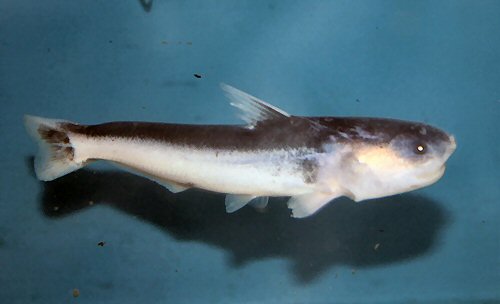
Common Name: |
Blue Whale Catfish, Whale Catfish, Baby Whale Catfish, Blue Shark Catfish, Blue Torpedo Catfish or Candiru |
Synonyms: |
Silurus coecutiens, Silurus caecutiens |
Family: |
Cetopsidae |
Subfamily: |
Cetopsinae |
Distribution: |
South America: Namely the Amazon basin, Peru, Bolivia, Colombia, Ecuador, Venezuela and Brazil - Tocantins and Orinoco River basins. |
Size: |
265mm S.L. (10½ins) (standard length – this is the measurement of the fish from the tip of the snout to the base of the caudal peduncle) |
Temp: |
22-28°C (71-83°F) |
p.H. |
6.0-7.4. |
Characteristics |
The body shape of Cetopsis coecutiens is described as being cylindrical, torpedo or cigar shaped. The body is also best described as being naked or devoid of scales. The pectoral fin spines are not serrated. The eyes are small in comparison to the rest of the body and are often described as being “piggy”. The mouth is relatively large in comparison to the rest of the body with the mandible being under slung, with the maxilla protruding, almost giving the appearance that the fish is smiling. |
Colouration |
The base colour of the dorsolateral region of the body and head is blue, whilst the ventrolateral region is predominantly white in colour interspersed with some patches of blue towards the head. The dorsal and caudal fins have some blue colouration whilst the remaining fins are white in colour. |
Aquarium Care & Compatibility |
| Wherever possible I would recommend that the aquarist keep these catfish in a species only aquarium in small groups, but as the absolute minimum I would suggest two to three specimens assuming that they are available in these numbers. In their natural habitat Cetopsis coecutiens would be found in very large shoals. This catfish is not a species to be trusted in with other species due to its ability to bite lumps out of other large fish, and would soon devour any small fish within the confines of its environment. With this information in mind I would not recommend that you keep any other fish with these catfish. |
Reproduction |
As far as I am aware there are no documented records of Cetopsis coecutiens having been spawned in aquaria to date (but then who would want to?). |
Sexual differences |
The males tend to be more slender than the females. The dorsal fin of the male tends to be more pointed in mature specimens. |
Diet |
| As with all the other catfish that I have had the pleasure to keep over the years, Cetopsis coecutiens readily accepts a mixed but meaty varied diet. I found that these catfish relished meaty foods such as whole mussel, cockles, prawns and earthworms and after a while they even accepted the occasional sinking catfish pellet! A word of caution though, these catfish will easily gorge themselves if given too much food, so you need to ensure that these catfish are not overfed. |
Glossary of Terms |
Dorsolateral:
Defined as extending from the top to the side. |
Etymology |
| Cetopsis:
from the Greek cetos which means whale,
and cosis which means like, hence the reference to
this catfish being whale-like in appearance. |
IUCN Red List |
Despite there being little information available on this species, it has a wide range, and is not impacted by any known threats; therefore it is assessed as Least Concern. (IUCN 2023). |
Reference: |
Frederico,
R.G. 2023. Cetopsis
coecutiens. The IUCN Red List of Threatened Species
2023. |
Photo Credits |
© Chris Ralph |
|

If you would like to contribute to the monthly factsheets with an
article, information or photos, please e-mail
me. You will of course be credited for your work.
If you would like to donate any denomination of money to the site just click the above link button. All proceeds will go to running the site and hopefully to keep it going for a few years yet.
ScotCat Sources
 Entomology-genera
Entomology-specific name
Online Sources
 Search
 Fishbase
 Catalog of Fishes
 GBIF
GBIF
 Fishnet2
 iNaturalist
 IUCN
IUCN

