SCOTCAT.COM
your internet guide to all things catfish
FACTSHEETS: July 2025 - no. 349
Chrysichthys brachynema Boulenger, 1900 |
|
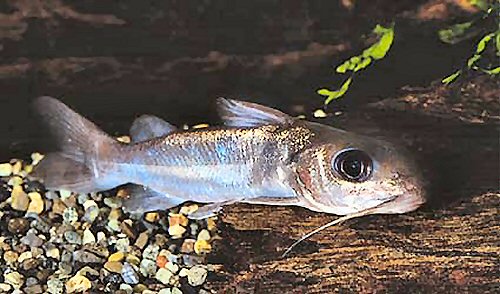
Chrysichthys brachynema is endemic to Lake Tanganyika where it is widely distributed along the littoral zone. Locally threatened by siltation and heavy fishing pressure but the impacts are not thought to be lake-wide. The discovery of Chrysichthys brachynema was made by Mr J. E. S. Moore in Lake Tanganyika during his expedition between 1895-1896 and later described by George Albert Boulenger in 1900. George Albert Boulenger (19 October 1858 – 23 November 1937) was a Belgian-British zoologist who described and gave scientific names to over 2,000 new animal species, chiefly fish, reptiles, and amphibians. Boulenger was also an active botanist during the last 30 years of his life, especially in the study of roses. The report focuses
on the ichthyology of Lake Tanganyika, specifically
the fish species found during Moore's expedition.
It provides a detailed account of the collected specimens,
likely including descriptions, classifications, and
potentially illustrations or plates. The appendix
by J.E.S. Moore may offer additional insights into
the expedition, the collection process, or other observations
related to the fish and their environment. The publication
is significant for its contribution to the understanding
of the fish fauna of Lake Tanganyika during that period.
|
 he catfish species Chrysichthys brachynema,
also known as the Kibonde or salmontail catfish, is
found in Lake Tanganyika. It belongs to the Claroteidae
family and was first described by George Albert Boulenger
in 1900. This fish can grow up to 77cm (30 inches)
in length and primarily inhabits inshore areas of
the lake, where it feeds mainly on crabs.
he catfish species Chrysichthys brachynema,
also known as the Kibonde or salmontail catfish, is
found in Lake Tanganyika. It belongs to the Claroteidae
family and was first described by George Albert Boulenger
in 1900. This fish can grow up to 77cm (30 inches)
in length and primarily inhabits inshore areas of
the lake, where it feeds mainly on crabs.
![Kalambo [Lake Tanganyika].](../maps/kalambo.jpg)
Common Name |
Goldback spiny catfish, Kibonde |
Synonyms |
Amarginops brachynema, Chrysichthys myriodon |
Family |
Claroteidae |
Subfamily |
- |
Distribution |
Africa: Lake Tanganyika. Type locality: Kalambo [Lake Tanganyika]. |
Size |
70.0cm. (2ft 4ins) |
Temp. |
24-28°C (75-83°F) |
p.H. |
7.5-8.5. |
Characteristics |
Head little longer than broad, smooth above; snout twice as broad as long; diameter of eye 5 to 6 times in length of head; maxillary barbels half or two thirds length of head outer mandibular one third or half; nasal barbels not or but scarcely longer than diameter of eye; teeth on the palate forming a broad crescentic or horse-shoe shaped band on the vomer and pterygoids. Dorsal spine one third or two fifths length of head. Adipose fin measuring one third or half its distance from the rayed dorsal. Pectoral spine very strongly serrated. Caudal deeply notched, with obtusely pointed lobes. |
Colouration |
Olive colour above, white beneath. |
Aquarium Care & Compatibility |
| As with most of this genera it cannot to be trusted with smaller tank mates. Would do better with larger African Tetras or Cichlids. Give it a choice of hiding places to make it feel more comfortable in its surroundings as it can be nocturnal. This is a species for the larger aquarium or at least a Public Aquarium setting. Care should be taken when handling as the sharp dorsal and pectoral spines are covered in mucus that will irritate the skin. Can live in fresh or brackish water. |
Reproduction |
Unreported |
Sexual differences |
In mature males the skin is thickened and becomes coated in mucus, pectoral and dorsal fin spines are thicker and less needle like. |
Diet |
| Inhabits inshore areas of the lake down to 30m depth and feeds mainly on crabs. They are an omnivore and will take a wide variety of food in the aquarium including frozen food, tablets, pellets and prawns. |
Glossary of Terms |
Anal
fin: The median, unpaired,
ventrally located fin that lies behind the anus, usually
on the posterior half of the fish. |
Etymology |
| Chrysichthys:
chrysós (Gr.),
gold or golden, referring to golden-yellow head and/or
specific name of C. auratus (=golden); ichthýs
(Gr.), fish. |
References |
Chrysichthys
brachynema Boulenger, 1900 Collected
in Zambia by South African Institute for Aquatic
Biodiversity (licensed under creativecommons.org). |
IUCN Red List |
Chrysichthys brachynema has most recently been assessed for The IUCN Red List of Threatened Species in 2006. It is listed as Least Concern. |
Photo Credits |
©
|



|

If you would like to contribute to the monthly factsheets with an
article, information or photos, please e-mail
me. You will of course be credited for your work.
If you would like to donate any denomination of money to the site just click the above link button. All proceeds will go to running the site and hopefully to keep it going for a few years yet.
ScotCat Sources
 Etymology-genus name
Etymology-specific name
Other Sources
 Search
 Fishbase
 Wikipedia
 Catalog
of Fishes
Catalog
of Fishes
 GBIF
GBIF
 FishNet2
 iNaturalist
 IUCN
IUCN

