SCOTCAT.COM
your internet guide to all things catfish
FACTSHEETS: September 1997 - no. 015
Hoplisoma concolor (Weitzman, 1961) |
Hoplisoma concolor
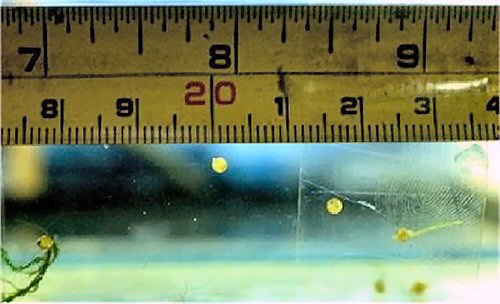
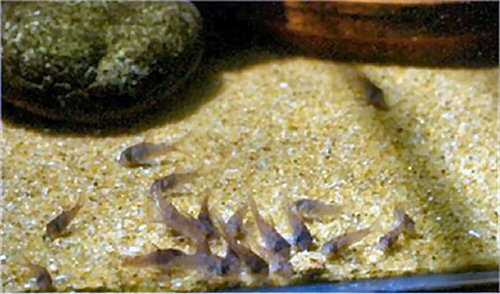
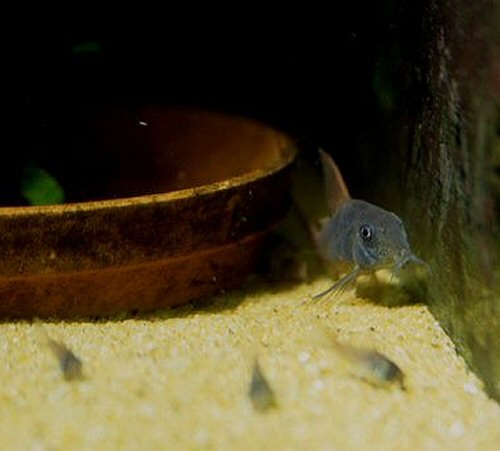
Both sexes have a nice orange colouration to their fins with some species having more colour than others, probably depending on the catchment area. The Latin meaning for concolor is uniformly coloured; of the same colour. but I find this a bit of a misdemeanor as they can show traces of blues and greens in a healthy specimen and also the colour in the fins as mentioned earlier. I find them to be quite an easy Corydoras/Hoplisoma to keep but somewhat shy, I sometimes wonder why they are not more popular, but in the U.K anyway, they are not so abundant in the aquatic shops. I did have quite a bit of success in spawning this species and I have a short summery in the breeding section of this factsheet. Below is a small photo album of the breeding of Hoplisoma concolor, just click on the thumbnail to see a larger image.
If you are keen on Corydoras/Hoplisoma and you see concolor in your local shop, give them a go, you will not be disappointed. Buy at least 4 and more if you can afford it as they are not all that expensive, although they will cost more than your average cory such as aenea, paleatum etc.
|
 s
can be seen in the photograph this is a male due to
the longer dorsal fin against the normal of the female.
This cory is somewhat similar to Osteogaster aenea
(formerly Corydoras aeneus), but there
the similarity ends, as concolor is smaller
and a more robust looking fish, it appears to be more
chunky, especially fully grown adults which can get
very heavy and impressive looking.
s
can be seen in the photograph this is a male due to
the longer dorsal fin against the normal of the female.
This cory is somewhat similar to Osteogaster aenea
(formerly Corydoras aeneus), but there
the similarity ends, as concolor is smaller
and a more robust looking fish, it appears to be more
chunky, especially fully grown adults which can get
very heavy and impressive looking.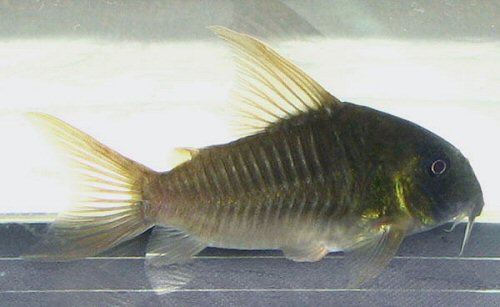
Remarks: Corydoras concolor is placed in Lineage 9, the "short-snouted" species with the designated type species: C. punctatus. A revision in the future would constitute the resurrection of the genus name Hoplisoma (Agassiz, 1846). Update: As of the latest revision (Dias et al 2024) Corydoras concolor has now been placed in Lineage 9 and has the new genus name of Hoplisoma. This species is still found on some online sources as Corydoras concolor.
|
Common Name |
Slate Cory |
Synonyms |
Corydoras esperanzae, Corydoras concolor |
Family |
Callichthyidae |
Subfamily |
Corydoradinae |
Distribution |
South America: Venezuela, Las Mangas, in a tributary to the Río Parguaza, western part of the State of Bolivar, Venezuela. The Río Parguaza is a stream arising in the Serranía de Parguaza, flowing northwest and into the Río Orinoco almost opposite the island of El Gallo (6°20’N, 67°10’W. |
Size |
Male: 5.5cm (2¼ins) Female: 6.0cm (2½ins) |
Temp |
23-26°C (73-79°F) |
p.H. |
6.5-7.2. |
Characteristics |
Dorsal 1/7; Anal 1/5; Head short and compact. |
Colouration |
Body colour reddish/brown with glimmers of greens/blues when in good condition. All fins have an ochre to orange colouration with no markings. Black band running through eyes. |
Aquarium Care & Compatibility |
| Will do well in a community setup with smaller tankmates such as Rasboras and Tetra's. Do not house with aggressive species or large Cichlids. |
Reproduction |
I set them up for breeding in a 18" x 12" x 12" tank with sand, Java moss, Java fern and a sponge filter. They spawned with the temperature of their water at 78°f and a pH of 6 and GH 1. The eggs are quite large measuring 2mm and a creamy white colour. My first spawning yielded only 8 eggs but my second spawning 7 weeks later amounted to 25 eggs. They laid eggs on and off for the next year then suddenly stopped for a year. I didn't get them going again until the night of this article (14th Sept.98) The fry look like any other cory fry having spots over the top half of the body and gradually begin to look like the parents after 6 weeks with pale orange fins, a dark head which has quite a steep incline, making it look quite chunky. |
Diet |
| The usual fare for adult Corydoras/Hoplisoma, a good quality flake food, tablet food, frozen bloodworm and whiteworm used sparingly. I fed the fry with infusuria to start off the first few days then on to Brine shrimp naupli, Microworm, fry and crushed flake. |
Etymology |
| Hoplisoma:
hóplon, shield or armor; soma, body, referring
to bony plates on sides. |
References |
Alexandrou,
Markos & Taylor, Martin (2011). Evolution,
ecology and taxonomy of the Corydoradinae revisited. |
Photo Credits |
Top: © Graham
Ramsay |

|

If you would like to contribute to the monthly factsheets with an
article, information or photos, please e-mail
me. You will of course be credited for your work.
If you would like to donate any denomination of money to the site just click the above link button. All proceeds will go to running the site and hopefully to keep it going for a few years yet.
ScotCat Sources
 Etymology-genera
Etymology-specific name
Online Sources
 Search
 Fishbase
 Catalog of Fishes
 GBIF
GBIF
 Fishnet2
 iNaturalist

