SCOTCAT.COM
your internet guide to all things catfish
FACTSHEETS: September 2025 - no. 351
Erethistes filamentosus (Blyth 1860) |
|
Erethistes
filamentosus
is still listed as Hara
filamentosa in Fishbase and a few other online
sources but this name is treated as a synomyn in Eschmeyer's
Catalog of Fishes.
|
 bit
of history is called for, as in our September factsheet
(2025). Ferraris (2007) moved Hara back to
its original placement from Erithistidae to the Sisoridae
family, which had been moved there by de Pinna in
1996, along with Conta, Erethistoides,
Erithistes and Pseudolaguvia. Thompson
& Page (2006) published a paper on the Genera
of the Asian catfish families Sisoridae and Erethistidae.
In part, they set forth their diagnosis and reasons
for reclassifying or, more to the point, reassigning
Hara species as Erethistes.
bit
of history is called for, as in our September factsheet
(2025). Ferraris (2007) moved Hara back to
its original placement from Erithistidae to the Sisoridae
family, which had been moved there by de Pinna in
1996, along with Conta, Erethistoides,
Erithistes and Pseudolaguvia. Thompson
& Page (2006) published a paper on the Genera
of the Asian catfish families Sisoridae and Erethistidae.
In part, they set forth their diagnosis and reasons
for reclassifying or, more to the point, reassigning
Hara species as Erethistes.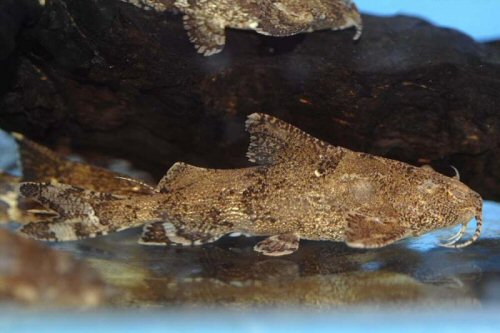
Common Name |
None |
Synonyms |
Erethistes maesotensis, Hara filamentosus, Hara filamentosa, Hara maesotensis |
Family |
Sisoridae |
Subfamily |
Sisorinae |
Habitat |
Found in fast flowing river with depth nowhere more than 80 cm and with bottom mainly consisting of stones and sand with numerous empty gastropod shells. |
Distribution |
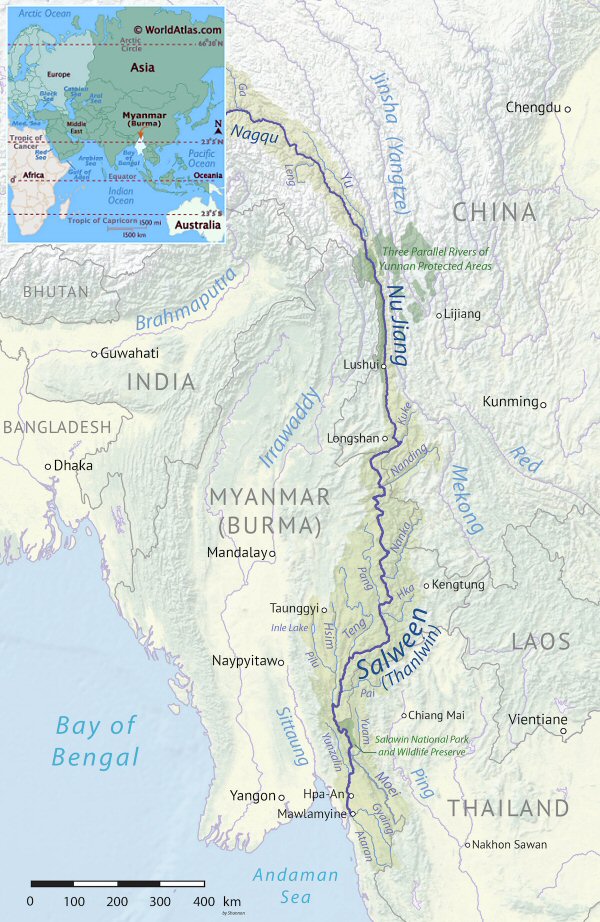
Asia: Ataran, Salween and Sitting river drainages: Myanmar and Thailand. Type locality: Tenasserim, Burma. |
Size |
5.0cm. (2ins) |
Temp. |
20-24°C (66°-75°F) |
p.H. |
6.0-7.5. |
Characteristics |
Caudal peduncle length 14.9-17.8% SL, depth 6.1-7.2% SL (depth 2.1-2.9 times in its length); body depth 13.9-19.2% SL. No thoracic adhesive apparatus; robust (vs. slender) body; 8–12 anal rays; anterior margin of pectoral spine with serrations all pointing toward tip of spine, or arranged in divergent pairs, or outwardly directed and not divergent; smooth to granulate anterior margin on dorsal spine; papillate upper lip; 8–12 anal rays. Long filament extending from upper segment of caudal fin. |
Colouration |
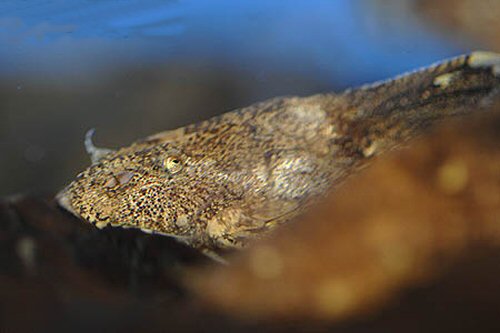
Head and body dark chestnut brown to light chocolate brown, with a mottling caused by numerous smaller, irregular darker brown patches. Belly and ventral surfaces of head light brown. Two thin, irregular light brown bars on body: first chevron-shaped and located between dorsal and adipose fin bases, second thicker than first and located on caudal peduncle. Dorsal fin dark mottled brown, except for thin hyaline distal margin. Pectoral fin dark brown, with thin hyaline distal margin and either a small ovoid hyaline spot or a crescentic median hyaline band on middle third of fin. Pelvic and anal fins hyaline, with dark brown bases and subdistal stripes. Adipose fin brown as in body, with lighter coloured distal margin. Caudal fin hyaline, with irregular W-shaped band subdistally and with small dark brown flecks randomly distributed throughout fin. Two small light brown patches present at bases of caudal fin lobes in some individuals. Maxillary and mandibular barbels light brown, with dark brown annuli, (Ng, Heok Hee, & Kottelat, Maurice 2007). |
Aquarium Care & Compatibility |
| A tank with a sandy bottom and rounded stones and pebbles with a good water flow as befits an asian hillstream setup. Good water quality is a must for this family. Keep the water temperature on the cool side of a tropical aquarium. Tank mates such as the zebra danio (Brachydanio rerio) and asian fish of the same small size will make good tankmates. |
Reproduction |
Unknown
|
Sexual differences |
Females are deeper and wider bodied. |
Diet |
| Prefers live foods such as bloodworm, grindle worm and daphnia. |
Glossary of Terms |
Anal
fin: The median, unpaired,
ventrally located fin that lies behind the anus, usually
on the posterior half of the fish. |
Etymology |
| Erithistes:
Etymology not explained, presumably
erethizon, porcupine and–istes, adjectival suffix,
i.e., porcupine-like, referring to strong and serrated
dorsal and pectoral-fin spines. |
IUCN Red List |
Not evaluated. |
References |
Adrian Taylor:
pers. comm. |
Photo Credits |
©
Johnny
Jensen @ |

|

If you would like to contribute to the monthly factsheets with an
article, information or photos, please e-mail
me. You will of course be credited for your work.
If you would like to donate any denomination of money to the site just click the above link button. All proceeds will go to running the site and hopefully to keep it going for a few years yet.
ScotCat Sources
 Etymology-genus name
Etymology-specific name
Other Sources
 Search
 Fishbase
 Wikipedia
 Catalog
of Fishes
Catalog
of Fishes
 GBIF
GBIF
 FishNet2
 iNaturalist

