SCOTCAT.COM
your internet guide to all things catfish
FACTSHEETS: October 2004 - no. 100
Hemibagrus wyckioides Fang & Chaux, 1949 |
Hemibagrus
wyckioides The following week the wholesaler was visited by my friend who informed him of the mix up. The wholesaler said “But you don’t know anything about catfish, and I thought that nobody would notice”, to which my friend replied “I know, but my customer does”! Apparently the wholesaler was a tad embarrassed and has promised to replace the fish for me at some stage. I subsequently re-homed one of these catfish to some very good friends on the Isle of Wight, whilst in the not too distant future the remaining catfish is destined to be relocated to one of Daphne’s tanks in her fish room.
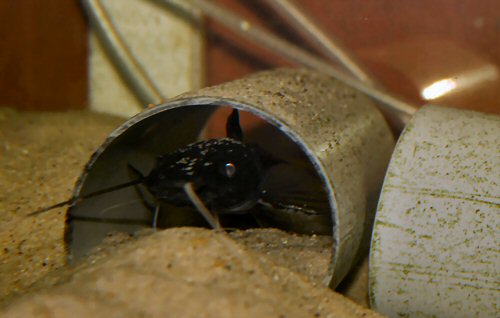
Hemibagrus wyckioides - juvenile
I have to say that this is a catfish full of character, but one that is also purely evil. It looks at you as if butter would not melt in its mouth, but turn your back and it is probably the most mischievous fish that I have had the pleasure to keep recently. This catfish is constantly rearranging the décor in the tank, one day the aquarium sand (BD Aquarium Sand) is piled up against one end of the tank the next you cannot see through the front glass! This catfish will eat literally anything that I care to feed it ranging from earthworms, cockles, prawns, mussels etc to catfish pellets and floating food sticks. In some respects I will be sad to see the fish go but I know that it will have much larger accommodation than I can provide for it at present. As most of you reading this will realise this catfish is not one to be taken lightly, and is not one for the novice fish keeper. Anyway I digress, back to the confusion over the naming of this catfish. Those of you who surf the web will no doubt have come across many sites listing or referring to our favourite subjects “Catfish”, this is where some of the confusion certainly on my part sets in. My first encounters with this catfish (too many years ago to remember now), were when I saw the odd specimen in a retailers tank labeled up as Mystus nemurus, how things have changed. At one time these catfish were compared to the Red tailed catfish – Phractocephalus hemioliopterus “The Emperor of the Amazon” as being the poor man’s cousin. At the time it was thought that H. wyckioides only grew to around 300mm or 12” how naive we were. As the years have passed by this catfish has seen some name changes from Mystus nemurus to Hemibagrus nemurus (or so we thought), to what we now know as Hemibagrus wyckioides; hence the confusion! To further add to this confusion Hemibagrus nemurus is a valid species but differs from Hemibagrus wyckioides in that it does not posses the red coloured tail and has a more flattened head, shorter adipose fin and filamentous extensions to the dorsal and caudal fin rays. In its natural habitat H. wyckioides is found at irregular depths usually over rocky substrates in large upland rivers. It is documented that this catfish reproduces in its local environment and enters the flooded forest during the high water season which is usually between July and October. It is a predator feeding upon a diet that includes prawns, insects, fish and crabs in its natural habitat. As with all large species of catfish (or any other fish for that matter) good water quality and general aquarium husbandry are paramount to the successful keeping of this fish. Water changes should be performed at least weekly to maintain good water quality. This catfish prefers good water movement which can usually be provided by using adequately sized external and or internal power filtration. Finally it is described as being the largest bagrid in Asia reaching weights of up to 80kg!
|
 n
honour of ScotCats 100th factsheet, author and Practical
Fishkeepings catfish expert, Chris Ralph, has offered
to compile an article on a catfish that could very
well be deemed a wolf in sheep's clothing!, Hemibagrus
wyckioides.
n
honour of ScotCats 100th factsheet, author and Practical
Fishkeepings catfish expert, Chris Ralph, has offered
to compile an article on a catfish that could very
well be deemed a wolf in sheep's clothing!, Hemibagrus
wyckioides.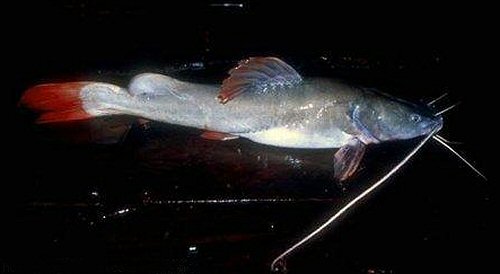
Common Name |
Asian Red Tailed Catfish, Common Baung, Pla Kayeng Thong, Trey khya, Asian redtail catfish. |
Synonyms |
Macrones wickioides, Macrones wyckioides, Mystus wyckioides, Mystus wyckoides. |
Family |
Bagridae |
Subfamily |
Bagrinae |
Distribution |
Asia: Mekong, Chao Phraya and Xe Bangfai basins. Cambodia, Thailand river systems, Malay Peninsula, Sumatra, Borneo and Java. |
Size |
950mm or 38” SL (although 1300mm TL is suggested) |
Temp. |
19-29°C ( 65-85°f) |
p.H. |
6.0-8.2 (although pH 6-7.6 seems to be preferable) |
Characteristics |
The dorsal fin has 1 spine with 7-8 soft rays. The anal fin has 12-14 soft rays. The adipose fin is described as being long with a gently sloping anterior margin. The maxillary barbels usually reach to the middle of the base of the adipose fin, although the barbels sometimes extend beyond this point. The head is described as being flat as opposed to being conical with a short occipital process not close to the basal bone of the dorsal fin. |
Colouration |
The base body colour of this catfish is light grey/brown with a greenish tinge. The lower half and underside of the body is whitish in colour. The caudal fin in adult specimens is whole or partially coloured bright red. Juvenile specimens have a whitish coloured caudal fin. |
Aquarium Care & Compatibility |
| This catfish has the reputation of being one of the most (if not the most) aggressive freshwater fish in the world. This catfish has the ability to bite, hence the reason why in captivity this catfish is ultimately destined to a life in solitary confinement, for if it is kept with other fish the most likely outcome is that they will eventually form part of its diet. |
Reproduction |
There are no known reported aquarium spawning's of this catfish, most likely due to the eventual size that these fish attain and their aggressive nature! The males are said to possess a genital papilla just in front of the anal fin. |
Diet |
| Whilst this catfish is best described as a predator/carnivore in its natural habitat feeding on fish, insects, crabs and prawns; in captivity this catfish will feed on mussels, prawns, pieces of fish, earthworms and will even take prepared foods such as catfish pellets. |
Etymology |
| Hemi-
half; bagrus - From 'bagre',
a South American name for a catfish, but is only used
for African and Asian species. |
References |
Planet Catfish
- www.planetcatfish.com |
Photo Credits |
Top: ©
Johnny Jensen @ |

|

If you would like to contribute to the monthly factsheets with an
article, information or photos, please e-mail
me. You will of course be credited for your work.
If you would like to donate any denomination of money to the site just click the above link button. All proceeds will go to running the site and hopefully to keep it going for a few years yet.
ScotCat Sources
 Article
 Etymology-genera
Etymology-specific name
Online Sources
 Search
 Fishbase
 Catalog of Fishes
 GBIF
GBIF
 Fishnet2
 iNaturalist

