SCOTCAT.COM  

your internet guide to all things catfish
≡
  • HOME
  • FACTSHEETS
    • By Month/Year
    • By Family
    • by Genus
    • by Common Names
    • By Specific Names
    • By Continent
      • Index
      • Africa
      • Asia
      • Australasia
      • Europe
      • North America
      • South America
  • GALLERIES
    • Photo Gallery
    • Art Gallery
    • Movie Gallery
    • Stamps Gallery
  • FAMILIES
    • A-B
      • Ailiidae
      • Akysidae
      • Amblycipitidae
      • Amphiliidae
      • Anchariidae
      • † Andinichthyidae
      • Ariidae
      • Aspredinidae
      • Astroblepidae
      • Auchenipteridae
      • Auchenoglanididae
      • Austroglanididae
      • Bagridae
    • C-D
      • Callichthyidae
      • Cetopsidae
      • Chacidae
      • Clariidae
      • Claroteidae
      • Cranoglanididae
      • Diplomystidae
      • Doradidae
    • H-I
      • Heptapteridae
      • Heteropneustidae
      • Horabagridae
      • Ictaluridae
    • K-L-M
      • Kryptoglanidae
      • Lacantuniidae
      • Loricariidae
      • Malapteruridae
      • Mochokidae
    • N-P
      • Nematogenyidae
      • Pangasiidae
      • Phreatobiidae
      • Pimelodidae
      • Plotosidae
      • Pseudopimelodidae
    • R-S-T
      • Ritidae
      • Schilbeidae
      • Scoloplacidae
      • Siluridae
      • Sisoridae
      • Trichomycteridae
  • ARTICLES
    • Index
    • Breeding
    • By Author
    • Cat-Articles
    • General
    • Numbered List
    • Ichthyology
    • Travel/Collecting
  • IDENT-A-CAT
  • RESOURCES
    • Citation
    • Etymology
    • Fishhouse
    • Glossary
    • Scientific Papers
    • ScotShop
  • SITE MAP
  • FB GROUP
  • HELP
    • Index
    • Catfish Anatomy
    • Convertors
    • FAQ
    • Ident-A-Cat
    • Water Chemistry

FACTSHEETS: January 2014 - no. 211

Hoplisoma loretoense (Nijssen & Isbrücker, 1986)


imilar to
Hoplisoma armatum, but this species is higher bodied. There is also a variety with an eye mask which may be the juvenile pattern of Corydoras loretoensis (now Hoplisoma loretoense) with this trait disappearing as they grow into adulthood.


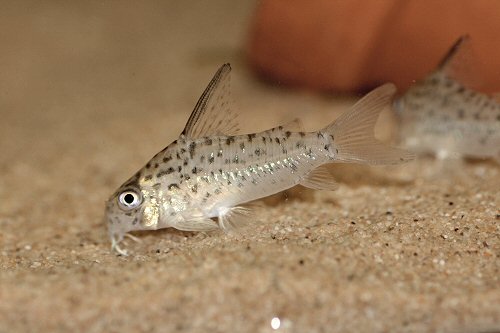
Hoplisoma loretoense

Hoplisoma loretoense


At first glance in your LFS you would be challenged to think of a more unspectacular looking cory, but believe me when you get them home and settled in your aquarium you will be surprised at the beauty of this little catfish. Of course not a looker in the sense of colouration, but the high dorsal with the black edging and the black spots on the grey body coupled with its gregarious behavior will make it a firm favourite in your fish room/hut. I picked mine up at an auction and wondered why I had bid for them, but I am very glad that I did as I had not kept this Corydoras/Hoplisoma in over 30 years of fishkeeping and it sparked a bit of exhilaration in my Fishhouse.


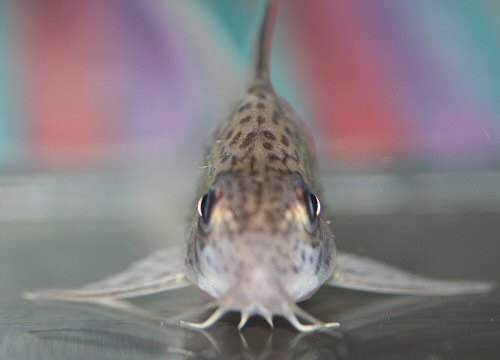
Hoplisoma loretoense - head view

Hoplisoma loretoense - head view


The head view image above shows the unusually large eyes which are situated high on the head. The snout is very short and angular.

Conclusion: This is a very social Hoplisoma and one that you should consider if you have not kept this species before.

Remarks: Corydoras loretoensis is placed in Lineage 9, the "short-snouted" species with the designated type species: C. punctatus. A revision in the future would constitute the resurrection of the genus name Hoplisoma (Agassiz, 1846).

Update: As of the latest revision (Dias et al 2024) Corydoras loretoensis has now been placed in Lineage 9 and has the new genus name of Hoplisoma and a change to the specific name to loretoense. This species is still found on some online sources as Corydoras loretoensis.


Common Name

Loreto Cory

Synonyms

Corydoras loretoensis

Family

Callichthyidae

Subfamily

Corydoradinae

Distribution

South America: Peru, Loreto Province, Rio Nanay. Type locality: Xeberos and Huallaga, Peru.

Size

4.5cm (1¾ins) Male; 5.0cm (2ins) Female.

Temp

23-26°C (73-79°F)

p.H.

6.0-7.2.

Characteristics

Head short and blunt. Eyes large which are situated high on the head. Dorsal fin elongated.

Colouration

Ground colour of head and body grey with black spots and blotches. Dorsal fin spine is black and the rest of the fin may have a few dark spots/blotches. Rest of fins hyaline but some specimens may show faint bars in the caudal fin. There is a hint of a pale eye mask in adults.

Aquarium Care & Compatibility

This is akin to most of this genus, very peaceful, and would be best housed with small to medium sized tankmates such as Tetras, Rasboras and Danios or in a species tank for breeding purposes. Best to purchase 6 individuals or more as they will be happier in a group.

Reproduction

As per Corydoras/Hoplisoma 'T' mating fashion but not one of the easiest members of this genera to spawn but once you have been successful they should spawn at regular intervals. Will lay their eggs in Java moss, spawning mops or the corners of the tank glass. There have been reports (Fuller 2013) of this species laying eggs in the sand substrate.

Sexual Differences

Males tend to be more brightly coloured with the females showing a paler colouration.

Diet

Readily accepts a mixed and varied diet which includes granular foods, tablet food, frozen bloodworm and a good quality flake.

Etymology

Hoplisoma: hóplon, shield or armor; soma, body, referring to bony plates on sides.
loretoense: From Loreto, a department in Peru where this Corydoras species was found.

Glossary of Terms

Caudal fin: The tail.
Dorsal fin: The primary rayed fin(s) on top of the body.
Hyaline: Transparent or clear without pigment.

References

Alexandrou, Markos & Taylor, Martin (2011). Evolution, ecology and taxonomy of the Corydoradinae revisited.
Angelica C Dias, Luiz F C Tencatt, Fabio F Roxo, Gabriel de Souza da Costa Silva, Sérgio A Santos, Marcelo R Britto, Martin I Taylor, Claudio Oliveira, Phylogenomic analyses in the complex Neotropical subfamily Corydoradinae (Siluriformes: Callichthyidae) with a new classification based on morphological and molecular data, Zoological Journal of the Linnean Society, 2024;, zlae053.

Ferraris, C.J. Jr., 2007. Checklist of catfishes, recent and fossil (Osteichthyes: Siluriformes), and catalogue of siluriform primary types. Zootaxa 1418:1-628.
Fuller, I.A.M. & Evers, H-G
: 2005 Identifying Corydoradinae Catfish 384 p.

Photo Credits

© Allan James @ ScotCat

Donate towards my web hosting bill!


If you would like to contribute to the monthly factsheets with an article, information or photos, please e-mail me. You will of course be credited for your work.

If you would like to donate any denomination of money to the site just click the above link button. All proceeds will go to running the site and hopefully to keep it going for a few years yet.


ScotCat Sources

Etymology = Genus Etymology-genera

Etymology = Species Etymology-specific name


Online Sources

Search  Search

FishBase Fishbase

Catalog of Fishes Catalog of Fishes

Global Biodiversity Information Facility GBIF

FishNet2 Fishnet2

iNaturalist iNaturalist

  • Facebook about us + contact us + citation + translate + site map + scotshop + glossary + etymology +
  • help YouTube

©2025 SCOTCAT.COM