SCOTCAT.COM
your internet guide to all things catfish
FACTSHEETS: June 1997- no. 012
Hoplisoma sterbai (Knaak, 1962) |
Hoplisoma sterbai
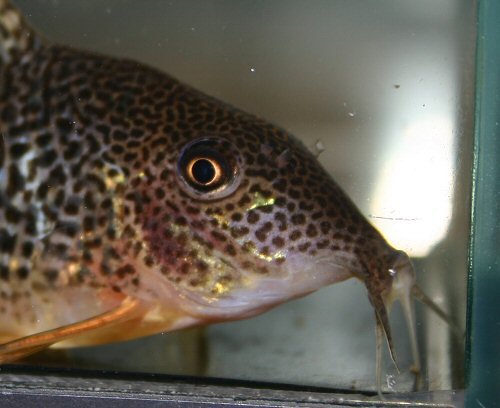
Brochis haraldschultzi - head view
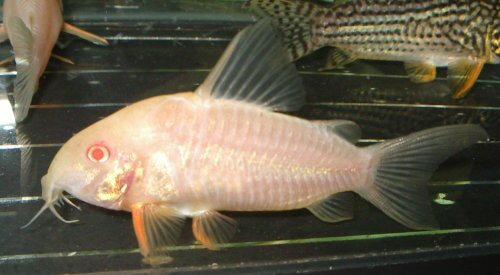
To make matters even more complicated there is an albino version bred in Singapore which first made its appearance in 1998. You can even see an orange taint in the pectoral and ventral fins in this variety. Only time will tell if this will become as popular as the Osteogaster aenea 'albino' with aquarists. I have a feeling that it won't go down too well with some Corydoras enthusiasts! and of time of writing (May 2002) it is still quite an expensive purchase, but I quite like it.
Hoplisoma sterbai - albino
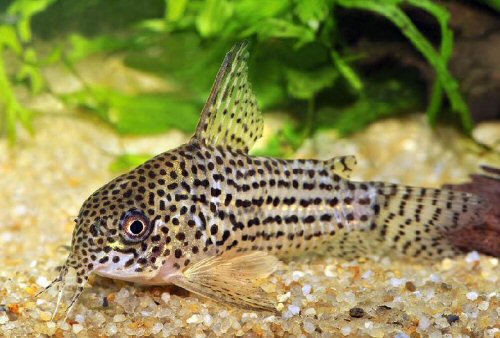
The common version which we all know and love occurs in the Upper Rio Guapore which straddles the border between Brazil and Bolivia. Named In honour of Dr Günther Sterba who in my humble opinion wrote some of the best books on the hobby in the late 60's and early 70's, and which still hold up well to this day. Hoplisoma sterbai is much like any other species of the genus Corydoras/Hoplisoma, easy to keep but will do better in a group as they are sociable animals and do like their own company. They will also appreciate a bit of water movement in the aquarium. In 2003 in Bolivia there was a collection made by Joachim Knaack in the Río Itenez which was very similar to our Factsheet of the Month subject. You can access the information and image here.
|
 his
Corydoras/Hoplisoma has been around
for many years and is still very popular, and when
it pops up in auctions they can still fetch a reasonable
price. The main talking point about sterbai
is of course the pectoral fins, being the colour of
orange, one of a handful of Cory's with this trait,
the ventral fins are also this colour. In well marked
specimens you can get an orange colouration in the
abdomen area.
his
Corydoras/Hoplisoma has been around
for many years and is still very popular, and when
it pops up in auctions they can still fetch a reasonable
price. The main talking point about sterbai
is of course the pectoral fins, being the colour of
orange, one of a handful of Cory's with this trait,
the ventral fins are also this colour. In well marked
specimens you can get an orange colouration in the
abdomen area. 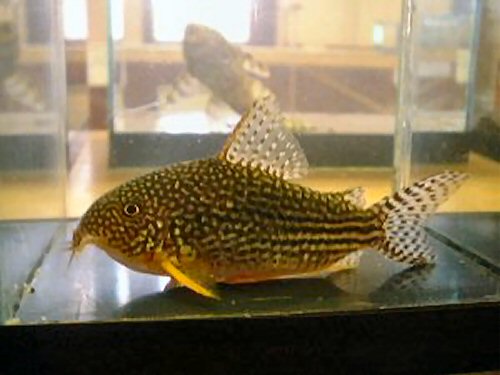
Remarks: Corydoras sterbai is placed in Lineage 9, the "short-snouted" species with the designated type species: C. punctatus. A revision in the future would constitute the resurrection of the genus name Hoplisoma (Agassiz, 1846). Update: As of the latest revision (Dias et al 2024) Corydoras sterbai has now been placed in Lineage 9 and has the new genus name of Hoplisoma. This species is still found on some online sources as Corydoras sterbai.
|
Common Name |
Sterba's Catfish |
Synonyms |
Corydoras sterbai |
Family |
Callichthyidae |
Subfamily |
Corydoradinae |
Distribution |
South America: Brazil, Upper Rio Guaporé, near Pontes e Lacerda. |
Size |
Male: 6.0cm (2¼ins) Female: 6.5cm (2½ins) |
Temp |
23-28°C (73-83°F) |
p.H. |
6.0-7.2. |
Characteristics |
Dorsal 1/7; Anal 1/5; Head is short and compact. Stubby appearance. |
Colouration |
Body colour is dark grey with 7 to 8 bands of spots leading from the front of dorsal down to the caudal peduncle. White spots to head area from snout to leading ray of dorsal. Pectoral and ventral fin spines are orange with rest of fins clear with black banding. |
Aquarium Care & Compatibility |
| This is akin to most of this genus, very peaceful, and would be best housed with small to medium tankmates such as Tetras, Rasboras and Danios or in a species tank for breeding purposes. |
Reproduction |
Not too difficult, will breed as per any Corydoras/Hoplisoma species giving a good diet and water conditions, and water changes of a lower temperature to induce spawning. Two males to one female or one pair. Setup could be a 18"x12"x12" tank with sand or bare bottom with Java moss, Java fern and a sponge filter, adding if you like a power filter for extra aeration and circulation of the water all leading to a hopefully successful spawning. |
Diet |
| Adults will take a variety of foods, good quality flake food, tablets, frozen bloodworm and the occasional feeding of whiteworm. Start of the fry, after using up their yolksac, with microworm, brineshrimp and fry flake. |
Etymology |
| Hoplisoma:
hóplon, shield or armor; soma, body, referring
to bony plates on sides. |
References |
Alexandrou,
Markos & Taylor, Martin (2011). Evolution,
ecology and taxonomy of the Corydoradinae revisited. |
Photo Credits |
© Allan James
@ |


|

If you would like to contribute to the monthly factsheets with an
article, information or photos, please e-mail
me. You will of course be credited for your work.
If you would like to donate any denomination of money to the site just click the above link button. All proceeds will go to running the site and hopefully to keep it going for a few years yet.
ScotCat Sources
 Art Gallery
 Etymology-genus
Etymology-specific name
Online Sources
 Search
 Fishbase
 Wikipedia
 Catalog of Fishes
 GBIF
GBIF
 Fishnet2
 iNaturalist

