SCOTCAT.COM
your internet guide to all things catfish
FACTSHEETS: July 1998 - no. 025
Hyalobagrus flavus Ng & Kottelat, 1998 |
Hyalobagrus
flavus
In researching the new genus they also found that there was more than one distinct species going under the name of Pelteobagrus ornatus. Hyalobagrus ( hyalo+bagrus=3D transparent bagrid) belongs to the subfamily Bagrinae (sensu Mo,1991) and there are three species. Hyalobagrus flavus (flavus=3D yellow) only known from the Batang Hari drainage in Sumatra and the Mentaya Basin in Southern Borneo. Hyalobagrus leiacanthus (leiacanthus=smooth thorn) from the Kapaus and Barito Basins in Central Borneo. Hyalobagrus ornatus (Duncker, 1904) known only from Muar Drainage in the Southern Malay Peninsula. If you do possess this fish and know the type locality, you can put a name to it. As far as I have ascertained the fish depicted in the aquatic books is flavus and not ornatus as has been thought for a number of years. Now that we have finished with the science bit! how do we keep flavus. This is not your typical bagrid who will cruise your tank at night and have a free lunch on your tetra's on your behalf, it is a small mid-water to bottom living species that is diurnally active, constantly on the look out for foods such as small invertebrates, insect larvae etc. I find them a little more sensitive to water conditions than its larger relatives so weekly to two weekly water changes are a must to keep them in good condition. It is also beneficial to keep them in a shoal in a planted tank as they seem to prefer their own company. You will see them sparring with each other now and again but no damage is done.
Hyalobagrus flavus
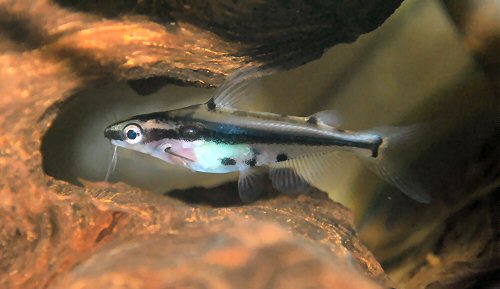
This species does seem to be a prime target for spawning as the females have been seen with a cluster of green/blue eggs in their clear (transparent) body cavity (see top image) and they have a more rounded profile, so buying at least six and placing them in a well planted species tank with good water quality and water movement would be a good start. This fish in good condition and colour can do well at Fish Shows and I have seen quite a few who have went on to get best Catfish or Best in Show, because of their relatively small size and good deportment.
Acknowledgements: To Asian catfish specialist Shane Linder for his contribution to this months factsheet.
|
 n
the last couple of years there has been an ongoing
revision (and confusion) of the Bagridae family
and this is just one of the fishes involved. You may
have known this bagrid as Pelteobagrus ornatus
and it was only in 1998 that Ng Heok Hee and Maurice
Kottelat erected a new genus for this fish, namely,
Hyalobagrus, (Ichthyol. Explor. Freshwaters
v. 9 (no. 4) 340 Fig. 6, a new genus of miniature
bagrid catfish from Southeast Asia).
n
the last couple of years there has been an ongoing
revision (and confusion) of the Bagridae family
and this is just one of the fishes involved. You may
have known this bagrid as Pelteobagrus ornatus
and it was only in 1998 that Ng Heok Hee and Maurice
Kottelat erected a new genus for this fish, namely,
Hyalobagrus, (Ichthyol. Explor. Freshwaters
v. 9 (no. 4) 340 Fig. 6, a new genus of miniature
bagrid catfish from Southeast Asia).
Common Name |
3D Transparent Bagrid |
Synonyms |
None |
Family |
Bagridae |
Subfamily |
Bagrinae |
Distribution |
Asia: Indonesia, Batang Hari drainage in Sumatra and the Mentaya Basin in Southern Borneo. Type locality: Indonesia: Sumatra: Jambi: Danau Arang Arang in the vicinity of Muara Kompeh, 1º37'32.0"S, 103º47'19.0"E. |
Size |
4.5cm (1¾ins) |
Temp. |
21-26°C (69-79°F) |
p.H. |
6.5-7.2 |
Characteristics |
Body: Naked, compressed posteriorly. Head: Large and slightly depressed towards the rounded snout. Mouth: Sub-terminal, almost terminal on some specimens. Eyes: Large and superior. Barbels: Four pairs. Two mandibular, one maxillary and one nasal. All fairly short and very slender. Hair like in thickness. Dorsal: 1-5/7; Fin spine with strong serrations along the posterior edge and smaller but more numerous serrations along the anterior edge, remainder with slender but sharp spines. Anal: Fin fairly long with 18-21 rays. Caudal: Fin forked. Pectoral: 1-6/7; Fins with slender sharp spines. |
Colouration |
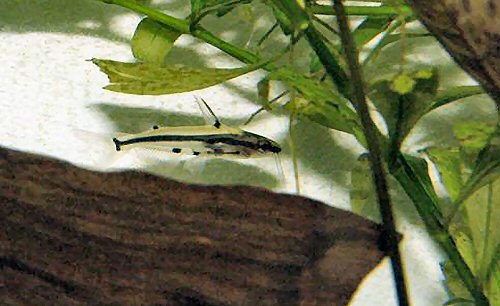
A translucent body with a metallic yellow tint. Black lateral line from snout, passes through the eye and ends at the base of the caudal fin. Two finer black lines on top of the head start at the snout then converge and end just in front of the dorsal fin spine. Three or four small spots along the back. The two at the base of the dorsal fin and the start of the adipose fin are the more apparent. There are two or three small dark spots on the ventral half of the body, the most prominent are those just behind the ventral fin and at the base of the anal fin. Small dark vertical patch, sometimes broken into two spots at the base of the caudal fin. The translucency of the body is such that the dark lateral band on the other side of the body can be seen through the fish. |
Aquarium Care & Compatibility |
| Good catfish for a small community tank or a species tank, well planted and kept in a small shoal. |
Reproduction |
Not reported. |
Diet |
| Likes all types of live food such as Daphnia and Brine shrimp. Also small frozen bloodworm and tubifex. Will sometimes take flake, but does prefer the aforementioned foods. |
Etymology |
| Hyalobagrus:
Hyalo+bagrus=3D transparent bagrid. |
References |
Baench.
Aquarium Atlas 3,1993. |
Photo Credits |
© Yann Fulliquet |
|

If you would like to contribute to the monthly factsheets with an
article, information or photos, please e-mail
me. You will of course be credited for your work.
If you would like to donate any denomination of money to the site just click the above link button. All proceeds will go to running the site and hopefully to keep it going for a few years yet.
ScotCat Sources
 Etymology-genera
Etymology-specific name
Online Sources
 Search
 Fishbase
 Wikipedia
 Catalog of Fishes
 GBIF
GBIF
 iNaturalist

