SCOTCAT.COM
your internet guide to all things catfish
FACTSHEETS: September 2001 - no. 063
Leporacanthicus triactis Isbrucker, Nijssen & Nico, 1993 |
The genus Leporacanthicus is relatively new being erected in 1989 to house Leporacanthicus galaxias. That said it has been quick to gain a number of members. Within this genus aquarists are most familiar with Leporacanthicus galaxias, most commonly referred to as the Galaxy Pleco but also L007, L029, Tusken or Vampire Pleco. It is certainly the most commonly available member of the genus. Others (specifically L. heterodon and L. joselimai and our fish, L. triactis) are also available from time to time. The common name of 3 Beacon Pleco is not widely established, but these things have to have their beginnings somewhere and it is an accurate name - more descriptive than L091 at least.
Leporacanthicus triactis
Although usually thought of as a new import it has been at least sporadically available for quite some time as it's lower l-number suggests. It was labelled L91 in April 1992 before its scientific description in 1993. It is an easily recognised pleco and has no other L-number "synonyms". Before L-numbers we just didn't know what to call it. As such it does make an appearance in a couple of older catfish books. Eagle-eyed pleco buffs will have noticed it in Burgess' Catfish atlas on P732 (second photo from top on the left hand side) and it labelled Hypostomus sp. The same picture appears in Kobayagawa's World of Catfishes on page 59 coincidentally in the same position.
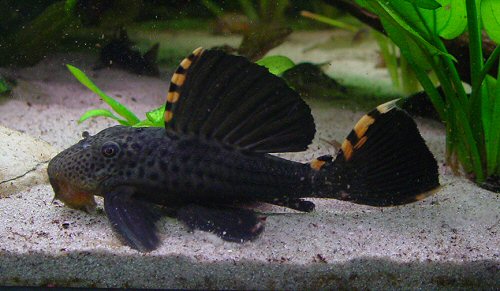
Juvenile kept in dark surroundings
Leporacanthicus have a number of interesting anatomical features that make them easily to identify in their rather complex sub-family. The name "vampire pleco" is actually more appropriate to the genus rather than any one species as they all equipped with an unusual and certainly formidable form of dentition. The upper teeth in the sucker-mouth are long and rasping giving these fish great power in their search for food. Although not a true bloodsucker, in the Transylvanian sense anyway, this destructive dentistry is most easily witnessed at home should you try feeding certain types of shelled crustaceans or molluscs. These offerings are despatched with frightening ease and presumably form the mainstay of their wild diet. In addition all Leproacanthicus have a small, horn-like protrusion on the top of their heads giving rise to the "tusken pleco" moniker. The purpose of this is appendage is unknown and doesn't appear to have any function in captivity. Personally I find this fishes colouration it's most strikingly beautiful and intriguing point. Depending on its surroundings the fish can vary from brown or grey to charcoal black. It has 3 vivid orange blotches; one each on all 3 non-paired fins. These pulses of colour put you in mind of a two-tone disco light cable lain along the fishes lower back especially when the leading dorsal fin ray is laid flat along the back. Unlike many Loricarids with similar markings these flashes, if anything, increase intensity with age. Although not as dark bodied as youngsters, this still makes adults a striking fish. Some aquarists believe that these markings are too confuse predators as to where the vital (tasty?) parts of the fishes anatomy lie. In my opinion this fish already has some mean predatory protection in the form of it's spiky fin rays and armour plating; I believe its vivid colouration is for a more specialised reason. To understand it we must first be familiar with this fishes mode of reproduction (see reproduction below). |
 o
mark the launch of version2 of ScotCat, Jool's of
Planetcatfish has gracefully accepted my invitation
to write this months Catfish Factsheet. He has decided
to go with a comparatively new species of Loricariidae
and a most beautiful one at that. So without much
more ado I'll hand you over to Jool's.
o
mark the launch of version2 of ScotCat, Jool's of
Planetcatfish has gracefully accepted my invitation
to write this months Catfish Factsheet. He has decided
to go with a comparatively new species of Loricariidae
and a most beautiful one at that. So without much
more ado I'll hand you over to Jool's.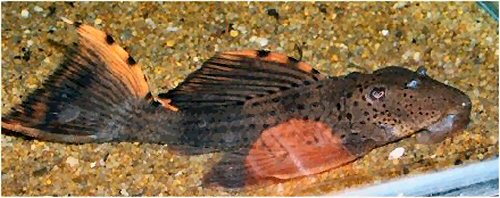
|
|
Common Name |
L 091, Three Beacon Pleco |
Synonyms |
None |
Family |
Loricariidae |
Subfamily |
Ancistrinae |
Distribution |
South America: Venezuela, Amazonas, upper Orinoco basin. Type locality: Venezuela, Territorio Federal Amazonas, oberer Orinoco, Caño Mavaquita etwa einen Kilometer flussaufwärts von der Mündung in den Río Mavaca, ungefähr 2º12'30"N, 65º05'30"W. |
Size |
25.0cm. (10ins) |
Temp. |
22-25ºC ( 71-77°f) |
p.H. |
6.5-7.2. |
Characteristics |
The upper teeth in the sucker-mouth are long. Narrow, pointed head, round lower lip, and fleshy tentacles on the upper lip. |
Colouration |
Body brown or grey to charcoal black. 3 vivid orange blotches; one each on all 3 non-paired fins. Unlike many Loricarids with similar markings these flashes, if anything, increase intensity with age. |
Aquarium Care & Compatibility |
| This fish can be territorial with its own kind and so must have a big enough aquarium if more than one is kept. Regular water changes must be adhered to, and also having a powerful filter system that can deliver a high oxygen content. Hiding places are beneficial to this fish with bogwood or wood of some description and/or some rockwork. |
Reproduction |
These fish are cave spawners. It is unclear whether they make their own burrows in the clay mud vertical walls of riverbanks or inhabit those that birds have deserted at the onslaught of the rising river in the rainy season. Either way, imagine the underwater scene at breeding time on such an immersed bank. Hundreds of holes, some empty but many occupied by males in fine colouration - competition for these burrows would be high and they are jealously guarded. Think of it like a cliff face populated by hordes of nesting sea birds all competing for nests, mates and eventually tending young. When in residence the male pleco enters these holes head first - once safely ensconced all can that can been seen in the dark, murky waters are the swaying tail lights of bright orange. It is my opinion that these markings allow the females to find occupied burrows and perhaps even the brightness of them indicates the suitability of the male? Certainly it would allow the female to avoid the potentially damaging mistake of entering a cave occupied by another species of pleco or indeed catfish. In other similar plecos two or more females visit one male's nest site laying their eggs for the male to guard - it is not beyond the realms of possibility that this is true of the 3 beacon pleco too. This intriguing idea has yet to be tested in the aquarium as captive spawning of this species still eludes specialist pleco keepers. Presumably some suitably sized cave like structures specially constructed from fired clay would be required along with a pair of these fish. More than a pair would require a spacious aquarium as the fish are quite territorial, even male and female will squabble if not given sufficient room. Yet it may be that the maintenance of a species group is necessary to facilitate at least a good sized spawn if not a spawn at all. |
Diet |
| Not a true vegetarian so a wide variety of foods including algae wafers, cucumber or courgette ( zuchini), frozen bloodworm, prawns, shrimps and tablet food. Shelled crustaceans or molluscs |
Etymology |
| Leporacanthicus: From the Latin; "lepus", "leporis" meaning rabbit and from the Greek, "akantha" meaning thorn. triactis: tri– (L.), three; aktís, ray, unique among congeners in having three (vs. four) branched anal-fin rays. |
IUCN Red List |
Leporacanthicus triactis has a large range, but is rarely encountered. It is unlikely that the species is imperilled, and based on its large distribution it is considered Least Concern (IUCN 2023). |
Photo Credits |
Top:
© Julian
Dignall @ |

|

If you would like to contribute to the monthly factsheets with an article, information or photos, please e-mail me. You will of course be credited for your work.
If you would like to donate any denomination of money to the site just click the above link button. All proceeds will go to running the site and hopefully to keep it going for a few years yet.
ScotCat Sources
 Etymology-genera
Other Sources
 Search
 Fishbase
 Wikipedia
 Catalog
of Fishes
Catalog
of Fishes
 GBIF
GBIF
 Fishnet2
 iNaturalist
 IUCN
IUCN

