SCOTCAT.COM
your internet guide to all things catfish
FACTSHEETS: June 2002 - no. 072
Lophiobagrus cyclurus (Worthington & Ricardo, 1937) |
Lophiobagrus
cyclurus
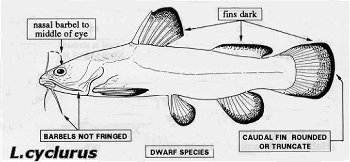
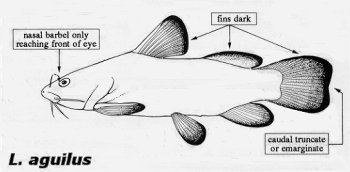
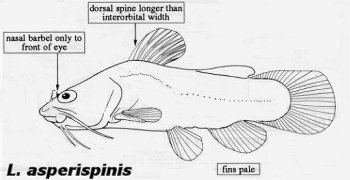
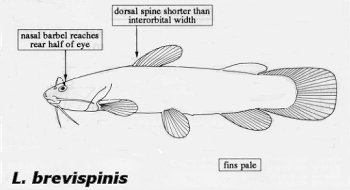
Now after all that scientific jargon how do we keep Lophiobagrus cyclurus. Dinyar Lalkaka an accomplished catfish enthusiast from New York is presently keeping two of this species and he sent me this short composition below. "I keep them at pH 7.8-8.0, 78-80 F with my Lake Tanganyika synos. I feed the usual catfish cuisine: flakes (esp. Tetra ColorBits), frozen food (brine shrimp, bloodworms) and live bloodworms. They’re not fussy eaters, but obviously prefer steak (meat) to potatoes (veggies). The tank has a coarse, calciferous substrate with lots of caves and crannies formed by “Moon Rock” (grey, looks like spongy concrete, but is a naturally occurring agglomeration of sea shells and such). Two of the four I got as 0.5” juveniles; one of these is now 2.5”, the other still 1.5”. They grew fast! The larger one is brown, the smaller one black. Apart from color and growth rate, they look quite similar, but I wonder if they are not different species. There are several Lophiobagrus species in Lake Tanganyika and all of them look very similar. I would not be surprised — in fact, I’d expect — that more than one of these has entered the trade and not every Lophiobagrus sold as L. cyclurus is in fact such. But that’s only a hunch." To further capitulate on Dinyar's theory about being more than one Lophiobagrus species sold in the trade we have to take a closer look at the Lophiobagrus genus residing in the lake. There are four species of Lophiobagrus in Lake Tanganyika, L. cyclurus, L. aquilus, L. asperispinis and L. brevispinis. Below you can see the differences particularly in the body and caudal shape, and the length relative to the eye, of the nasal barbels.
Dinyar Lalkaka for his contribution to this months factsheet. Shane Linder for his information on the family Claroteidae.
|
 his
small species from Lake Tanganyika, Africa is now
beginning to be found in the aquatic shops especially
in the U.S.A and Canada where shipments are turning
up more regularly. It was a member of the Bagridae
family until 1991 when Mo split it up up and constructed
a new family, Claroteidae, which included not only
the Lophiobagrus genus but also the Clarotes-like
and Auchenoglanis-like groups.
his
small species from Lake Tanganyika, Africa is now
beginning to be found in the aquatic shops especially
in the U.S.A and Canada where shipments are turning
up more regularly. It was a member of the Bagridae
family until 1991 when Mo split it up up and constructed
a new family, Claroteidae, which included not only
the Lophiobagrus genus but also the Clarotes-like
and Auchenoglanis-like groups.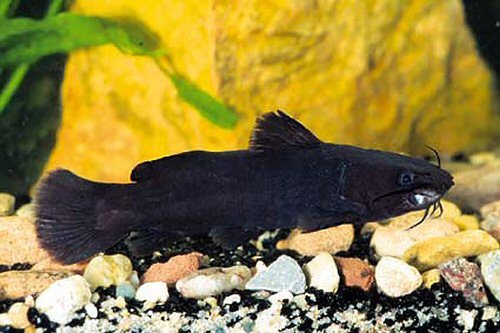
Common Name |
African bullhead, Tanganyika bullhead |
Synonyms |
Chrysichthys cyclurus, Lophiobagrus lestradei |
Family |
Claroteidael |
Subfamily |
Claroteinae |
Distribution |
Africa: Lake Tanganyika. |
Size |
10.0cm. (4ins) |
Temp. |
23-26°C (73-79°F) |
p.H. |
7.5-8.0 |
Characteristics |
Body short, weekly compressed; eyes small, subcutaneous. |
Colouration |
Colouration of body; dusty black or brown. Clear edging to dorsal and caudal fins. Barbels show some white colouring. |
Aquarium Care & Compatibility |
| They will certainly eat smaller fish in the aquarium as most Bagrid-type catfish will do. A setup as Dinyar has expanded on with probably a Lake Tanganyika or Lake Malawi setup being the best bet with either Cichlids from these lakes or with other similar sized alkaline loving species such as the Lake Syno's. |
Reproduction |
Has been bred in the aquarium with the eggs laid in a cave which had been excavated by the parents and the eggs hatched in about four to five days. |
Diet |
| In Lake Tanganyika it feeds on chironomid larvae, beetle larva, and small crustaceans with the occasional vegetable matter mixed in. In the aquarium they will feed on any meaty foods, frozen or freeze-dried. |
Etymology |
| Lophiobagrus:
Lophia, lophos = mane, crest; bagrus = 'Bagre'
meaning catfish. |
IUCN Red List |
Endemic to Lake Tanganyika where it is widespread and locally threatened by siltation and heavy fishing. However, with no widespread major threats identified, it is assessed as Least Concern (needs updating IUCN 2006). |
References |
Burgess,
W.E. 1989 An atlas of freshwater and marine
catfishes. A preliminary survey of the Siluriformes.
T.F.H. Publications, Inc., Neptune City, New Jersey
(USA). 784 p. |
Photo Credits |
Top image: ©
|

|

If you would like to contribute to the monthly factsheets with an
article, information or photos, please e-mail
me. You will of course be credited for your work.
If you would like to donate any denomination of money to the site just click the above link button. All proceeds will go to running the site and hopefully to keep it going for a few years yet.
ScotCat Sources
 Etymology-genera
Online Sources
 Search
 Fishbase
 Wikipedia
 Catalog of Fishes
 GBIF
GBIF
 Fishnet2
 iNaturalist
 IUCN
IUCN

